

-
GLP-1 receptor agonists are medications originally developed for type 2 diabetes that mimic a natural gut hormone involved in appetite regulation and blood sugar control.
.
Common examples include:
.

• semaglutide (Ozempic®, Wegovy®)
• tirzepatide (Mounjaro®)
.
They work by increasing satiety, reducing appetite, slowing gastric emptying and improving glucose control.
And let’s be clear — in high-risk, overweight adults, they are producing meaningful weight loss.
That’s not opinion. That’s data. I am currently working with over 70 people successfully using GLP-1s.
.
Which raises an important question:
.
If GLP-1s reduce appetite… who is protecting the muscle?
The Honest Reality
.
These medications can reduce body weight by 10–20% while improving metabolic risk markers. And for many people, that’s life-changing.
But weight loss does not discriminate. Without resistance training and adequate protein, a significant portion of the weight lost can be lean mass.
💪 That’s muscle. And let me be clear, muscle is not decorative tissue. It is metabolic currency 💪
The Case for Resistance Training
.
Resistance training is one of the most powerful preventive tools we have.
It consistently:
.
💪 Improves insulin sensitivity
💪 Lowers HbA1c in type 2 diabetes
💪 Reduces blood pressure
💪 Increases resting metabolic rate
💪 Preserves bone density
💪 Reduces all-cause mortality
💪 Muscle improves how the body handles glucose, stabilises joints and tolerates physical load.
Lose it, and resilience drops.
Preserve it, and the system performs better — even at the same body weight.The Quiet Risk of GLP-1 Alone
.
GLP-1 therapy reduces appetite.
In middle-aged males this often means lower food intake overall — including lower protein intake and less spontaneous movement.
Without strength training we risk creating:
A lighter body with the same metabolic fragility.
That’s not a long-term strategy.
A Slightly Tongue-in-Cheek Proposal - forgive me!

.
If GLP-1 therapy is prescribed for weight management…
Perhaps it should come with a clause:
“To be accompanied by structured resistance training, minimum twice weekly.”
Medication quiets appetite.
Resistance training builds structure.One reduces weight. The other improves durability. Together? Powerful.
Final Thought
.
GLP-1s may currently lead the weight-loss race.
But dumbbells still lead the longevity race.
Perhaps the future isn’t medicine versus movement.
Perhaps it’s medicine plus muscle.
-
Walk into any modern gym and you’ll see hundreds of machines, cables, gadgets and “new-age” training ideas promising better results.
And look — many of them have value.
But here’s the truth after 35+ years in gyms, rehab rooms, corporate wellness sites and endurance sport:
.
Five resistance movements have stood the test of time — and they always will.
.
They are the Mt Rushmore of strength training. Not trendy. Not flashy. Just perpetually effective.
.
Why? Because they train the body the way the human body was designed to move — pushing, pulling, lifting, bracing and stabilising as one coordinated system.
The king of human movement.
The squat trains what we do every day:
- sitting
- standing
- climbing
- lifting from the ground
Why it still rules:
- Massive muscle recruitment (legs, glutes, trunk)
- Builds bone density and joint resilience
- Improves balance and mobility simultaneously
- One of the best metabolic exercises you can perform
If you could only choose one exercise for lifelong function — this would be hard to beat.

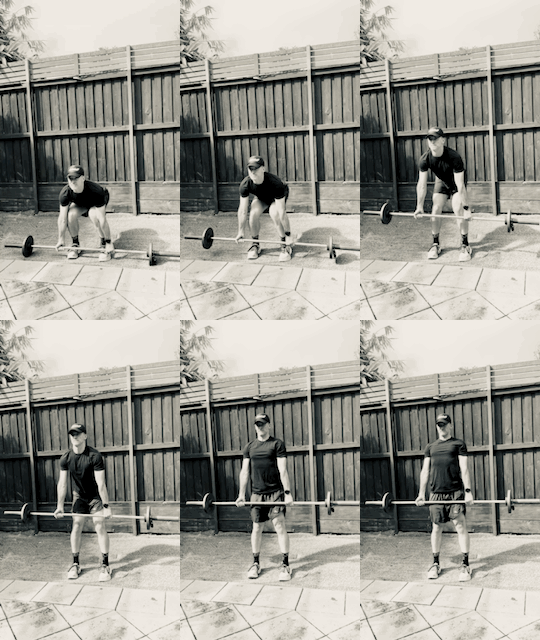
Real-world strength in its purest form.
Picking something up safely off the ground is a life skill — not just a gym exercise.
Why it remains king:
- Trains posterior chain (glutes, hamstrings, back)
- Reinforces safe lifting mechanics
- Builds grip strength and spinal stability
- Transfers directly to daily life and sport
Done well, deadlifts are less about “lifting heavy” and more about learning how to move safely under load.
Total-body strength disguised as an upper-body exercise.
Standing presses demand coordination from head to toe.
Why it still matters:
- Shoulder strength and stability
- Core activation without needing crunches
- Postural control
- Functional overhead capacity (think reaching, lifting, carrying)
You don’t just press weight — your whole body learns to stabilise and organise force.

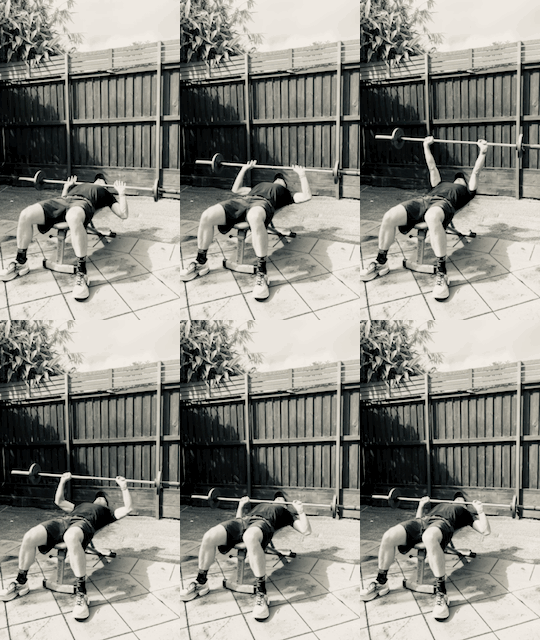
The classic push movement — and still incredibly valuable.
Yes, it’s famous. Yes, it’s often over-glorified. But when performed properly, it’s enormously effective.
Why it endures:
- Develops pushing strength
- Builds chest, shoulder and triceps coordination
- Improves upper-body structural capacity
- Easy to scale for beginners through to athletes
The key isn’t ego lifting — it’s controlled movement and good positioning.
The posture protector.
In a world of sitting, screens and rounded shoulders, this movement is gold.
Why it remains essential:
- Strengthens upper back and posterior shoulders
- Supports spinal alignment
- Balances pressing movements
- Improves pulling strength needed for daily tasks
If the bench press builds the front, rows keep the body honest from the back.

-
The Best Part? Nearly Everyone Can Do Them.
With:
.
• practiced technique
• appropriate range of motion
• sensible loading
• adequate rest between sets
.
…these movements can be adapted for almost anyone.
And that’s the beauty of strength training done properly.
I am practising all five movements with a light Olympic Barbell, but Mum (80 years young) uses a broomstick, effectively.
It’s about movement quality, confidence, and maintaining independence for life.
-
I’ve pitched versions of intermittent fasting in this post many times before — and I’ll probably keep doing so.
.
Why?
.
Because the results I continue to see — both in people I assess and in the research — are consistently impressive.
.
What is fasting?
.
Fasting simply means not consuming calories for a set period of time. That’s it.
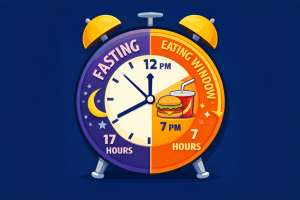
Based on the data I see in real people — not just lab studies — a 17:7 fasting window often produces the most practical and sustainable results.
.
Meaning:

.
⏱️ 17 hours without calories
🥗 7-hour eating windowFor many people that might look like:
Coffee in the morning > Lunch around midday > Dinner around 7pm
.
The Breakfast Question
.
Here’s where I tend to challenge the modern script.
Unless you are training hard early in the morning, or you have a naturally high metabolic rate, ‘most’ people simply don’t physiologically require breakfast.
I’m not anti-breakfast — I consumed plenty of it during decades of heavy training — but I am pro-logic.
If you’ve just woken up from 7–8 hours of sleep, you’ve already been fasting overnight. Your body still has plenty of stored energy available. For most people, they’re simply not necessary yet.
.
And smoko?
Unless you've done something truly physical before 10am — it’s usually habit, not hunger.
The Science Behind It
.
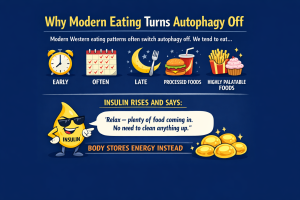
One of the most fascinating discoveries behind fasting comes from Nobel Prize winner Dr Yoshinori Ohsumi, who helped explain a process called autophagy.
Autophagy literally means “self-eating.” It’s the body’s natural clean-up system.
When calories are scarce — typically after 16–24 hours without food — the body begins breaking down:
.
✔️ damaged cells
✔️ dysfunctional proteins
✔️ old mitochondria (our energy factories)
✔️ cellular debris that has accumulated over time
.
Think of it as the body doing a biological tidy-up.
Cells that are weak or no longer functioning well are recycled for energy.
It’s an elegant survival system that most modern lifestyles barely allow to switch on.
Right, here's the problem
.

.
What a Fasting Window Can Do
.
Research now shows that periodic fasting windows can help:
.
✅ reduce inflammation
✅ improve insulin sensitivity
✅ clear dysfunctional mitochondria
✅ encourage cellular repair
.
And the best part? It costs nothing.Just giving your body a little space between meals.Honestly, in many ways it behaves like a blockbuster drug — except it’s free.💊.
The only time I’d break that pattern?
.
🏃 If I’ve done a hard morning training session 🏃 Then breakfast absolutely makes sense.
.
Want to Try It?
.
If you'd like to see what a simple 17:7 day of eating might look like — with some practical, nourishing meal ideas — I’m happy to share one.
Just reach out.
-

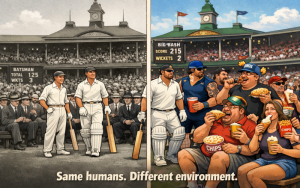
Take a look at almost any old black-and-white photo from Australia.
.
🏖️ Bondi Beach.
🏈 Country footy teams.
🏏 Or a packed day at the SCG in Bradman’s era..
The players look lean. vThe crowd looks lean. Blokes in suits and hats — all built like bantamweights.
.
Fast forward to today and things look… a little different.
.
Now before anyone starts pointing fingers — let’s be very clear about something.
.
I most certainly don't believe it has anything to do with discipline or willpower - zero!
The real story is far simpler — and a little confronting.
.
The environment changed.
In the past 40–50 years, the way we move, eat and live has shifted dramatically.
Here are my five biggest reasons why those old photos look so different.
We sat less and moved more without even thinking about it
Back in the black-and-white era, most Aussies weren’t doing “fitness” as such — they were just living more physically.
Walking to the shops. Hanging washing. Mowing lawns. Doing manual jobs. Walking kids to school. Standing more. Carrying more. Fiddling with life the hard way.
So while hardly anyone was counting steps, they were often stacking up a heap of movement across the day — and that matters.
Modern life has done the opposite. We can now work, shop, eat, pay bills, order dinner, and watch the cricket without barely moving our backside off the chair.
No one’s “failed” here. The environment simply changed — and it changed hard.
Portion sizes quietly blew out
This one happened so slowly most of us barely noticed it.
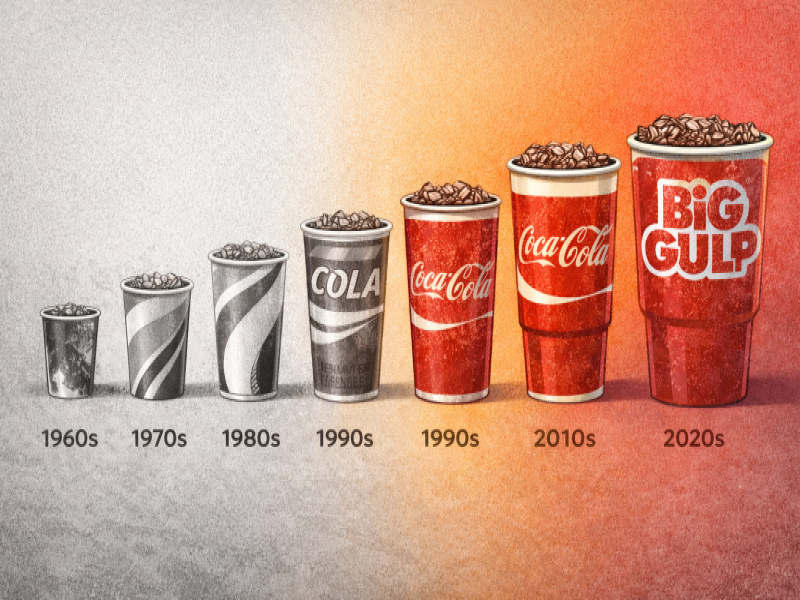
A soft drink that once came in a modest little serve is now a bucket. Chips became family tubs. Muffins became doorstops. Café slices became roofing tiles.
And the tricky bit? We still tend to see one serve as… one serve — even when it’s twice the size it used to be.
So a lot of modern overeating isn’t greed or weakness. It’s simply that normal got bigger.
Bit by bit, decade by decade, our eyes, appetite, and expectations got dragged along for the ride.
Snacking became a national pastime
For a lot of old-school Australians, food had a fairly simple rhythm: breakfast, lunch, dinner — and Bob’s your uncle.
Now we’ve got morning tea, desk snacks, servo snacks, “healthy” snacks, afternoon pick-me-ups, post-training treats, movie snacks, and a little something while watching Netflix.
The problem isn’t just the extra calories. It’s that appetite never really gets a clean break.
We keep nudging the system all day long — often with foods that are easy to chew, easy to crave, and very easy to overdo.
Again, no shame here. Modern food is built to be convenient, visible, tasty, and hard to resist. That combo is a sneaky little beauty.
Movement disappeared from everyday life
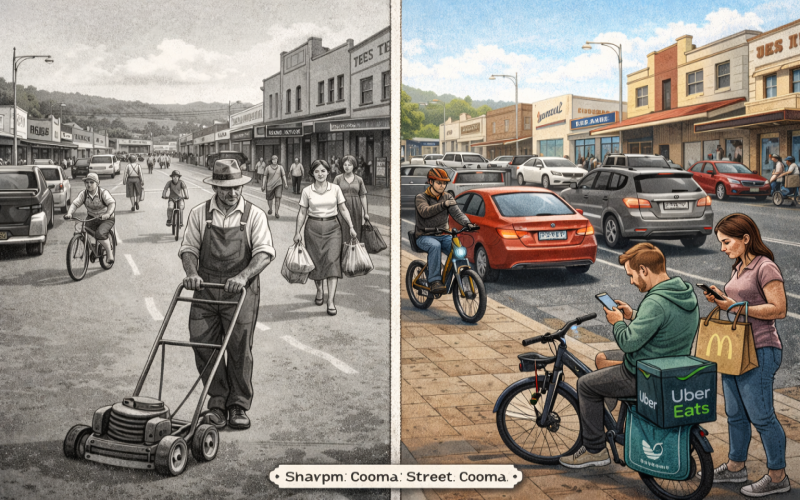
This is slightly different to “exercise.” This is about the movement that used to be built into normal life.
Kids rode bikes. People walked up the street. Jobs were more physical. Shopping meant carrying bags. Lawns got pushed. Chores took effort. Life had more friction — and weirdly, that was good for us.
Now? Cars, screens, online ordering, remote controls, escalators, apps, delivery, e-bikes, ride shares, and chairs — lots and lots of chairs.
So even before we talk “training,” the average human now burns less through the day simply because the day itself demands less.
That’s why this issue isn’t about people becoming softer. It’s more that life became easier on the body — and tougher on the waistline.
Our food changed — and this is the big one
In my view, this is the biggest reason of all.
It’s not just that modern food has more sugar, more fat, or more convenience. It’s that a huge slab of it is now altered, enhanced, engineered, and built to make us want more than we physiologically need.
Years ago, food mostly looked like food. Meat. Veg. Fruit. Oats. Eggs. Bread. Spuds. Home baking. Simple stuff.
Now a lot of what lines supermarket shelves is designed for maximum reward: big flavour hit, soft texture, fast chew, instant pleasure, and very little natural braking.
And yes — I absolutely believe flavour enhancers play a big role here.
Once you start wandering into the world of E600–E699 — the flavour enhancer family — you are no longer just eating food in its natural form. You’re eating something that has been tweaked to hit the brain harder.
That means the normal appetite-regulating system can get a bit scrambled. The brain goes, “Crikey, this is fantastic — keep going.”
Throw in colour additives, aroma additions, refined starches, sugars, fats, crunch, melt-in-the-mouth texture, and salty-savoury sweetness all in the one packet… and you’ve got a product that can seriously override “that’ll do.”
That doesn’t make people weak. It means people are up against foods that are very cleverly built to keep the hand going back to the bag.
So when people say, “Why didn’t everyone look like this in 1955?” — this is why I start here.
Same human biology. Totally different food environment.
Pampy’s take: when food becomes more enhanced than nourished, more stimulating than satisfying, and more engineered than earned, the appetite system can start wanting more than the body truly needs.