
Why Negative Splitting in Training Wins on Race Day
Most runners don’t fade late because they’re unfit. They fade because they went out too hard, distorted their effort early, and paid for it in the back half. Train the back end properly, and race day changes.
Let’s call it as it is. Most runners don’t fall apart late in races because they’re unfit.
They fall apart because they went out too hard… and their system cashes the cheque later.
I’m a big believer in practising — not just talking about — negative splitting in training.
And I’m not just talking pace. I’m talking output — effort, heart rate, breathing, and that internal sense of how demanding the session really is.
The Simple Pampy Version
Train your longer runs and key endurance sessions like this:
- First 60–70% → deliberately easy
- Middle section → settle into your sustainable all-day rhythm
- Final 30% → gradually apply pressure
- Lift output — not stupidity
- Finish stronger than you started
The rule is simple:
Bring it home stronger — not shattered.
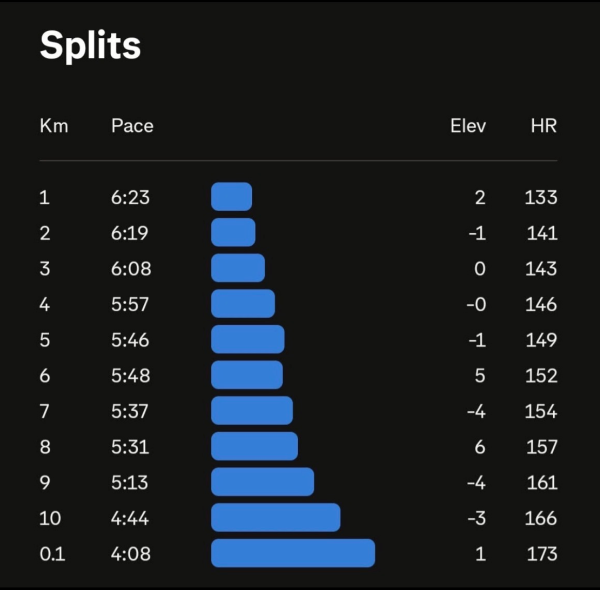
Damo’s 10km: A Proper Build
This is the sort of race file I love — controlled early, patient through the middle, then stronger when others are starting to leak. That’s not luck. That’s practice.

The Classic Cooked Look
We’ve all seen it — and most runners have worn it. Go out just a little too hard, then spend the second half negotiating with yourself.
Why Most Runners Positive Split
In nearly every foot race on the planet over meaningful endurance distance, the vast majority of runners slow in the second half.
That’s a positive split.
And yet, bizarrely, many of those same runners somehow find their fastest 200–500 metres at the very end.
- 👉 So the system wasn’t completely broken
- 👉 The body hadn’t fully fallen apart
- 👉 The brain had simply started protecting you earlier than it needed to
That’s why this matters. We’re not just training fitness here. We’re training pacing skill, metabolic restraint, and late-race belief.
Reason 1: You Burn the Good Stuff Too Early
Put simply, you’ve got two main energy tanks available for longer endurance work.
The Fast Tank — Glycogen
Think sugar. It’s quick, powerful, easy to access, and brilliant when you really need it.
But it’s also limited.
Use too much of it too early and you create a late-race problem.
The Slow Tank — Fat
Harder to light up. Slower to access. But once it’s going, it can fuel long steady work beautifully.
For events lasting beyond about 90 minutes, this pathway matters — for both muscles and overall race stability.
The trouble is, most runners go out just a touch too hard, and that small pacing error changes the fuel mix early.
You feel great at first — fresh, tapered, carb-loaded, music pumping, announcer yelling, everyone charging out like heroes.
But if your output is above what you’ve truly trained for, you start leaning too hard on the fast tank.
Then later, when the lights flicker, the brain starts throwing reasons at you:
- Slow down
- Walk a bit
- Today’s not your day
- This pace is unsustainable
By then, it’s often too late to magically recover the race.
Race Day Distorts Your Perception
Your training 4/10 effort is not always your race day 4/10 effort.
On race day, adrenaline, atmosphere, crowd energy, and freshness can make a clearly-too-hard pace feel strangely manageable early.
That is exactly why disciplined pacing matters.
The watch matters. The feel matters. And your rehearsal in training matters.
Reason 2: The Brain Isn’t Certain
The second reason people finish poorly is not always a lack of aerobic fitness, strength, or fuelling.
Often, it’s simpler than that.
The brain is not absolutely certain you can keep going at that pace.
So it starts producing emotions, sensations, and doubt:
- My legs are gone
- I’m overheating
- I’ve got no energy
- My shin is starting to hurt
- I’m not handling fluids or carbs well
- I just need to ease off a bit
Sometimes one of those is real.
But often, they’re exaggerated protective signals — especially if you went out a fraction too hard and pushed the system into a state it now wants to escape.
The Hidden Truth
We know a lot of this is illusion because most runners who say they’re absolutely cooked at 70–90% of the event still find a finishing kick once the line is in sight.
So what changed?
- 👉 The body didn’t suddenly become fitter
- 👉 The fuel tanks didn’t magically refill
- 👉 The brain simply became willing to release more because the threat window was almost over
That’s why negative split training is so powerful.
It teaches the brain:
“It’s OK to keep pressing late. Nothing bad is happening here.”
So What Do We Do?
We practise it. Deliberately.
Not every session. Not recklessly. But regularly enough that your system learns what a proper build feels like.
You want your long runs and key endurance sessions to become a rehearsal for calm restraint early… and confident pressure late.
Take the Ego Out Early
Too easy is usually about rightStart slower than you feel like you should. Let the race come to you. Let the session build on you.
Fresh runners almost always think they’re going easier than they are.
Build Into Rhythm
Smooth, relaxed, repeatableFind your sustainable all-day effort. Breathing controlled. Posture tall. Movement calm. No panic.
This is where patience starts paying you back.
Press the Final 30%
Controlled pressure, not chaosGradually lift output late in the run. It may be pace. It may be heart rate. It may simply be perceived effort.
The win is simple: finish stronger than you started.
The Hidden Skill You’re Building
How to hold back when fresh.
How to settle into true endurance output.
How to tolerate discomfort late.
How to keep moving when the brain starts bluffing.
The Race Day Payoff
Instead of being the runner hanging on, drifting backwards, and surviving to the line…
You become the runner who:
- moves through the field late
- holds form and rhythm longer
- feels more in control under fatigue
- finishes with intent rather than relief
And psychologically, this matters more than people realise.
It is far better to be tackling competitors late than being tackled.
You almost feel like you steal their last bit of energy when you go past them.
Bottom Line
For better race outcomes, stop treating the start of the race like the place to prove yourself.
The race is usually won in the final 30%.
Respect the early pace. Build into your best sustainable effort. Then trust the training you’ve done.
Your best race pace is already in your training — if you’re disciplined enough to honour it early.