
-
I didn’t think I’d be writing this. But the data doesn’t lie.

.
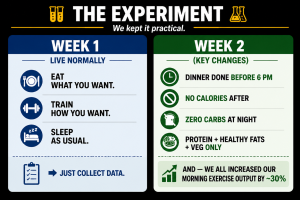
Over the past two weeks, three of us — very different bodies, very different lifestyles — ran a simple experiment.
.
🍽️ No crazy dieting.
💊 No pills.
💦 No suffering..
Just a couple of controlled changes.
And what we found… might change how you think about fat loss completely.
.
THE SET-UP
.
Right now, we’ve been walking around like human science experiments.
Each of us wearing:
.
..........🩸 A Continuous Glucose Monitor (CGM)
..........🩸 A Continuous Ketone Monitor (CKM)
.
In simple terms:
👉 We can see, in real time, whether our body is running on sugar… or fat
.
WHY THIS EVEN MATTERS
.
Most people still believe fat loss comes from:
.
..........⚖️ Training harder
..........⚖️ Sweating more
..........⚖️ Eating less
.
But the body doesn’t work like that.
.
👉 You don’t burn fat because you try harder…
👉 You burn fat when the body allows it.
THE SIMPLE VERSION (FOR MOST PEOPLE)
.
..........✅ High glucose → insulin up → fat burning OFF
..........✅ Low glucose → insulin down → fat burning ON
..........✅ Ketones present → body using fat for fuel
.
So instead of guessing… 📈 We measured it.
.
.
THE CREW
.
👱♂️ Me — 55, still moving ok… a few wobbly bits
👩 Jessica – 52, structured lifestyle, hormonally dynamic (adaptative)
👩🦱 Wilko – 38, roofer, 8-hour physical days
.
Three very different humans.
.
SO… WHAT DID WE FIND?
.
👉 First surprise:
.
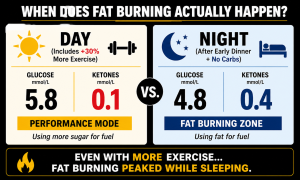
Even with ~30% more morning exercise… fat-burning signals 'didn’t' increase during the day.
.
Let that land.
.
DURING THE DAY (INCLUDING EXERCISE)
.
Across all three of us:
.
.......... • Glucose stayed the same or even went UP a tad
.......... • Ketones stayed LOW
.
👉 Meaning:
Your body is mostly in performance mode - Not pure fat-burning mode
.
“When Does Fat Burning Actually Happen?”
.
Now here's where it gets interesting...
.
DURING THE NIGHT (SLEEPING SOUNDLY)
.
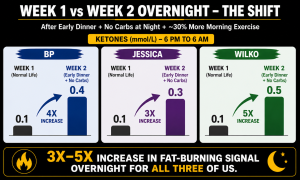
All three of us showed:
.
.......... • Lower glucose
.......... • 3x–5x higher ketones (ketones are the lipids broken down to fuel energy)
.
Meaning👉 A clear shift into fat-burning mode
.
“Same People. One Change. Big Shift.”
.
LET ME SAY THAT AGAIN
.
We trained. We worked. We moved more than usual.
But…
👉 We burned the most fat while we were asleep
.
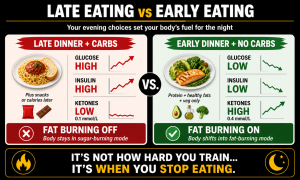
WHY THIS HAPPENS
.
When you:
.
.......... • Eat late
.......... • Eat carbs at night
.......... • This can often influence sub-optimal sleep
.
👉 Your body stays in sugar-burning mode
.
When you:
.
.......... 👉 Eat early - Remove carbs at night
You create:
.
.......... • Low insulin
.......... • Low glucose
.......... • Rising ketones
.
👉 The perfect environment for fat burning
.
.
.
THE REAL TAKEAWAY
.
This isn’t about:
.
..........❌ “Exercise doesn’t work”
.
Because it absolutely does:
.
......... 👉 Fitness
..........👉 Strength
..........👉 Longevity
..........👉Mental health (extraordinary gains)
.
But if your goal is:
.
👉 Fat loss
.
Then this matters:
👉 Your body burns fat when the conditions allow it — not when you’re working hardest
.
FINAL WORD
.
I should also add that, for each of us, across the 1–2 nights where we experienced poorer sleep, our ketone levels dropped.

WHAT
A structured strength + movement plan.
A structured strength + movement plan designed to:
- Build strength
- Improve tone & posture
- Keep metabolism firing
- Create consistency
👉 Not random workouts
👉 Not smash-yourself sessions
Just planned, progressive training that works.
HOW
Short, clear, repeatable sessions.
- Short, repeatable sessions — 3 x 20 minute sessions
- Monday, Wednesday & Friday varying sessions
- Clear exercise structure — clear GIFs
- Gradual progression — no overwhelm
- Simple tracking to keep you accountable — target 48 sessions over winter
👉 The win isn’t intensity
👉 It’s showing up consistently
WHY
Winter is the setup phase.
Winter isn’t a setback… it’s a setup phase.
Done right, this is where women:
- Rebuild strength
- Support bone health — 40+
- Reduce injury risk
- Move into spring ahead — not behind
👉 Most wait
👉 Ellie’s crew are ready
-
🔧 Sitting for hours on end — particularly when highly focused — can become a postural disaster.
🔧 Jammed hips, tight lower back, guitar-string hamstrings… and a pain in the neck!
🔧 I find that if I don’t break up this cycle, not only do I feel it physically, but mentally, I start drifting off the mark as well.
.
Here’s my “Super Six” go-to reverse-sitting loosen-up routine.
If practical, find yourself a little 1 x 1 space and give them a whirl - holding each stretch on both sides for 10-30 seconds.
⚕️ Check with your Physical Therapist if apprehensive.
-
7 hours 59… 6 hours… even 4 hours… doesn’t automatically mean you’re rolling into a bludger of a day.
.
Sleep isn’t a fixed target — it’s a moving part.
.
Your optimum depends on your genetics, training load, mental stress, and how deep in the hole (or out of it) you are right now.
And just like training, work, relationships — you’re not nailing it perfectly every single day/ night.
.
Some cultures build in short daytime naps — and they work.
If you go there, keep it tight (think ~15–17 minutes) so you don’t mess with your night-time rhythm..
Here’s the bit most people miss…
Sleep isn’t one flat block — it runs in cycles..
You typically move through 90-minute cycles — about 4–6 per night.
And it’s the quality of those cycles, not just the total hours, that counts..
You can have a messy start — tossing, turning, broken early sleep —
…but if you land a couple of solid deep/REM cycles later in the night, you’re often good to go..
Simple resetters if you’re chasing better nights:
• Read a hard copy book before bed – an old Steve Waugh diary seems to work well.
• Kill the blue light
• Park the phone away from the bed – yep, try it!
• Let your body do what it’s built to do
.
Bottom line:
Don’t become a slave to the metric..
Don’t decide your mood, your output, or your belief for the day based on whether your watch said 8 hours.
.
Some days you’ll feel flat with 8 hours.
Some days you’ll fly on 6..
Trust your body more than your dashboard.