
Pre-Run Strength Beats Weak Mega Miles
Why most runners don’t need more tired kilometres — they need a stronger chassis before they start ticking them off.
What do you do to get better at running?
Run.
Oh der.
And yes, of course running matters. You don’t get better at running by staring at your shoes, polishing your watch, or buying another pair of shorts that promise “race day energy”.
But here’s where my experience kicks in.
When it comes to distance running — where near all of us are holding well below maximal effort, living largely in aerobic territory, and simply trying to hold form for longer — I think there’s a very real point of no return.
At some stage, more running does not give you much more running.
It just gives you more tired.
What Do Mega Miles Actually Give You?
And let’s be clear — I’m not talking about a 28-year-old trying to smack down a sub-15 minute parkrun.
I’m talking about the lion’s share of the running population. Everyday runners. Masters runners. Corporate runners. Time-poor runners. People with jobs, families, calves with opinions, and hips that remember what year it is.
Longer progressive miles can absolutely top up your aerobic capacity.
That’s the obvious benefit.
But once that benefit starts to flatten out, the return on investment can get pretty ordinary.
Your Aerobic Hardware
Your aerobic capacity is built on a pretty impressive bit of internal hardware:
- Lungs — capacity and breathing efficiency
- Heart — stroke volume and pumping power
- Blood — red blood cells and oxygen transport
- Capillaries — the tiny delivery roads that improve with training
- Muscle cells — using oxygen to create usable energy
Smart progressive training and genetics dictate how far that system can go.
The Point of No Return
For most people, you can reach a very useful aerobic level quickly enough with consistent, sensible running.
Not elite. Not Olympic. Not “I sleep in an altitude tent and weigh my lettuce”.
But useful.
And once you’re there, a banging stack of additional miles might help mentally — no argument there. Some people love the grind. Some people need the head space. Some people just love clicking over numbers.
But physically?
The upside can become small, and the downside can become large.
More niggles. More calf grumbles. More tendon complaints. More foot soreness. More “I’ll just run through it” rubbish that eventually turns into three weeks off and a very sulky runner.
The Better Question
So the better question is not:
“How do I run more?”
The better question is:
“How do I get faster, stronger and more durable without spending my whole week banking weak kilometres?”
My Answer: Strength Training
Not necessarily big gym sessions.
Not necessarily an hour of mirrors, machines and protein shaker theatre.
I’m talking about short, run-specific strength routines that sit right before the run.
For most mere mortals — particularly ageing runners — I’ve found that integrating 2–10 minute pre-run strength sets into the total time you devote to a workout is a far better use of time.
Rather than run 60 minutes at 80%, practise run-specific strengthening movements for 10 minutes, then run for 50 minutes.
In my opinion, that’s a smarter session.
Same time spent. Better chassis built.
Why Bother Before the Run?
Because this is where the strength becomes specific.
You are not just training muscles. You are priming the running pattern.
The goal is to wake up the arms, hips, glutes, feet, posture and timing before you start asking the body to repeat the same stride thousands of times.
- Hold your technique tight
- Avoid late-session and race-day wobbles
- Decrease injury risk
- Drive mental confidence
- Make the first kilometre feel organised, not clunky
Here’s the Type of Pre-Run Actions I Like
These are examples of the sort of short, specific movements I like to include before running.
They are not designed to smoke you.
They are designed to switch you on.
Pump, posture, hips, spring, rhythm — then run.
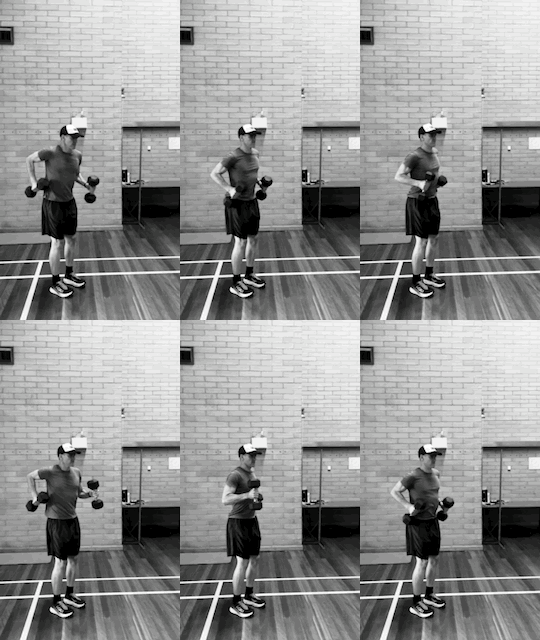
DB Running Arms

DB High Hip Flexion
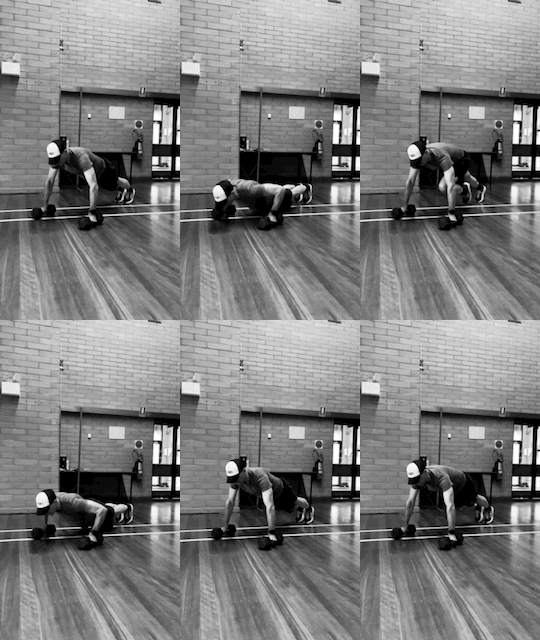
Push Up Track Starts
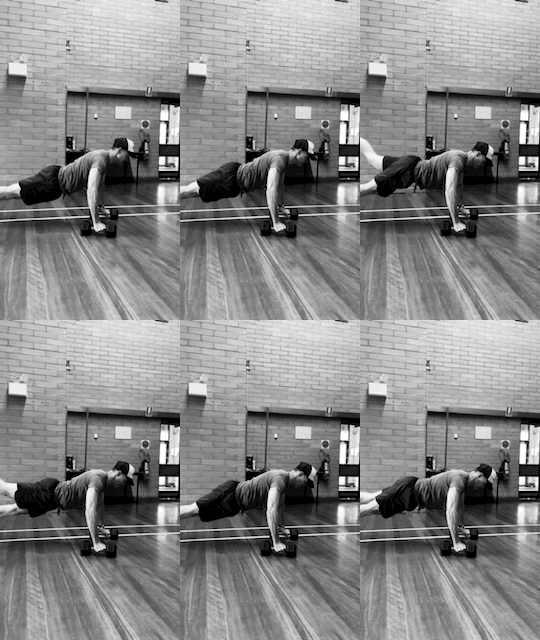
DB Hip Extensions
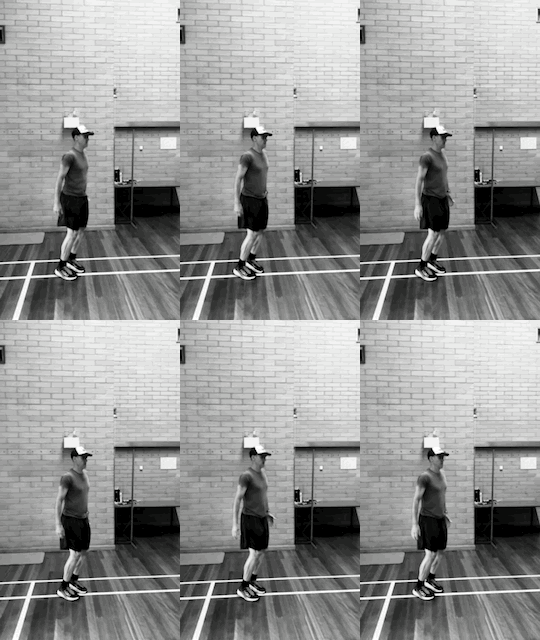
Bounces
Why These Work
Running well is not just about lungs.
It is about holding your structure under repeat load.
When runners get tired, most do not suddenly run out of aerobic capacity in some dramatic scientific movie scene.
They collapse a little.
The hips sit down. The foot strike gets noisy. The arms cross over. The stride reaches. The knees drift. The cadence drops. The whole thing starts looking like a shopping trolley with one bad wheel.
Strength helps you hold the line.
What Strength Gives the Runner
- Better posture when tired
- Cleaner hip drive
- Stronger foot and calf stiffness
- Improved arm rhythm
- Better stride control late in the run
- More confidence when the body starts negotiating
That is not gym vanity.
That is running durability.
Why I Prefer This for Most People
Most runners are not constantly tapping into high-end lactate zones.
So don’t build an entire program around pretending they are.
For the everyday distance runner, I believe muscle endurance, stiffness, posture and repeatable mechanics are often far more valuable than simply adding more weakening kilometres.
Yes, running volume matters.
But weak volume — tired, sloppy, survival-style kilometres — can be over-rated.
Give me a runner who can hold shape at kilometre 14, 18, 25 or 35 over a runner who just added more junk miles and hopes the chassis survives.
The Time Trade-Off
This is where people get caught.
They think strength training has to be extra.
Another session. Another time slot. Another thing to feel guilty about missing.
It doesn’t.
It can sit inside the running session.
The Mental Bit
There is another benefit that does not get spoken about enough.
Confidence.
When you have done the little strength actions before the run, you feel switched on. Taller. Sharper. More athletic.
And when the back end of a run gets a bit ugly, you have a better chance of holding posture rather than bargaining with your calves, blaming your shoes, or pretending the wind changed direction in every suburb.
The Six Routine Concept
I currently use six varying pre-run and post-run specific routines.
They are progressive, specific and deliberately short.
Some are more about posture and activation. Some are more about elastic bounce. Some are more about hip drive. Some are more about arm rhythm and upper-body connection.
The point is not to turn the warm-up into a circus.
The point is to keep the runner honest.
Better shape before more load.
The Caveat
I’m not saying “don’t run”.
That would be ridiculous.
Running is still the main meal.
But for most people, especially ageing runners, the answer is not always more kilometres.
Sometimes the answer is making the kilometres you already run cleaner, stronger and more useful.
Simple Pampy Version
Mega miles can build aerobic confidence.
But strength keeps the chassis from falling apart.
For most runners, I’d rather see 10 minutes of smart pre-run strength and 50 minutes of better running than 60 minutes of weak, sloppy, tired kilometres.
Don’t just chase more miles.
Build the body that can actually use them.