
Carbon-Plated Shoes — What’s All the Fuss?
A Pampy POV on the shoe that took my normal run, bent the rules a little, and made my ageing chassis feel like it had found another gear.
I’ll declare it upfront.
I was thankful to share a relationship with the shoemaker HOKA for many years.
And yeah, that is a declaration. Certainly for me — and I believe for most people — they are one of the best running shoe brands on the market.
Back in 2018, HOKA produced their first carbon-plated shoe — a prototype — and I was lucky enough to take them for a testing period.
OMG.
The game changed overnight.
I returned from that normal local run 4 minutes faster than usual, at a lower heart rate, and my ageing legs felt like they could easily go around again.
What just happened?
The Pampy Mechanics
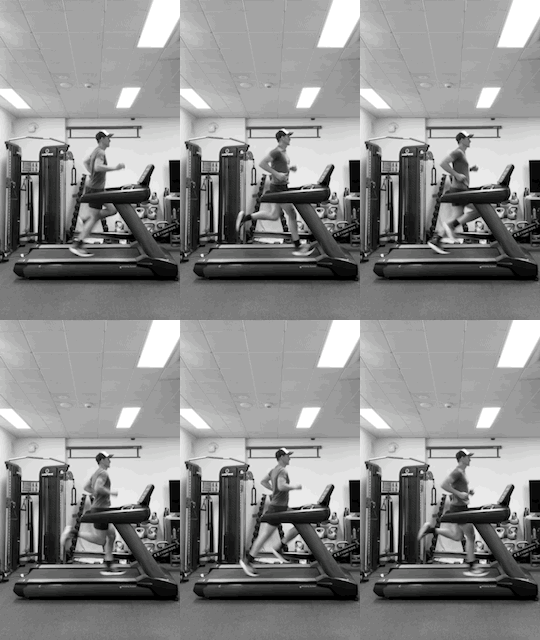
I run tall.
I land and load my foot strike directly under my hip — my centre of mass — and as such, I tap into the natural plantar fascia elastic recoil that pops my loaded foot back off the surface and into the next stride.
This plantar fascia elastic recoil phenomenon doesn’t fatigue, doesn’t burn fuel in the same way, and doesn’t produce lactate like working muscle does.
In essence, it can just keep assisting the Achilles, calves, hamstrings, quads and hip flexors to do their thing.
That’s efficient running.

The Built-In Spring
The arch of the foot stores and returns elastic energy when you land well under your hips.
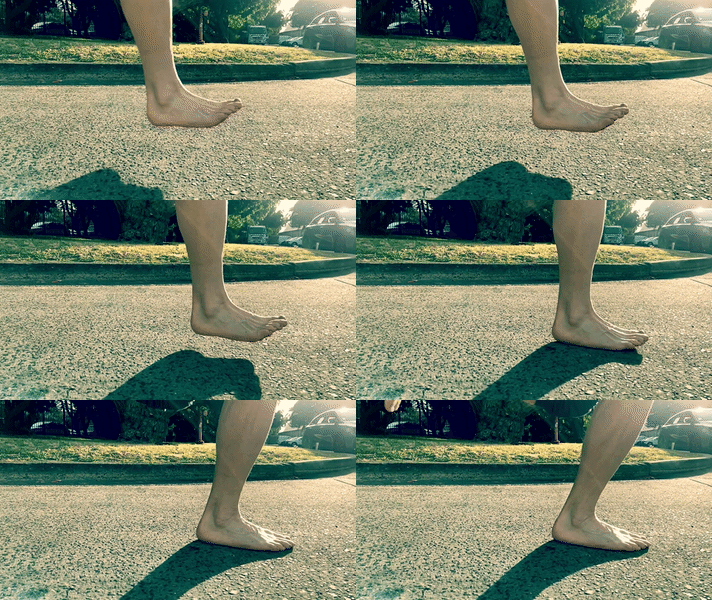
Load. Stretch. Pop.
This is the natural foot spring doing its job — provided the body lands in the right place.
Then Carbon Turns Up
Now, carbon takes this natural foot-arching pop and turns it into turbo overdrive.
The carbon fibre does it for me — only better.
If I hit in the right place, stretch that carbon plate, it naturally wants to pop straight back to its original curved shape.
So my loaded leg springs out of that stride and into the next.
For free.
Same Movement Pattern… Amplified
So now I’ve got two things working together:
- My natural foot spring
- A mechanical carbon spring layered on top
That’s where the magic sits.
Good mechanics first. Carbon second.

The Stride Pattern
Land well, load well, recoil well. Carbon rewards this pattern.
So What’s the Outcome?
Regardless of my ageing chassis, I am faster with less effort.
Better still, I feel like I’m protecting my clunky bits because the running muscles don’t have to work quite as hard to get the job done.
- Faster speeds at the same effort
- Lower heart rate for the same pace
- Less muscular fatigue
- Less post-run soreness
And at 50-plus, that last one matters. Big time.
Why They’ve Improved So Much
Since 2018, carbon shoes have continued to improve the efficiency of the running stride.
The carbon plates are better quality, shaped better, and now supported by high-rebound foams wrapped around them.
It is not just a plate anymore.
It’s the system — plate, foam, geometry and the runner using it properly.
My Little Real-World Experiment
Back in 2022, I ran a simple comparison on my regular Manly 8km loop.
Nothing fancy. Same runner. Similar course. Heart rate controlled around the same ceiling.
The aim was simple: what happens when I swap non-carbon shoes for carbon-plated shoes?
| Date | Shoe | Heart Rate | Time |
|---|---|---|---|
| 12.9.22 | Bondi 8 | 147 | 37:08 |
| 13.9.22 | Carbon X3 | 146 | 35:33 |
| 14.9.22 | Bondi 8 | 148 | 37:10 |
| 15.9.22 | Carbon X3 | 147 | 35:31 |
| 16.9.22 | Bondi 8 | 146 | 37:13 |
| 17.9.22 | Carbon X3 | 148 | 35:26 |
Same effort. Roughly 90 seconds faster over 8km.
That is not a lab study. That is not pretending to be peer-reviewed science.
But for me, as a runner who knows his body, route, heart rate and rhythm extremely well — it was enough to make me sit up.
The Big Call
I’ll say it straight.
There is no way I would run now without carbon-plated shoes.
Regardless of the cost, they keep me running, give my ego a cheeky little fake boost, and probably save me physio bills.
The “What If” Factor
This is an educated guess.
I was in my mid-40s when carbon shoes came out, and probably past my best potential running years.
But my maths suggests my best marathon of 2:40 would have been 10-plus minutes faster at the same intensity — same heart rate, same lactate buffering, same general engine.
That is beyond significant.
Caveat — And This Matters
Now, let me be clear.
If a runner does not run tall, land and load under their hips, these shoes are fruitless.
Possibly even dangerous.
And let’s face it — they are expensive.
This technology supports the elite runner most because elite runners generally have the technique, stiffness, strength and rhythm to use the shoe properly.
Carbon shoes reward good mechanics. They do not magically create them.
Practical Pampy Advice
Proper technique, progressive strength training, and a periodised inclusion of these shoes comes first.
- Do not buy them the week before a race.
- Fine tune your technique first.
- Practise in them.
- Use them for key sessions and race day.
- Do not assume they are for every runner.
I’m also not certain they are a practical fit for trail running.
Road running? Yes.
Trail running? Case by case — and mostly, I’m not sold.
Simple Pampy Version
Carbon shoes are a performance amplifier.
Not a performance creator.
If you move well, they make you better.
If you don’t, they expose you.
For me, I love ’em, because they allow for continued strides.
And at this stage of the game, that’s a very nice win.