
-
Pampy’s Post (#343) — Oct25a
Aging Activity, Altitude Training, Protein Power, Tracey's Barrels
🎯The Golden Six Anti-Aging Actions - thank you Japan
🎯Sea Level vs 1500m - how much harder does it get?
🎯The Power of portioned protein - Animal vs Plant-based!
🎯Tracey's winter Swell Motivation - train, practice, ride
-
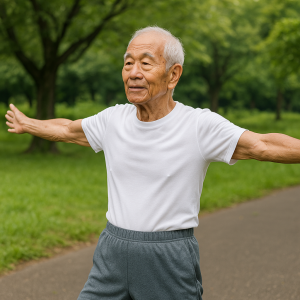 Our lovely Japanese neighbours have watched me roll home for years: salt-streaked from runs, chain-greased from rides, backyard clangs of weights… and the predictable chiropractor visits every other month. They smile at me and often shake their head.
They’re into their 80’s. They move like elite dancers. I don't.
Most mornings I catch them in the yard doing what looks suspiciously like the stuff we all did as kids—just… better. Finally, I cornered Satoshi, who looked me up and down with a Miyagi-like look of, ‘Oh, this man is doing it all wrong, ’ and asked, “Mate, what’s your secret?” You look like you could play five sets of tennis.
“We keep to the Golden Six,” he said. “Most Japanese practice the Golden Six.”
Apparently, every Japanese kid learns versions of these in preschool, and the smart ones keep them for life. Doctors even prescribe the G6 when people drift off the routine and out of good health. After watching these two garden with the enthusiasm of Labradors, I need to know more.
Why they look so annoyingly youthful?
The Japanese are global clubhouse leaders in functional & cognitive longevity.
🎌 World-leading longevity. Life expectancy (2023): 87.14 (women), 81.09 (men).
🎌 High “healthy life” expectancy (HALE). Years in full health (2022): 75.45 (women), 72.57 (men).
🎌 Lowest adult obesity in the OECD. Roughly 4–5%. Mobility + vascular-brain win.
🎌 Mobility improves with age. National fitness surveillance shows 65–79-year-olds improved walking speed and balance from 1998→2018.
🎌 “Rajio Taisō” culture. Big cohorts (e.g., JAGES) link regular radio callisthenics with a lower incidence of functional disability and dementia (≈18% ↓ for dementia).
Translation: more moving, more often, for more years.
Satoshi’s Golden Six
He suggested I start at #6 - the easiest! Yikes!
- - - - - - - - - - - - - - - - - - - - - - - - - - - - - - - - -
#6 六 — Sanpo
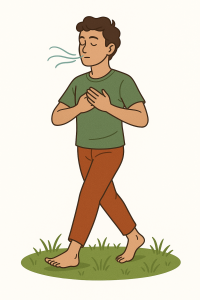
Barefoot, slow walking on grass with a simple breath cadence – which is where the magic comes from.
👣 How: Shoes off. Walk slowly; inhale through your nose for 2 steps, hold breath for 2 steps, exhale for 4 steps. Repeat.
👣 Time: ~3 minutes (morning is pleasant; dew, birds, sunshine… vibes).
👣 Why: Foot strength + sensitivity, balance, spatial awareness. Feel your feet grip the earth. I’ve spoken regularly in this post over the years of my strong belief in barefoot activity – Satoshi agrees with me!
- - - - - - - - - - - - - - - - - - - - - - - - - - - - - - - - -
#5 五 — Rajio Taisō

Daily mobility to music (no static stretches).
🙆♂️ How: Hit the YT piano track; follow the instructor through ~3 minutes 15 seconds of: arm swings, torso rotations, twists, side bends, marching on the spot, and easy ~45° squats.
🙆♀️ Why: Greases the hips, spine, ribs, and brain. Japan reports ~40% fewer low-back issues than many rich countries—this culture surely helps. Practised for a lifetime.
- - - - - - - - - - - - - - - - - - - - - - - - - - - - - - - - -
#4 四 — Shink Zuwari (Daily Squat Rest)
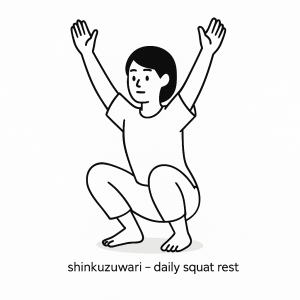
Full squat, heels down, chill.
👉 How: Use a wall or chair for support, sink to a full squat with feet flat. Hang out.
👉 Why: Opens hips/ankles, decompresses the spine, and smiles at your pelvic floor.
👉 Dose: Frequency beats heroics. Some folks accumulate long holds; I’m attempting one cricket over per day without whimpering.
- - - - - - - - - - - - - - - - - - - - - - - - - - - - - - - - -
#3 三 — Ippon-Ashi (Single-Leg Stand)
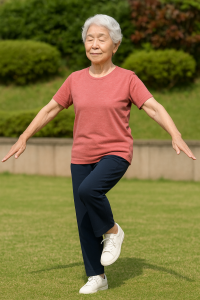
Balance + breath + brain tune-up.
⚖️ How: Stand on one leg. Progress to eyes closed. Breathe—slow and nasal.
⚖️ Why: Balance, coordination (proprioception) , and genuine cognitive benefits.
⚖️ Fun test: How long can you stand—'eyes shut'—on a mound of loose socks without swearing?
- - - - - - - - - - - - - - - - - - - - - - - - - - - - - - - - -
#2 二 — Seiza Henka (Floor-to-Stand Transitions)

Sit to stand without hands. Repeat. I remember watching our kids do this around 3 years (for fun).
How: Lower to the floor (cross-legged), then stand without using your arms.
Time: 3 minutes continuous.
Why: Core + hips + neural balance + mapping + play. Satoshi swears his dad did these into his 90s. Can you do one right now?
- - - - - - - - - - - - - - - - - - - - - - - - - - - - - - - - -
#1 一 — Tenugui Hibiki (Towel Twist)
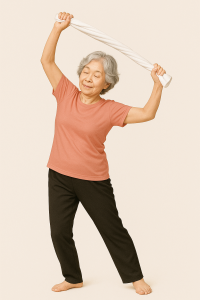
Overhead isometric twist with side bends.
🫔 How: Soak a towel (tenugui), hold it overhead, twist as if wringing it out, keep that tension while bending to one side for 30s, then the other.
🫔 Time: 3 minutes total.
🫔 Why: Whole-chain tension + mobility; blood to muscles and brain; bones get a healthy nudge. Also asks you to embrace a tasteful amount of discomfort.
“Oh please, Satoshi—how hard can—” (bends) “—oh dear.”
My verdict (one week in)
* I feel less rusty getting out of chairs.
* Ankles and hips are less grumpy on runs.
* The squat rest is a truth serum for how much I sit.
* The towel twist delivers instant wake-up for ribs/shoulders.
* I’m keeping it - my version. If my 80-something neighbours can out-garden me, I can at least out-squat my couch.
-
I live and train mostly at sea level, but I often find myself up in Cabramurra — a small mountain town sitting about 1500 m above sea level. I keep my exercise routine going when I’m there, and while I’ve always noticed training feels just that little bit tougher, I wanted to see exactly how much tougher it really is for me.
So, I set up a simple test: running on a treadmill at a 4:30 pace (13.3 km/h) for 30 minutes — once at sea level, and again at 1500 m. I’d already measured my VO₂ max with a VO₂ Master device (67.4 ml·kg⁻¹·min⁻¹), so I used that data to see how my body’s response shifted between the two environments.
💨 VO₂ max: the maximum amount of oxygen your body can use when you’re pushing hard — the higher it is, the fitter and more efficient your heart, lungs and muscles are.
-
My Results – Sea Level vs 1500 m
Metric
Sea level
1,500 m
What that means / why
Speed
4:30 / km
4:30 / km
Same external load — treadmill test.
% of VO₂ max
~66%
~74%
~10% VO₂ max drop at 1500 m if not acclimatised.
Minute ventilation (V̇E)
≈89–107 L/min
≈107–124 L/min
You breathe faster/deeper due to higher chemoreceptor drive.
Cardiac output (Q̇)
≈22.2 L/min
≈25.4 L/min
Lower O₂ per litre → Q̇ increases to deliver the same oxygen.
Heart rate (avg)
135 bpm
144 bpm
Compensates for lower arterial O₂ content.
SpO₂ (finger)
≈97–99%
≈92–95%
Lower ambient O₂ → arterial saturation drops.
Blood lactate
~2 mmol/L
~2.5–3 mmol/L
Slightly more glycolytic contribution — a bit more “sting.”
RPE (feel)
6/10
≈+1 point (~7.5/10)
Same pace feels a notch harder.
-
The Takeaway
At ~ 10% harder at 1500, if I want the same internal load (about ~66% of VO₂ max), my pace at Cabramurra needs to slow to about 5:00/km. That’s roughly 30 seconds per kilometre slower to match the same physiological demand as a 4:30 pace at sea level.
A Quick Word on Sleep
Almost every time I arrive at 1500 m, my first night’s sleep is ordinary. It usually takes about 24 hours to adapt to the thinner air, but by night two I’m settled — something worth knowing if you’re planning a training block at elevation.
💡 Verdict: Altitude does make a difference — even at a modest 1500 m. Same pace, same treadmill, but your body is working noticeably harder behind the scenes. I did consider the same protocol at Everest but getting the treadmill up there is proving difficult.
-
There’s been plenty of buzz about dietary protein lately — and for good reason. Here are my top five reasons why getting the right amount of protein at each meal is one of the smartest things you can do for your health.
🏋️♂️ 1. Muscle kept — not just weight lost
Protein drives muscle-protein synthesis (MPS), which means you hang on to lean muscle while you’re leaning out. That’s crucial for staying strong, steady and capable — from gym sessions to simply getting up off the floor as you age.
🍽️ 2. Hunger tamed
Protein is king for satiety per calorie and has the highest thermic effect of food. Translation: it keeps you fuller for longer, reduces snack ambushes, and helps you cruise between meals without energy dips.
⚡ 3. Steadier energy & better glucose control
When eaten with carbs, protein blunts post-meal blood glucose spikes — a win for afternoon brain function and long-term metabolic health.
🔧 4. Repair crew on call
Amino acids are the raw materials your body uses to repair tissue, build enzymes and create antibodies. Whether it’s from training, gardening, or just daily wear and tear — more protein means you recover faster and better.
🦴 5. Bones, bloods & body composition
Adequate protein supports bone health (especially when teamed with calcium and vitamin D), improves body composition, and often helps with blood pressure and lipid profiles thanks to more lean tissue and less fluff.
📏 How much, roughly?
For most active adults, aim for about 1.0–1.6 g per kg of body weight per day, spread across meals. Hitting 25–40 g per meal usually meets the “leucine threshold” — the level that stimulates MPS.
Where possible, mixing animal and plant sources gives you the full amino acid orchestra.If your goal is building or increasing lean muscle mass — whether you’re an athlete or my 80-year-old mum — research shows that bumping intake up to around 1.5–2.2 g/kg/day can deliver further benefit.
(If you have kidney disease, always follow your clinician’s guidance.).....................................................................................................................................
🌱 Can you get enough protein from plants?
Yes.
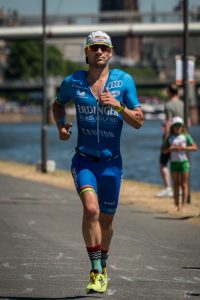
I had the chance to speak with Patrick Lange, a multiple-time Hawaii Ironman champion, shortly after his 2017 win. He conquered the brutal course — a 3.8 km swim, 180 km bike, and 42.2 km run — in 7 hours 45 minutes. He repeated the feat in 2018 and again in 2024, and is considered one of the fittest endurance athletes on the planet.
Patrick credits his strict vegan diet as a key part of his decade-long success. Since then, I’ve followed his career closely — he’s rarely injured or ill and keeps winning. He’s living proof that, with the right approach, it’s entirely possible to meet your protein needs on a plant-based diet.
💡 Part One takeaway: Check out my guide to 14 top protein choices — both animal- and plant-based — ranked per 100 g, to help you build meals that hit the mark.
🥩 Animal-Based Protein
Pro/100g
🌱 Plant-Based Protein
Pro/100g
1
Chicken breast (cooked)
31 g
1
Pumpkin seeds
30 g
2
Pork loin (cooked)
27 g
2
Seitan (wheat gluten)
25 g
3
Beef steak (lean, grilled)
26 g
3
Peanut butter (natural)
25 g
4
Kangaroo (lean, cooked)
26 g
4
Almonds
21 g
5
Lamb (lean, cooked)
25 g
5
Tempeh
19 g
6
Sardines (canned)
25 g
6
Chia seeds
17 g
7
Prawns
24 g
7
Rolled oats (dry)
13 g
8
Tuna (canned in water)
23 g
8
Tofu (firm)
12 g
9
Salmon (cooked)
22 g
9
Edamame (cooked)
11 g
10
Cheddar cheese
25 g
10
Lentils (cooked)
9 g
11
Eggs (whole)
13 g
11
Chickpeas (cooked)
9 g
12
Egg whites
11 g
12
Black beans (cooked)
9 g
13
Cottage cheese (low-fat)
11 g
13
Kidney beans (cooked)
8 g
14
Greek yoghurt (plain)
10 g
14
Quinoa (cooked)
4 g
🥗 Part 2 takeaway – Putting protein into practice
I’ve built two 7-day meal plans, each delivering around 80 g of protein per day spread across three meals. One leans on animal-based sources, while the other goes fully plant-based for those who prefer a vegetarian approach.
-
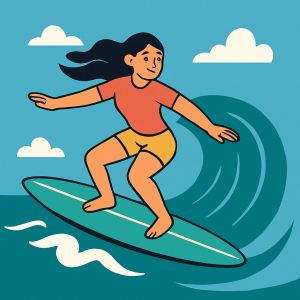 At the start of winter, Tracey admitted what most people do — her exercise motivation had slipped. We both agreed: roll into summer without a plan, and the outcome wasn’t going to be pretty.
Now, Tracey is one of those naturally athletic types. She can pick up pretty much any sport and look competent within minutes. So, to fire her up, we tossed around the idea of a winter surf trip.
True to form, the very next day I got an email: “Pampy, I’m booked, paid, and waxing my board.”
But here’s the catch — Tracey lives in the Snowy Mountains, a good three hours from the nearest wave. She needed a plan to prepare for her swell.
The Garage Gym Solution
Tracey had a garage full of sporting relics — dumbbells, BOSU balls, wobble boards — half-used by her, occasionally dusted off by her sons. Perfect. That’s all we needed.
I built her a daily program that tested:
🏋️♀️ General strength
🤸♀️ Coordination and balance
🏄♀️ Surf-specific demands — shoulders, back, core, and legs
Surfing calls for more than fitness. Unlike snowboarding (which Tracey already loves), the ocean moves under you.
The balance game is next-level.
Daily Training, Daily Purpose
She mixed women’s strength videos with surf-specific balance drills. The deal was simple: train every day, and when the swell arrived, her natural talent would do the rest.
And it worked. The promise of warm waves had her up every freezing morning. She barely missed a session, powered by the thought of that first paddle-out.
Aloha, It’s On!
Trip day came. After a few wobbly starters, Tracey found her groove. She clicked in, stood tall, and surfed her heart out.
Her motivation mantra? Straight out of Point Break:
“Fear causes hesitation, and hesitation will cause your worst fears to come true.” “If you want the ultimate, you’ve got to be willing to pay the ultimate price.”
Tracey paid her price in sweat through winter. The payoff? Sun, waves, and a heart full of stoke.