
Female Athletes, Fatigue & The Numbers That Quietly Tell The Story
Over the past six months I’ve become increasingly interested in Hematocrit (Hct) and Hemoglobin (Hb) monitoring in high-performing female athletes.
Particularly girls aged roughly 16–24 years who train hard, juggle busy lives, place pressure on themselves, and often sit right on the edge of overtraining.
The quiet drift into fatigue
I’m seeing more young women who are incredibly disciplined, exceptionally fit and mentally driven — but physiologically running themselves into the ground.
Often, they don’t realise it until:
- performance drops
- injury arrives
- moods change
- sleep deteriorates
- appetite becomes erratic
- cycles become irregular
- they lose their spark
Ani — the athlete I know best
Ani is 21 and a full-time high-performance athlete within the Australian Water Polo system.
She trains and competes globally and commits roughly 20 hours per week to swimming, S&C, recovery work, team training, games and travel.
She has excellent support available — dietician, physio, S&C coach, medical support, recovery systems and wearable tech.
And importantly, she absolutely loves training. If anything, Ani sits more on the “doing too much” side of the spectrum.
Over time, that commitment has occasionally shown up as:
- fatigue
- poor sleep
- personality changes
- irregular appetite
- sweet cravings
- hormonal instability
- injury
- erratic menstrual cycles
Before everyone jumps in: this is not unusual in high-performing female athletes. Many girls simply keep pushing.
Wearables are useful.
But I wanted another marker.
Modern athletes can now track almost everything — HRV, sleep, strain, workload and recovery scores.
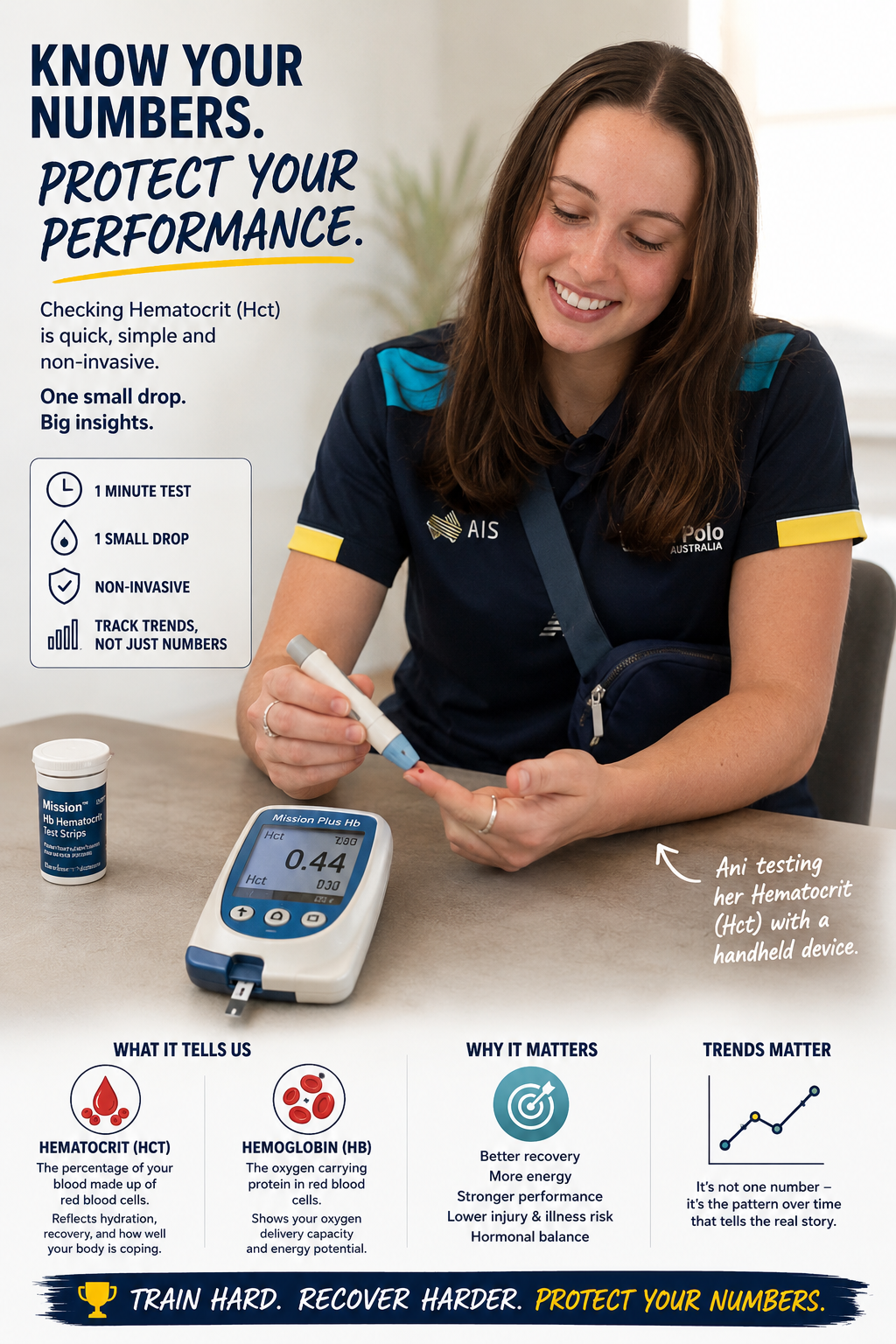
I purchased a handheld finger-prick Hematocrit (Hct) and Hemoglobin (Hb) analyser and we’ve been tracking Ani’s numbers daily.
So what are they?
Hematocrit is essentially the percentage of your blood made up of red blood cells.
Hemoglobin is the oxygen-carrying protein inside those red blood cells.
In simple terms — they heavily influence your ability to:
- transport oxygen
- recover from training
- maintain energy
- cope with load
- perform repeatedly (pic>>> Fred Etter)

Ani performing well
Better recovery, stronger energy, improved sleep and performance.
Numbers becoming concerning
Fatigue, soreness, low motivation, niggles and reduced performance.
Hb going well
Better oxygen delivery, stronger energy and better overall function.
Hb drifting low
Often linked with excess loading, poorer recovery and increased fatigue.
The performance bit matters
Ani simply doesn’t move, react, recover or perform at the same level when the numbers drift down and the life-load is climbing.
Again, this is not about one single reading. Elite endurance and aquatic athletes can display fluctuating numbers for many reasons.
- plasma volume changes
- hydration
- travel
- illness
- training blocks
- under-fuelling
- heat
- inflammation
The body often tells the story first
As coaches, parents and practitioners, we often notice the athlete becoming flatter before they admit they’re cooked.
- less spark
- emotional fatigue
- heavy movement
- slower recovery
- increased breathlessness
- reduced enthusiasm
Increasingly, I’m seeing Hct and Hb support what we are already observing clinically and visually.
Do these handheld systems replace proper pathology? Absolutely not.
But do I believe they may offer another useful wellness and recovery marker in heavily training girls? Absolutely.
Particularly when combined with sleep, nutrition, menstrual health, HRV, resting HR, workload, mood, recovery and general wellness trends.
The modern female athlete is under enormous pressure — physically, hormonally, emotionally, academically, socially and athletically.
Sometimes the smartest thing an athlete can do is not train harder.
It’s recover better.
Increasingly, I’m finding Hematocrit and Hemoglobin monitoring may offer another useful marker helping identify when the athlete is coping well… and when recovery may need greater attention.
Want to check your Hematocrit & Hemoglobin?
If you'd like your Hematocrit and Hemoglobin assessed, let me know.
It’s quick, non-invasive and very easy to perform.
Email Brad PampGLP-1’s, Muscle Mass & Why Resistance Training Matters More Than Ever
Over the past 12–18 months, I’ve worked alongside a growing number of women prescribed GLP-1 therapies through their GP or specialist.
My position is simple. When medically appropriate and properly supervised, I believe these medications can be an excellent tool for many women.

For many women, this is not just weight loss
It can be a first real feeling of physiological control after years of weight fluctuation, food noise, hormonal instability, emotional eating or dieting frustration.
Common early wins:
- better appetite control
- reduced food obsession
- more stable energy
- improved glucose control
- less joint load
- better confidence
But here’s my big coaching concern
If these medications help reduce body weight, but muscle mass is lost aggressively during the process, the long-term metabolic outcome may not be nearly as positive as many believe.
This is where appropriate resistance training becomes absolutely critical.
The Pampy POV
I’m not trying to make women simply lighter.
I’m trying to help them become stronger, more capable, more confident and metabolically healthier.
That’s a very different target.
Muscle Mass.
That’s the bit we cannot afford to throw away while chasing a smaller number on the scales.
Firstly — what are GLP-1 medications actually doing?
At a basic physiology level, GLP-1 therapies mimic natural gut hormone signalling involved in appetite regulation, glucose control and satiety.
In simplified terms, they may help:
- slow gastric emptying
- improve insulin response
- reduce appetite signalling
- reduce food noise
- increase fullness
- improve glucose stability
The practical outcome is often eating less frequently, smaller portions, less snacking and feeling satisfied earlier.
Ozempic
Originally developed for Type 2 Diabetes management. Semaglutide-based, with appetite suppression, glucose control and slower gastric emptying as key effects.
Wegovy
Essentially a higher-dose weight-management version of semaglutide, generally used for obesity management and cardiometabolic risk reduction.
Mounjaro
Tirzepatide acts on GLP-1 and GIP receptors. Often associated with stronger appetite control, insulin sensitivity and weight-loss responses.
The emerging grey-market conversation — Retatrutide
Retatrutide is attracting enormous global attention because it appears to activate GLP-1, GIP and glucagon receptors — the so-called three-prong attack.
Early data is interesting, but it remains investigational, long-term safety data is still developing, and much of the current interest sits in grey-market discussion circles.

But here’s the bigger issue…
Weight loss alone is not the goal.
Healthy body composition is.
Because when calorie intake drops substantially, body fat can reduce — but muscle tissue can also reduce.
And metabolically, muscle is everything.
Muscle is:
- metabolic tissue
- hormonal support tissue
- structural support tissue
- blood glucose storage tissue
- longevity tissue
Lighter… but weaker?
That is not the win we’re chasing.
The metabolic trap
Some women become lighter, but weaker. Smaller, but flatter metabolically.
- energy drops
- strength drops
- recovery worsens
- motivation falls
- metabolism slows
Why muscle matters particularly for women
Women who preserve muscle mass usually maintain better metabolic rate, insulin sensitivity, bone density, posture, joint integrity and long-term body composition.
My opinion?
Resistance exercise is not optional on GLP-1 therapy.
It is essential.
Why resistance exercise matters so much
Resistance training sends the body a very clear message:
“Keep this muscle. We still need it.”
It helps preserve and build:
- lean muscle tissue
- bone density
- tendon strength
- joint stability
- metabolic rate
- functional movement capacity
It also improves glucose disposal, insulin sensitivity, daily energy, confidence and long-term weight maintenance.
15 Minute Intro Strength Session
This is not about smashing yourself. It’s about giving the body a regular, sensible reason to hold onto muscle.
Circuit-style: complete x 3 | Load: safe but meaningful effort | Rest: 10 seconds between sets

Squat Press
10 reps

DB Lateral Raises
10 reps

Arm Curl / Press
10 reps

Full Frontal Raise
10 reps

DB Crunch
20 reps
The women who age best physically are rarely just the lightest women.
They’re usually the women who preserved their muscle.
If your physician has prescribed GLP-1 therapy appropriately and you’re responding positively, fantastic. But the medication is only part of the solution.
My advice?
Build strength. Preserve muscle. Eat appropriately. Move regularly. Support your metabolism long-term.
That’s where the real return on investment lives.
Email Brad PampThe Heavyweight Title Fight
Alright lads. Today we enter dangerous territory.
This article may upset pub blokes, fitness influencers, Coca-Cola lovers, beer snobs, dieticians, CrossFit coaches and probably a few dentists as well.
But after 35 years working in health, performance, body composition, metabolic dysfunction and men slowly falling apart… I honestly believe two regular full-strength Cokes may well be more metabolically destructive to the average bloke than two standard beers.
Now before everyone loses their minds: I am NOT promoting beer.

Before the bell
Alcohol absolutely comes with physiological downside:
- liver stress
- poorer sleep
- reduced recovery
- increased cancer association
- impaired judgement
- serious harm in excess
No argument there.
Red corner
COCA-COLA
The globally loved sugar-coated assassin.
A highly refined, ultra-processed liquid carbohydrate delivery system.
Blue corner
BEER
The socially accepted frothy bloke fuel.
Not healthy. Not harmless. But physiologically a very different product.
Two beers versus two full-strength Cokes.
Which one creates more long-term metabolic chaos inside the average male body?
The Coke ingredient list
Honestly, the ingredient list reads like a Year 11 chemistry assignment.
- carbonated water
- large amounts of refined sugar
- phosphoric acid
- caramel colouring
- flavouring
- caffeine
The “natural flavouring” bit always makes me laugh. That could mean almost anything.
The beer ingredient list
Beer generally contains:
- water
- barley
- hops
- yeast
- alcohol
- some residual carbohydrate
Again, I’m not calling it healthy. But physiologically and psychologically it is a very different product.
The binge reality check
I’ve got mates who could session 15+ tins while watching a Saturday arvo game.
So let’s not pretend beer can’t become enormously destructive in excess. Of course it can.
But physiologically? I have to believe any more than about 8 full-strength Cokes and most blokes would be folded like a camp chair.
And that’s part of the point. We instantly recognise excess alcohol as dangerous, but often massively underestimate repeated liquid sugar overload.
Blood glucose & metabolic chaos
Two standard full-strength Cokes can easily deliver around 70g of rapidly absorbable sugar.
Because it’s liquid, the body gets hit quickly.
- blood glucose spikes
- insulin spikes
- energy crashes
- hunger rebounds
- cravings increase
- appetite regulation worsens
Over years?
This repeated metabolic rollercoaster becomes heavily associated with:
- insulin resistance
- visceral fat gain
- metabolic syndrome
- fatty liver
- obesity
- Type 2 Diabetes
And importantly, many men consume soft drink daily. Not occasionally. Daily.
Teeth
This round isn’t even close. Coke absolutely unloads on teeth.
Sugar plus acid is a brutal combination. Dentists see this every day.
- erodes enamel
- feeds bacterial growth
- increases decay risk
- repeatedly acidifies the mouth
Beer’s scorecard
Beer isn’t exactly sparkling mountain water…
But compared to full-strength Coke in the teeth department?
It’s probably winning this round comfortably.

The liver conversation
This is where beer lands a few heavyweight punches back.
Alcohol absolutely places stress on the liver. Excessive alcohol intake is enormously destructive.
No intelligent health professional debates that.
But context matters
We’re now seeing massive levels of non-alcoholic fatty liver disease.
And one major driver? Chronic ultra-processed sugar intake. Particularly liquid sugar.
Meaning a bloke smashing multiple soft drinks daily may also be hammering his liver… without ever touching alcohol.
The fructose conversation nobody wants
Many researchers now believe chronic high fructose intake may place significant metabolic stress on the liver in ways surprisingly comparable to alcohol.
Not identical. But comparable. And that should make people pause.
Australian Coke formulations have historically used cane sugar rather than the high fructose corn syrup commonly used in parts of the United States. But metabolically, large repeated liquid sugar loads remain enormously significant.
Fructose is primarily processed by the liver — the same organ responsible for metabolising alcohol.
- fatty liver
- insulin resistance
- visceral fat gain
- elevated triglycerides
- metabolic syndrome
Many men fear alcohol-related liver disease while quietly marinating their liver in liquid sugar every single day.
Appetite & body composition
This one fascinates me.
Soft drink often seems to bypass fullness signalling. People consume huge calories, yet remain hungry.
That’s dangerous metabolically.
Beer?
Again — moderation matters enormously.
But beer generally slows consumption behaviour through volume, carbonation, satiety, alcohol pacing and social slowing.
Meanwhile, many men can inhale two Cokes in under four minutes and still want food afterwards.
Coke’s body blows
- chronic liquid sugar
- ultra-processed additives
- glucose volatility
- insulin load
- appetite dysregulation
- repeated metabolic assault
Beer’s warning label
- alcohol load
- liver stress in excess
- poorer sleep
- reduced recovery
- impaired judgement
- serious harm when abused
So who wins?
Honestly? Neither. Water wins. Always.
But if the average bloke asked me what’s likely doing more long-term metabolic damage — two full-strength Cokes daily or two standard beers — I’d probably lean toward the Coke.
Not because beer is healthy. But because I’m not convinced “just soft drink” is anywhere near as harmless as people think.
Final bell
If a bloke trains, carries reasonable muscle, eats fairly well, sleeps reasonably and enjoys two quiet beers socially… I’m probably less concerned than the bloke quietly drinking litres of Coke every week while believing it’s harmless because there’s no alcohol involved.
That’s my view. And after 35 years in this industry, I’ve become increasingly comfortable saying it.





Why the Push-Up Challenge Works!
From Sydney to Adelaide to Cabramurra — a simple action, a little accountability, and a surprisingly powerful link between movement and mental wellbeing.
Thankfully, these days, the stigma surrounding mental health appears to be easing.
More people are prepared to raise an emotional challenge with a partner, a mate, a colleague, or better still, an expert. That's a good thing.
Now, I am not a mental health expert.
But I am an expert in exercise physiology, and after more than three decades working in health and wellness, I can confidently say this:
People who practise fitting, appropriate, and consistent activity generally find themselves in a better position between the ears.
Here’s why.
The Push-Up Challenge is now in its tenth year, combining a simple action — the humble push-up — with raising awareness and funds for mental health initiatives.
From a physiological perspective, a push-up is a surprisingly effective exercise.
The muscles working
It primarily recruits:
- Chest muscles — pectorals
- Shoulders — deltoids
- Back of the arms — triceps
- Abdominals and lower back
- Glutes and hip stabilisers
But that’s only part of the story.
To perform a push-up correctly, the body also calls upon the abdominal muscles, lower back, glutes, and hip stabilisers to hold posture and maintain alignment.
In effect, it becomes a full-body exercise requiring both strength and coordination.
And while building muscle and fitness is valuable, the real magic may occur elsewhere.
Between the ears
Regular physical activity is associated with improved mood, reduced stress, enhanced self-esteem, better sleep quality, and improved cognitive function.
It provides structure, routine, purpose, and often a sense of achievement that carries well beyond the training session itself.
Raising more than dollars
So, from my perspective, even if you don't raise a single dollar, you are still raising something incredibly valuable.
You are raising your own mental wellbeing.
And quite possibly encouraging others to do the same.
The clever bit
I spend my working life encouraging people to practise fitting exercise. Rarely does anyone challenge the value of exercise itself.
The challenge is usually commitment.
That's where The Push-Up Challenge gets clever.
- A group dynamic
- A simple daily action
- A scoreboard
- A bit of accountability
- A touch of friendly competition
- All wrapped around a worthwhile cause
That’s powerful.
Suddenly, people who may never have committed to a structured exercise routine find themselves moving, engaging, connecting, and accumulating small daily wins.
The Push-Up Challenge.
Now, where am I going to punch out my 50 today?