
The Health Saboteur Championship
Our entrenched western lifestyle is littered with habits that quietly sabotage our health.
Sugar, alcohol, smoking, poor sleep, stress, sitting, junk food, vaping and not moving enough. None of these are doing us many favours.
So I decided to line them up like a knockout competition.

My Point Of View
This is not a laboratory ranking, and I am not pretending it is.
This is my view after more than 35 years working in health, fitness and wellness. These are the western lifestyle habits I have repeatedly seen contribute to poor health, poor energy, poor body composition and poor long-term outcomes.
More specifically, this is my knockout draw of the habits I feel people often find hardest to give up. Let the tournament begin.
The Scoreboard
Round One
Round Two
Round Three
Final
Champion
Yep, I reckon not moving regularly is the hardest thing to give up.
Why No Exercise Wins
Most people know exercise is good for them. Most people intend to exercise. Most people have started exercising at some point.
The challenge is not usually knowing what to do. The challenge is building regular movement into life and keeping it there.
In my experience, not moving regularly sits upstream of many common health problems. It influences body composition, blood sugar control, cardiovascular health, mental health, strength, mobility, sleep quality and ageing.
That is why, in my Health Saboteur Championship, No Exercise takes home the trophy.
The Pampy Take
- ✅ Move daily
- ✅ Protect muscle
- ✅ Walk more often
- ✅ Strength train consistently
- ✅ Make exercise boringly repeatable
Small movement, repeated often, changes lives.
You do not need a perfect program. You do not need to train like an Olympian. You need regular movement, done consistently, for long enough that it becomes part of who you are.
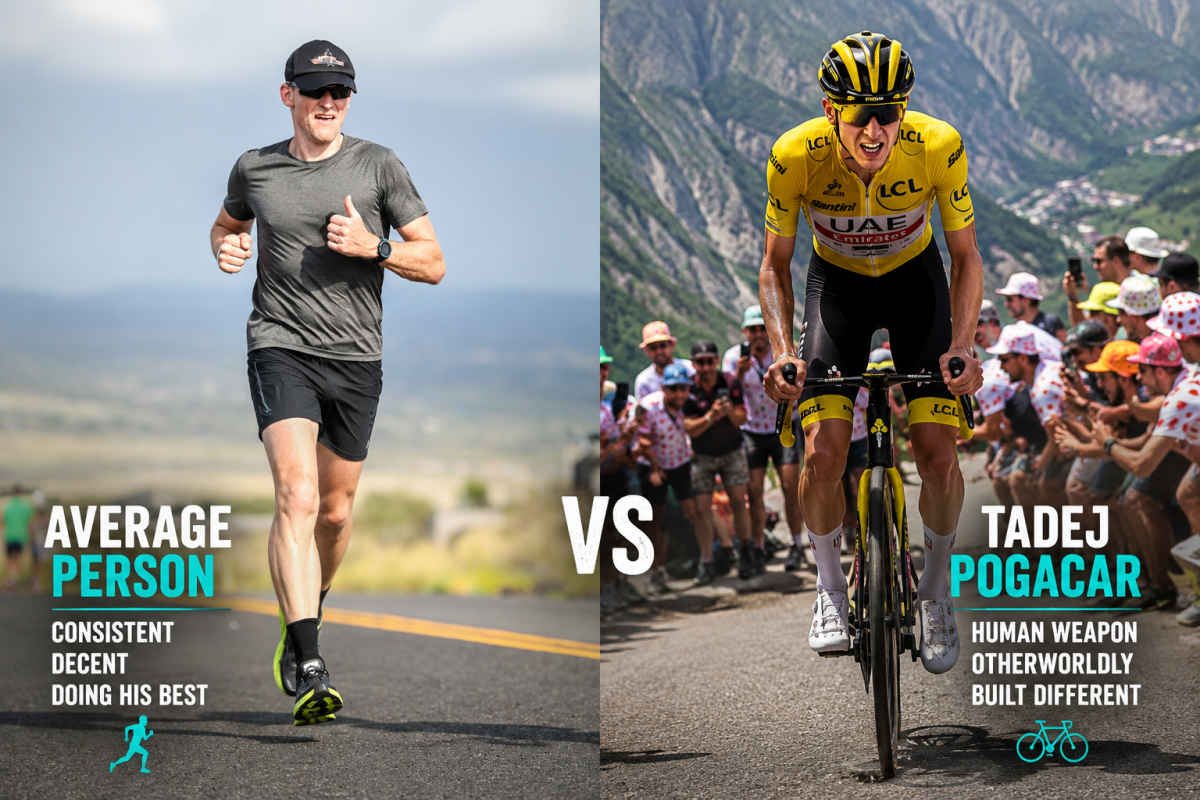
Brad Pamp vs Tadej Pogacar
Every July, the Tour de France reminds me just how outrageous elite endurance physiology can be.
So I thought I’d compare a solid exercise day for old me with one hard mountain stage from Tadej Pogacar — arguably the most dominant endurance athlete on the planet.
These numbers are approximate, but close enough to make the point: these riders are operating on a completely different physiological planet.
Who Is Tadej Pogacar?
Tadej Pogacar is a Slovenian professional cyclist riding for UAE Team Emirates-XRG. By his mid-20s he had already become a multiple Tour de France winner and world road race champion. His official team profile lists him at 176cm and around 66kg, which matters enormously when we get to the climbing numbers.
Put simply, Pogacar is helping reshape what many people thought was possible in endurance sport. He does not just win. He attacks. He climbs. He descends. He breaks races open from distances that seem ridiculous.
So let’s put this in normal-person terms. A pretty decent exercise session from me versus a brutal day from him in the Alps.
Brad Pamp
A fittish but aging 55-year-old exercise physiologist having a typical training day.
- 🏃 45-minute run
- ❤️ Average HR around 130 bpm
- 🏋️ 15 minutes full-body resistance movements
- ⏱️ About 60 minutes total work
Tadej Pogacar
One hard Tour de France mountain stage. Five hours in the saddle. The Alps. Attacking, chasing, climbing, descending and leading.
- 🚴 Around 5 hours
- ⛰️ Major alpine climbing
- 🔥 Repeated attacks and surges
- 🏆 World-class race pressure
The Physiology Scoreboard
Calories Burned
kcal across the run and resistance session.
kcal in one brutal mountain stage.
Average Heart Rate
Comfortable controlled running.
For five hours. That is the madness.
Peak Heart Rate
Maybe higher during harder efforts.
On final climbs and attacks.
Breathing Rate
breaths per minute during steady work.
breaths per minute while climbing hard.
Air Through Lungs
Air moved across the run.
Enough air to fill a decent-sized room.
Blood Pumped
Around one tonne of blood moved.
Over ten tonnes of blood in five hours.
Sweat Loss
Depending on heat and pace.
Sometimes more. A six-pack of water bottles.
Stroke Volume
Excellent for a trained 55-year-old.
World-class. Almost a soft drink can per beat.
VO₂max
Higher end for age.
Outer-space endurance physiology.
The Number That Blows My Mind
Relative Power
Not calories. Not heart rate. Not sweat. The number that really makes Tour de France physiology feel almost ridiculous is relative power.
Pogacar weighs roughly 66kg and can produce around 6.5–7 watts per kilogram for 30–40 minutes uphill.
For context, many recreational cyclists sit around 2–3 watts per kilogram.
That is not just fitter. That is another species of endurance performance.
Power Output
Pogacar can produce enormous short bursts during attacks, while still sitting on 350–450 watts across major mountain work and 500–700 watts on brutal climbs.
Pampy’s Take
After 35 years working in health and fitness, I still find Tour de France physiology almost impossible to comprehend.
My own 60-minute exercise session would place me well above average for a 55-year-old male. Yet compared to Tadej Pogacar riding through the Alps, I may as well be riding to the shops for milk.
These athletes are not simply fitter than the rest of us. They are operating on a completely different physiological planet.
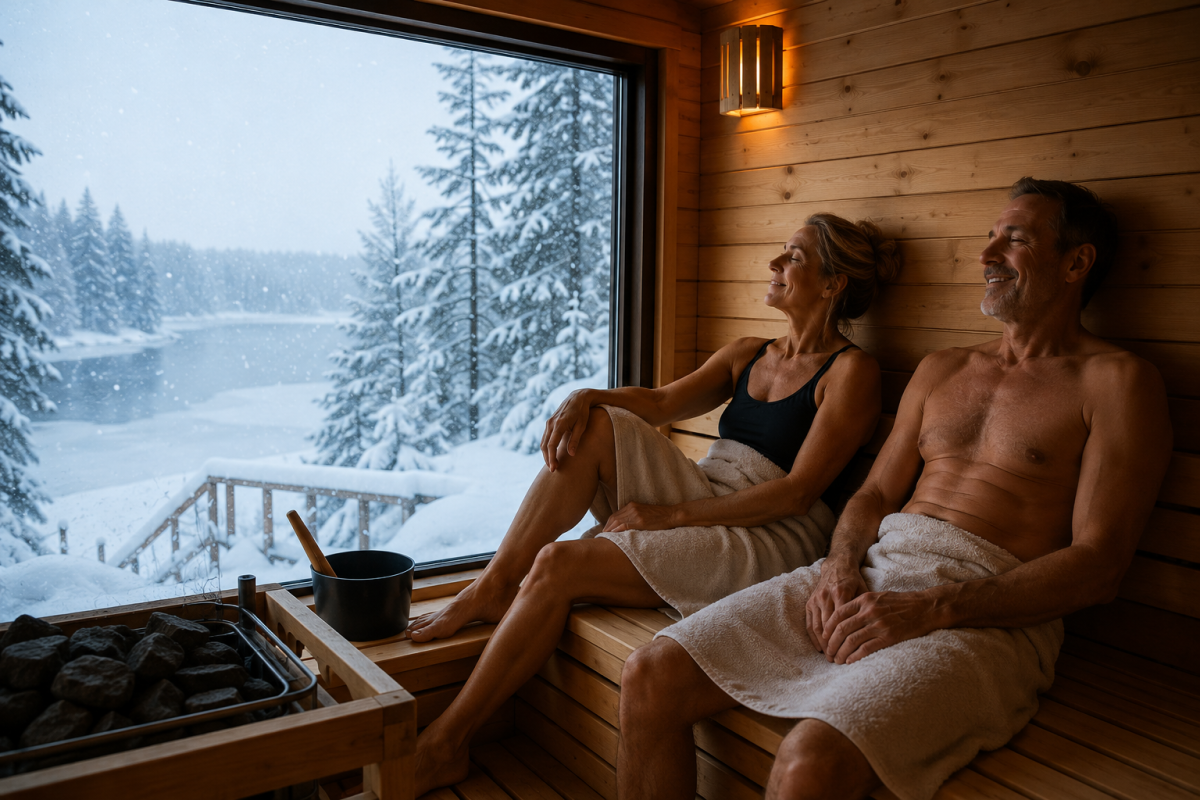
Why a Sauna Is a Powerful Health Strategy
Most people think of a sauna as a place to relax, unwind and sit quietly while they sweat.
And while all of those things are true, I would argue that a sauna is actually something much more powerful.
It is a deliberate stress. A healthy stress. And the human body responds remarkably well to appropriate stress.
Healthy Stress
The same way muscles adapt to resistance training, the cardiovascular system adapts to running, and bones adapt to loading, the body also adapts to heat.
Hormesis
This process is known as hormesis — exposing the body to a manageable challenge that ultimately makes it stronger.
Consistency Wins
None of the real benefits come from one heroic sauna session. Like exercise, they come from sensible repetition over time.
What Happens Inside The Body?
Exercise-Like Response
In many respects, your cardiovascular system responds similarly to light-to-moderate exercise.
A typical sauna session may elevate heart rate into the 100–140 bpm range, depending on temperature and the individual.
Your Heart Works
That means your heart is working. Your circulation is improving. Your body is practising adaptation.
The Brain Loves Heat Too
You walk in carrying the stress of the day. Emails. Deadlines. Work pressures. Life. Then you sit quietly. No phone. No distractions. Just heat.
The Health Benefits
How Much Is Enough?
A sensible starting point:
- ✅ 2–4 sessions per week
- ✅ 15–25 minutes per session
- ✅ 70–90°C dry sauna
Experienced Users
More experienced users may enjoy:
- ✅ 4–7 sessions per week
- ✅ 20–30 minutes per session
- ✅ Split sessions with cool showers
Adaptation comes from consistency, not heroics.
Hydrate Well
Heat exposure increases sweating. Go in hydrated and replace fluids sensibly afterwards.
Leave The Ego Outside
Exit immediately if you feel unwell. More heat is not automatically better.
Common Sense
Avoid excessive alcohol. If you have significant cardiovascular disease or a medical condition, seek medical guidance before commencing regular sauna use.
The Pampy Take
If I had to choose a handful of lifestyle strategies that consistently punch above their weight, sauna would be high on the list.
Not because it is magical. Not because it replaces exercise. And certainly not because it gives us permission to neglect the fundamentals.
But because it complements them. Exercise. Nutrition. Sleep. Stress management. A sauna fits beautifully alongside all four.
Adaptation is what healthy ageing is all about.
For 15–20 minutes, several times each week, you are giving your body and brain a reason to adapt.
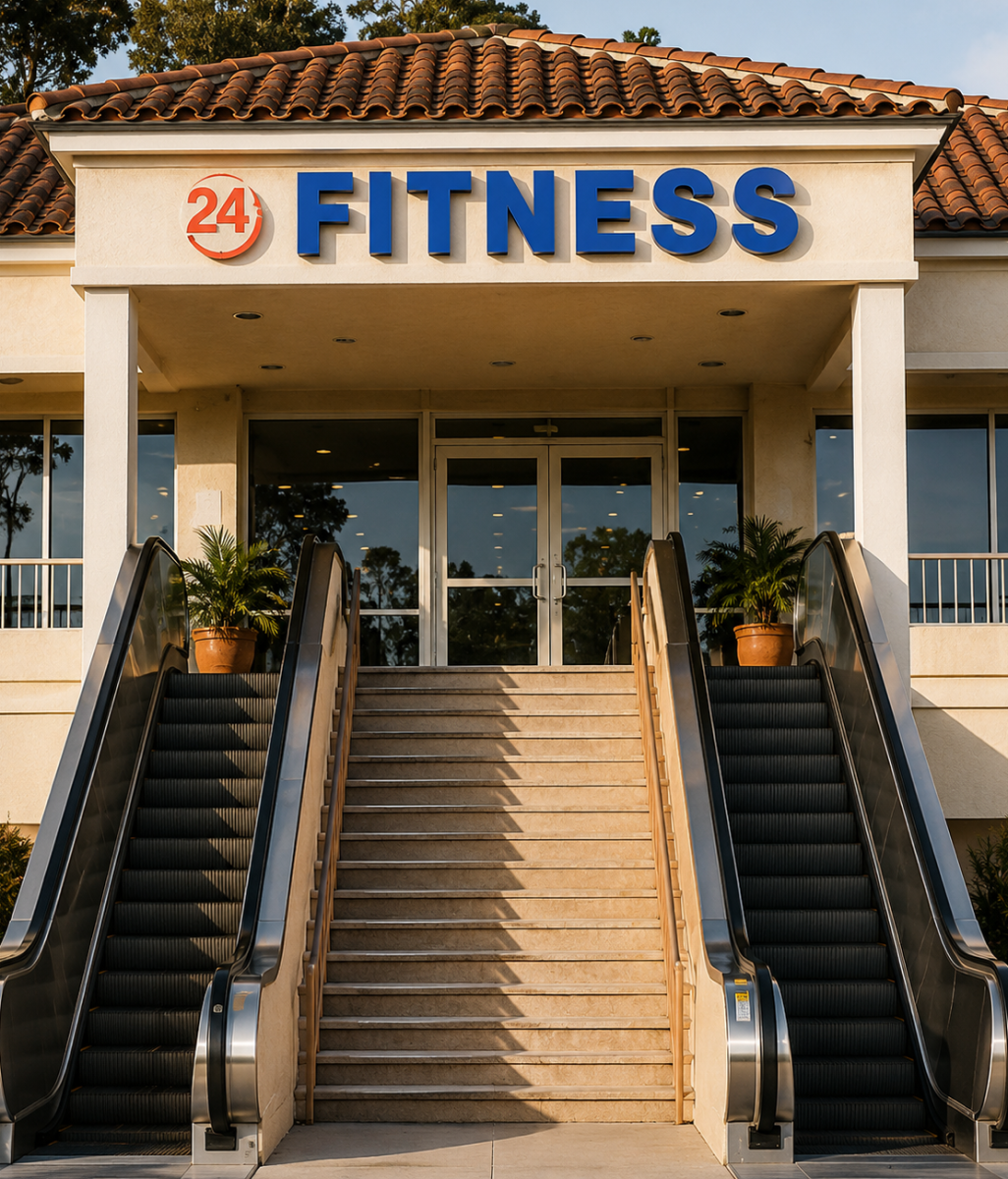
Why Taking The Stairs Is One Of The Most Underrated Exercises Around
(If able) Most people see a staircase and think one of two things:
"I'll take the lift."
Or...
"I suppose I should take the stairs."
What many don't realise is that stair climbing may be one of the most practical, accessible and effective forms of exercise available.
No gym membership. No equipment. No expensive shoes. Just a staircase and a willingness to use it.
A Built-In Cardiovascular Workout
The Secret Is In The Glutes
Not the knee.
Every step upward requires force. You are lifting your entire body weight against gravity.
Yet many people climb stairs almost entirely with their quadriceps. The knee drives forward, the front of the thigh does most of the work, and the powerful muscles around the hips barely contribute.
As your foot lands on the step, think about engaging the glute, pushing the step away behind you and extending the hip.
The result? Better movement efficiency, happier knees and a much stronger training effect.
Why Use The Glutes?
- ✅ Largest muscle in the body
- ✅ Designed for climbing
- ✅ Reduces knee dominance
- ✅ Improves power output
- ✅ Better lower-body balance
- ✅ More efficient movement
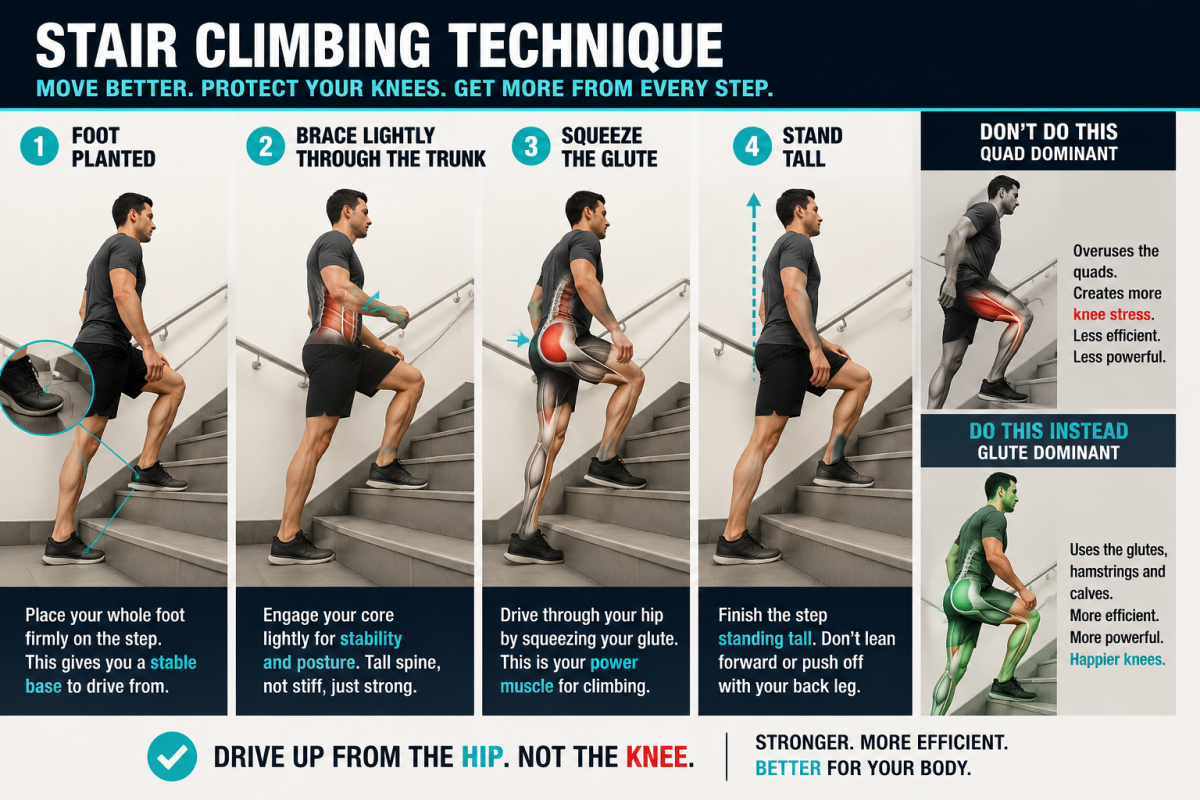
A Simple Technique Cue
The Pampy Take
If there was a medication that improved cardiovascular fitness, strengthened the lower body, elevated heart rate, challenged balance, improved mobility and required no equipment, we'd all be lining up for a prescription.
Fortunately, it already exists.
It's called a staircase.
Use your glutes.
Stand tall.
Breathe deeply.
Your heart, lungs, muscles and knees will probably thank you for it.