
Sleep
Re-Architecture
Elane wasn’t chasing perfect sleep.
She simply wanted fewer interruptions, fewer cramps, better temperature control and enough quality recovery to feel human again the next day.
She Simply Wanted One Thing
A decent night’s sleep.
When Elane first came to see me, she wasn’t actually complaining about her weight.
Or her cholesterol.
Or even her fitness.
She simply wanted one thing... a decent night’s sleep.
Like many women entering perimenopause, she described the same frustrating cycle.
Or simply lying there wondering... “Why can’t I sleep anymore?”
Why Does Sleep Change?
Oestrogen influences far more than reproduction. It also plays a role across several systems connected to sleep, recovery, temperature control and emotional wellbeing.
As hormone levels fluctuate, sleep can become lighter, more fragmented and far less predictable.
Many women continue spending eight hours in bed, yet wake feeling as though they barely slept.
The Body Temperature Challenge
One of Elane’s biggest frustrations was simply overheating.
This constant change in body temperature can interrupt the normal progression through the sleep stages.
That makes it harder to remain asleep for long enough to accumulate useful amounts of restorative deep and REM sleep.
Sleep Isn’t Simply Rest
It is active repair.
When sleep fragments night after night, everything becomes harder.
We Didn’t Chase Perfection
We chased improvement.
If Elane could improve from a 4/10 sleeper to a 7/10 sleeper, that would have the potential to change her quality of life.
Not perfect. Just substantially better.
Sleep Architecture
Rather than relying on one “magic supplement,” we worked on creating an entire sleep-supportive environment.
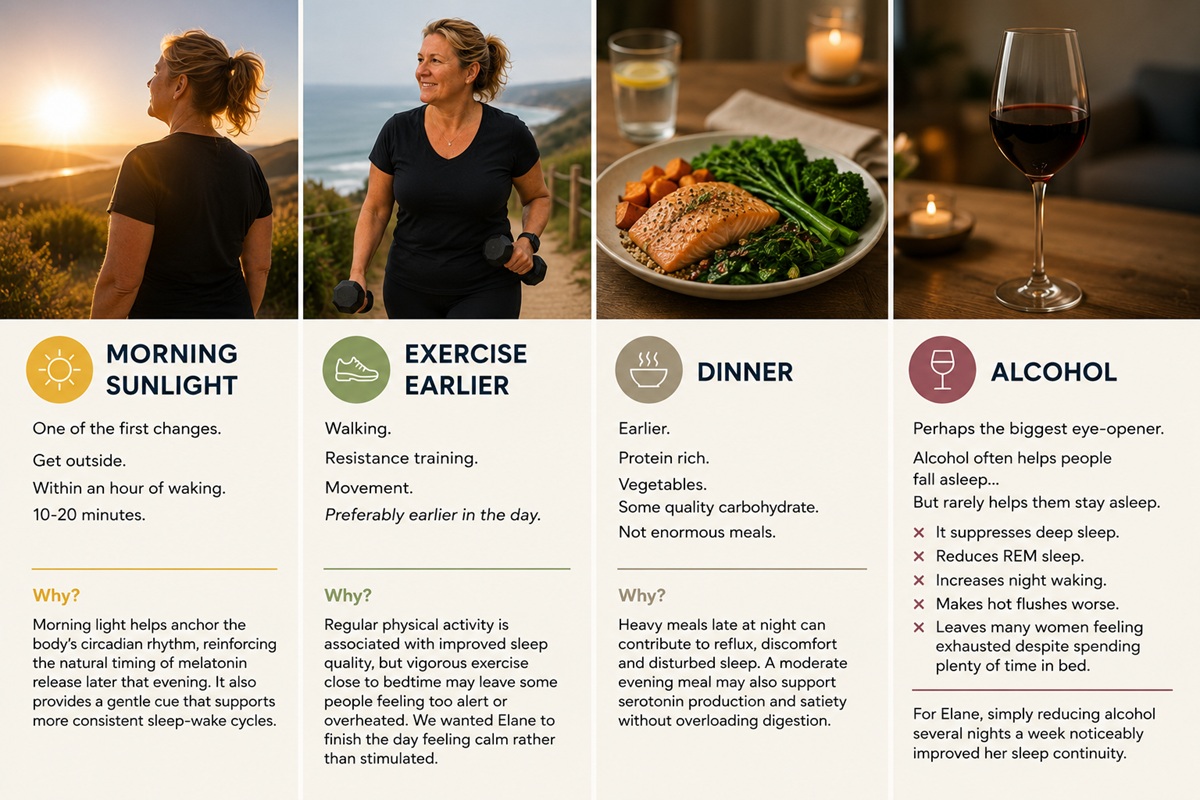
Managing the Busy Brain
Many women don’t necessarily wake because of stress.
They wake...
Then start thinking.
Work. Family. Tomorrow. Bills.
The conversation begins.
Simple strategies that may help include:
- Writing tomorrow’s tasks down before bed.
- Reading a book instead of scrolling on a phone.
- Gentle breathing exercises.
- Quiet stretching.
- Mindfulness or relaxation recordings.
The goal is to give the brain permission to switch from problem-solving to recovery.
Calf Cramps
Night cramps can have many contributing factors.
These may include dehydration, prolonged standing, muscle fatigue, electrolyte imbalance, certain medications and, in some cases, hormonal changes.
Our first priorities were simple:
- Adequate hydration throughout the day.
- Regular calf stretching.
- Gentle calf strengthening.
- Comfortable footwear.
- Avoiding sudden increases in exercise load.
If cramps persist, become severe or change noticeably, they are worth discussing with a healthcare professional to help rule out other causes.
Supplement and Medical Considerations
Importantly, Elane’s physician was aware of and cleared the choices she trialled.
Melatonin
For some women, particularly those with significant sleep-timing difficulties, melatonin may be considered in consultation with their healthcare provider.
It is not simply a traditional sedative. It is a hormone involved in signalling and regulating the body’s internal clock.
Menopausal Hormone Therapy
For women experiencing frequent hot flushes and night sweats, MHT can be highly effective and, for many, may lead to a substantial improvement in sleep quality.
It is not suitable for everyone, so decisions should always be made with a clinician who can consider symptoms, medical history, individual risks and personal preferences.
See the MHT section below.
Stop Asking, “Did I Sleep Eight Hours?”
Instead, we asked better questions.
Good Sleep Isn’t a Luxury During Menopause
It becomes one of your most powerful health supports.
Better-quality sleep supports appetite control, emotional resilience, muscle recovery, cardiovascular health, cognitive function and the energy required to make better choices the following day.
You don’t need perfect sleep to feel dramatically better.
Even small, consistent improvements can create a positive ripple effect through every other aspect of health.
That is what we gradually began to see with Elane.
We didn’t fix everything overnight.
But by improving her sleep environment, daily routine, temperature management and recovery habits, the nights slowly became calmer.
And as the nights became calmer, the days became brighter.
Where MHT Fits
One important part of Elane’s story is that, after discussing her symptoms with her GP, she chose to commence Menopausal Hormone Therapy — MHT — previously more commonly referred to as HRT.
This was not a decision made by me.
It was a medical decision made between Elane and her doctor.
For Elane, MHT became another tool within her overall health plan. It did not replace the lifestyle strategies. It supported them.
A Decision Made With Her Doctor
Individual symptoms, medical history, risks and preferences all need to be considered.
Elane’s MHT use sat inside the broader health plan — not above it, and not instead of it.
Her GP assessed her symptoms and personal medical situation before recommending treatment.
This case study does not attempt to identify the specific medication, dose or formulation used, because those decisions belong between an individual woman and her treating clinician.
MHT is not suitable for every woman.
Nor should one woman’s medication plan automatically become another woman’s.
The important message is that Elane sought appropriate medical guidance and included her treatment within a broader, well-supported health strategy.
Her Symptoms Were Affecting Everyday Life
Like many women, Elane had reached a point where several classic menopausal symptoms were beginning to meaningfully reduce her comfort, energy and overall quality of life.
Following medical assessment, Elane’s GP felt she was an appropriate candidate for a standard low-dose MHT regimen.
While every woman’s situation is different, MHT can be highly effective in reducing troublesome menopausal symptoms for women who are suitable candidates.
MHT Isn’t a Magic Pill
Hormones do not replace healthy living. They may create a better environment for healthy living to work.
She Has More Energy to Walk
Better sleep can improve daytime energy, motivation, appetite control and willingness to move.
Exercise Becomes More Enjoyable
Better temperature regulation can make movement feel less uncomfortable and less physically disruptive.
Strength Training Becomes Easier to Repeat
Feeling less exhausted or physically unsettled helps make short resistance sessions more manageable.
Healthy Eating Requires Less Effort
Better emotional wellbeing often supports improved planning, food choices and consistency.
Why We Still Focused on Lifestyle
Even with MHT, the body still responds enormously to what it repeatedly eats, does and experiences.
These remain the foundations of healthy ageing.
Think of Health as an Orchestra
No one person, treatment or strategy creates the whole result.
Your GP
Manages medical assessment, treatment and clinical follow-up.
Exercise Support
Helps you move safely, preserve muscle and build fitness.
Nutrition
Supports metabolism, energy, muscle and long-term health.
Sleep Habits
Support recovery, appetite control and emotional resilience.
Family Support
Provides encouragement, understanding and practical support.
The Result
Elane felt the combination of appropriate medical care and practical lifestyle change worked beautifully.
MHT helped reduce several of the symptoms that had been making everyday life difficult.
The lifestyle program then allowed her to build upon those improvements.
She was not relying on medication alone.
Nor was she trying to exercise her way through menopause.
Instead, she combined modern medicine with evidence-based nutrition, walking, resistance training, sleep strategies and ongoing personal support.
It Isn’t Medication or Lifestyle
Over more than 35 years working in health and fitness, one lesson continues to be reinforced.
Health is rarely about choosing one path over another.
It is not medication or lifestyle.
For many women, it is appropriate medication and lifestyle.
When suitable medical treatment is combined with sensible exercise, nourishing food, restorative sleep and ongoing support, the outcomes can be far greater than either approach may achieve alone.
That, to me, is exactly what Elane’s story demonstrates.
It was not about finding a miracle.
It was about building a team around her health.
And giving herself permission to use every appropriate, evidence-based tool available.
Thank You, Elane
Thank you for allowing me to share your experience so openly.
The health numbers.
The symptoms.
The strategies that helped.
The ones that did not.
And the personal realities of navigating this major physiological transition.
Hopefully, somewhere within this case study, another woman recognises herself, gathers a few practical ideas, feels a little more reassured — and realises she does not have to navigate menopause alone.
