
The Grass Is The Teacher
Barefoot running on grass is not about being heroic. It is about feedback, awareness, softer mechanics, better economy and allowing the body to remember how it was designed to move.
For more than 35 years, I have included barefoot running on grass within my own training.
Not every day.
Not every session.
Just enough to remind my body how nature intended us to move.
The funny thing is, when people see me running barefoot, they often assume I am trying to strengthen my feet.
While there may be some truth in that, it’s not the primary reason I do it.
I run barefoot on grass for two very important reasons.
1. The Grass Is The Teacher
I firmly believe barefoot running on grass helps improve running technique and running economy.
Now, before we go any further, let’s be clear.
I am not talking about sprinting barefoot.
I am not talking about threshold running.
I am not talking about trying to run personal best times.
I am talking about comfortable, relaxed, Zone 2 running at around 70% effort.
Think recovery pace.
Think conversational pace.
Think easy.
When The Shoe Comes Off
When you remove the shoe, something interesting happens.
The body immediately becomes more considerate.
- Foot strike generally softens
- Ground contact often becomes lighter
- Stride length naturally shortens
- Cadence tends to increase
- The foot generally lands closer to underneath the body’s centre of mass
The body begins searching for efficiency.
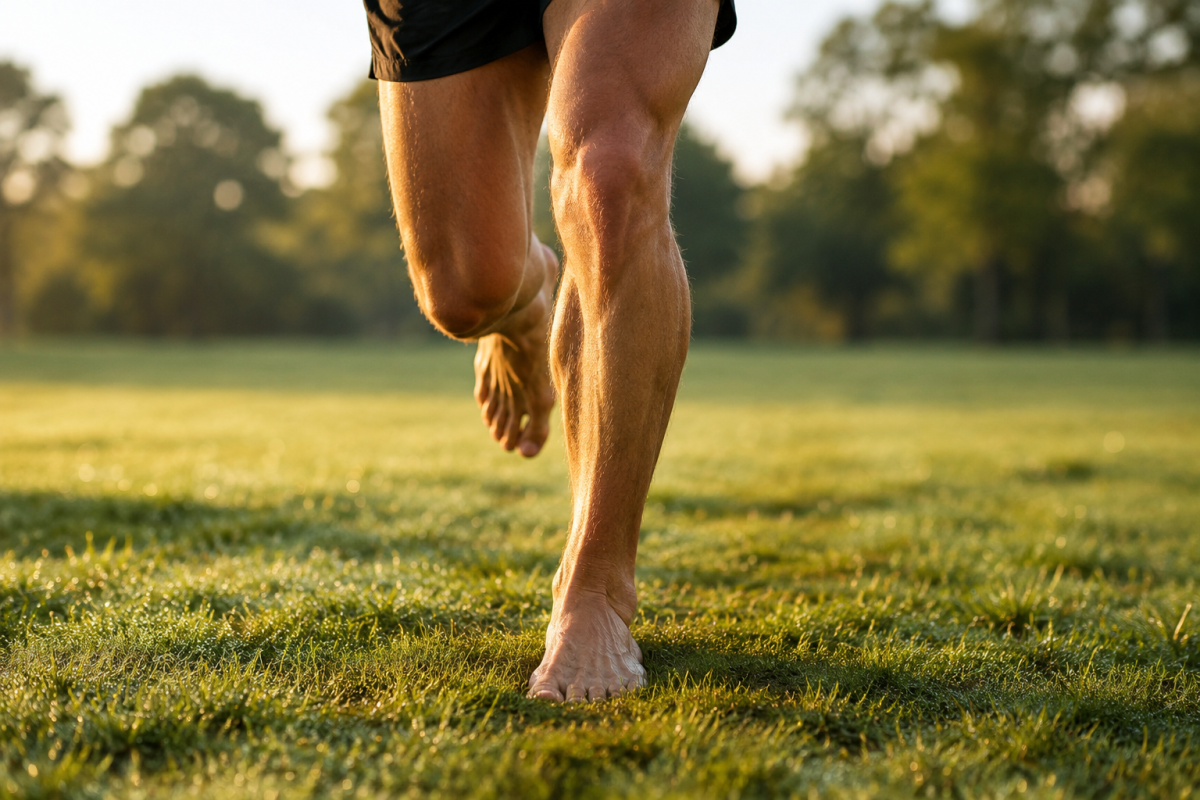
Immediate Feedback
The grass teaches through feel. No watch. No app. No metronome. Just the body responding to the ground.
The Cushioning Trap
Over the years, I have noticed that many runners wearing heavily cushioned shoes can occasionally become a little lazy with their mechanics.
The protection allows over-striding.
The foot reaches too far in front.
The knee extends excessively.
The heel lands heavily.
Impact forces increase.
Vertical oscillation increases.
Energy is wasted.
Barefoot running on grass makes this difficult.
The body quickly learns that landing heavily simply doesn’t feel good.
So it adapts.
It self-corrects.
It finds a smoother, lighter and more economical way to move.
The Pampy Rule
The grass does not lecture you.
It simply gives feedback.
And the body is remarkably good at responding to feedback when we let it listen.
No Coach. No App. Just Feedback.
The grass becomes the teacher.
No coach.
No app.
No watch.
No metronome.
Just feedback.
Immediate feedback.
And the body is remarkably good at responding to feedback.
The foot speaks. The brain listens. The body adjusts.
The Foot Speaks
I have always believed the sole of the foot contains an extraordinary amount of information.
Thousands of sensory receptors continually communicate with the brain.
Every step provides information about balance, pressure, stability and movement.
When we run barefoot, we reconnect with that communication system.
The foot speaks.
The brain listens.
The body adjusts.
It’s a process that many of us experienced naturally as children.
Long before running shoes, carbon plates and GPS watches.
Just movement.
Natural movement.
As nature intended.
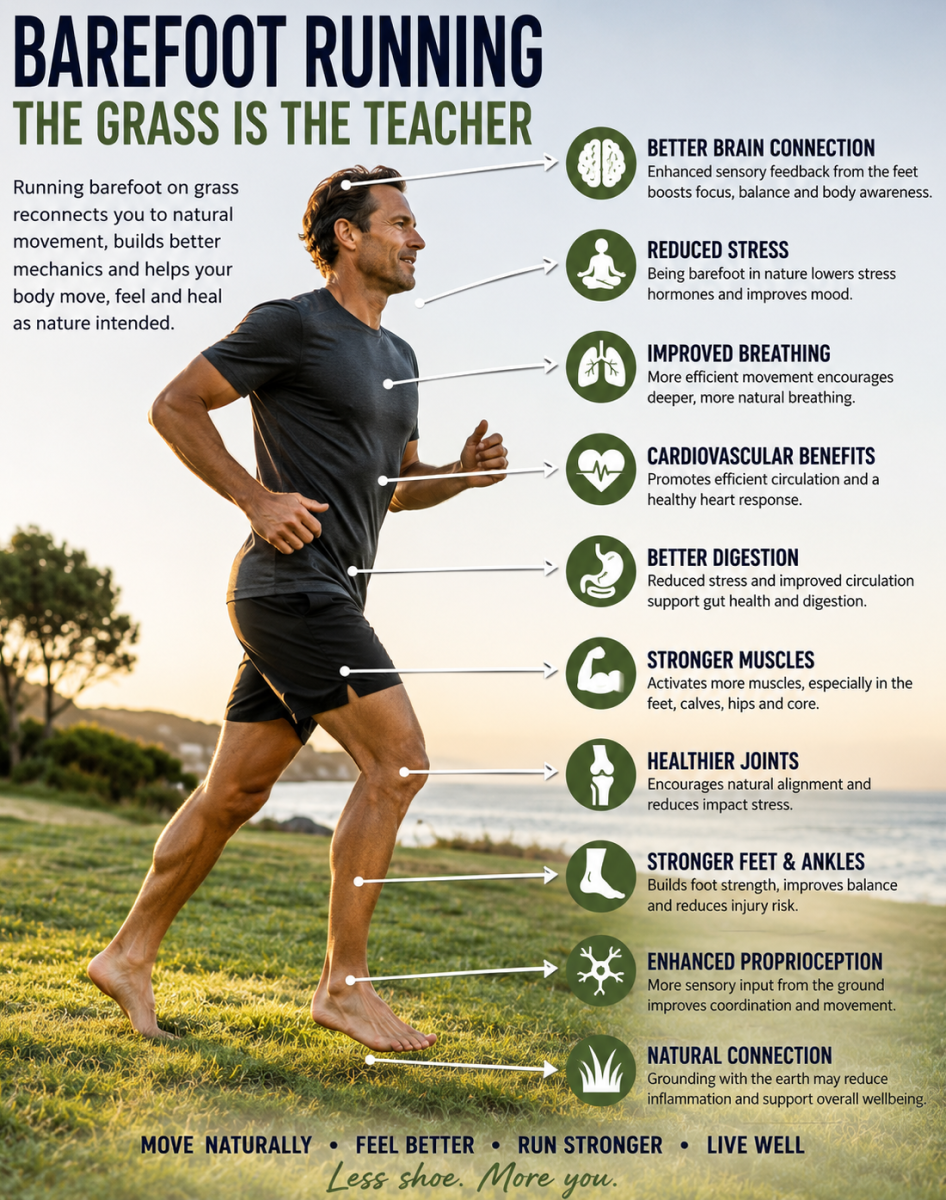
The Morning Dew
Cool grass, moisture and sensory feedback can heighten awareness — and awareness almost always improves movement.
The Morning Dew
One of my favourite times to run barefoot is early in the morning when there is still dew on the grass.
I appreciate there is limited science around this particular observation, but I have always loved the sensation.
The cool grass.
The moisture.
The sensory feedback.
It feels as though every nerve ending in the sole of the foot comes alive.
Almost like a little dance party for the nervous system.
The experience heightens awareness.
And awareness almost always improves movement.
2. Recovery And Healing
The second reason I love barefoot grass running is recovery.
Grass is forgiving.
Grass is compliant.
Grass reduces impact.
When combined with a softer foot strike and improved biomechanics, the overall cost of running often decreases.
The body absorbs less punishment.
The joints are subjected to less repetitive impact.
The muscles and connective tissues can often tolerate the workload more comfortably.
When I Use It
I often encourage runners to complete short barefoot grass runs after harder training blocks, races or periods where the body feels a little beaten up.
Not because barefoot running is magical.
But because it encourages the body to move well.
And when the body moves well, it generally experiences less stress.
Recovery is not simply about doing less. Recovery is about allowing the body to heal.
Barefoot grass running can be a wonderful way to continue moving while simultaneously reducing the overall cost of that movement.
How To Think About It
Easy pace.
Soft grass.
Short exposure.
Light feet.
Listen to the feedback.
Start Sensibly
I’m not suggesting everyone should immediately remove their shoes and run 10 kilometres across the nearest oval.
Like anything, barefoot running should be introduced gradually and sensibly.
Start with a few minutes.
Feel the grass.
Listen to the feedback.
Allow the body to adapt.
Final Thoughts
If you’re looking for a simple way to reconnect with natural movement, improve your running awareness and perhaps remind yourself how you moved as a child, barefoot running on grass is difficult to beat.
After all, some of the best coaching lessons don’t come from a coach.
Sometimes...
The grass is the teacher.