

STANDING ON SALT FOR 10 MINUTES.
ANOTHER HEALTH MIRACLE?
Just when I thought I'd seen most of the weird and wonderful things people do for better health, along comes another one.
Yep. Salt.
Apparently, this little practice might improve sleep, reduce inflammation, balance minerals and boost energy.
Crikey! And here I was thinking salt belonged on my food, not under my feet!
SO, WHAT'S THE THEORY?
Salt contains minerals. Our bodies need minerals. And apparently, standing on salt might allow some of these minerals to enter through our feet.
Sounds interesting.
But there's very little convincing evidence that this actually happens.
Our skin is a remarkable protective barrier.
BUT WHAT ABOUT THE OCEAN?
I've been jumping into the surf for pretty much all of my 55 years.
And I can tell you something.
A few waves over the head, some sunshine, fresh air — BOOM! I feel fantastic.
Even back in my younger days, when a few too many beers made the following morning a little ordinary.
Hangover? Ten minutes in the surf and I felt like a new bloke!
Of course, the ocean wasn't magically removing alcohol from my system. But the cool water, movement and psychological lift certainly made me feel better.
My money's on the latter.
RIGHTO. I GAVE IT A CRACK!
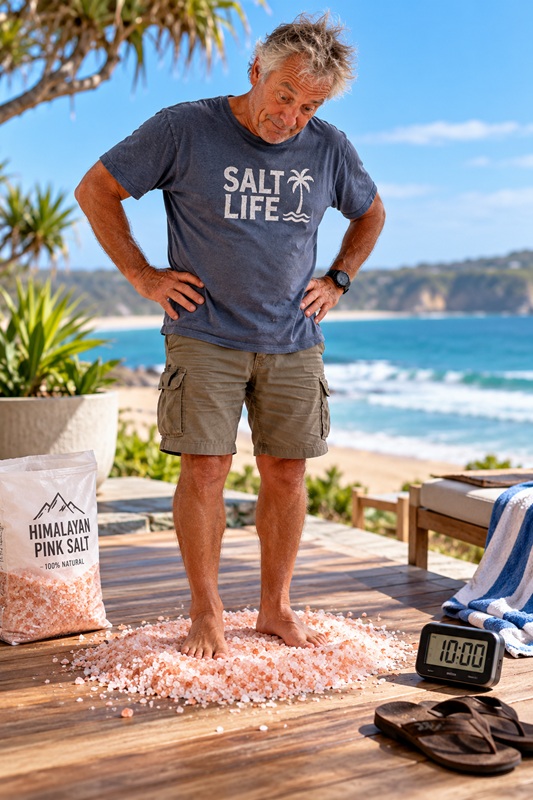
Three days. Ten minutes standing barefoot on salt.
No meditation soundtrack. No incense burning.
And the results?
But I generally feel pretty good anyway.
A little daily exercise, plenty of nourishing food, decent sleep and, of course, a healthy dose of AC/DC!
Hard to know what another 10 minutes standing on salt was supposed to add to that lot!
PAMPY SAYS...
Look, if standing on salt helps you relax, knock yourself out.
Well, not literally!
Taking 10 minutes to switch off might be beneficial in itself.
But just because something makes you feel better doesn't mean the explanation being sold to you is correct.
And three days of one bloke standing on salt hardly qualifies as a scientific study!
For me, I'll stick with the surf.
And when that's not an option?
A good walk, some decent nourishing, a solid night's sleep and a little Thunderstruck through the speakers.
WHEN YOUR BRAIN
JUST WON'T PLAY BALL!
Ever sat down to do something you know you need to do, something that might only take 20 minutes, and found yourself doing absolutely everything except that task?
Yet give yourself something you're genuinely interested in, and suddenly you've got enough focus and enthusiasm to move mountains.
Welcome to a little something I've been dealing with for pretty much all my life.
WHEN I'M ON, I'M ON!
There's a characteristic often associated with ADHD called hyperfocus — becoming completely absorbed in something that genuinely captures your interest.
Then there's executive dysfunction — difficulties initiating, organising or completing tasks, even when you know they're important.
Now, I've never been formally diagnosed with ADHD, so I'm certainly not claiming I have it.
But I recognise some of these characteristics in myself.
Give me a race to prepare for, an interesting physiological theory to test, a new person to meet or something that genuinely grabs my attention, and I'm away!
During my Ironman years, if training required getting out of bed at 4 am, there was never a debate. I just did it.
University? High distinctions in subjects I loved. Spectacular failures in others!
I can sit down for hours on end learning the chords on guitar to a song "I like"!
But ask me to sit down and do my tax, complete some mundane paperwork or concentrate on something that doesn't interest me?
And it's not always a matter of laziness or lacking willpower.
Sometimes getting the brain to engage is the hardest part.
SO, HOW DO I GET MY BRAIN TO PLAY BALL?
Over the years, through plenty of trial and error, I've developed a little morning routine that seems to help me create the enthusiasm and momentum I need.
Nothing revolutionary. Just a few things that appear to work for me.
1 MOVE FIRST.
Some cardio, a few strength movements, whatever gets the blood pumping.
Exercise is my number-one starting point. I generally feel sharper and more motivated afterwards.
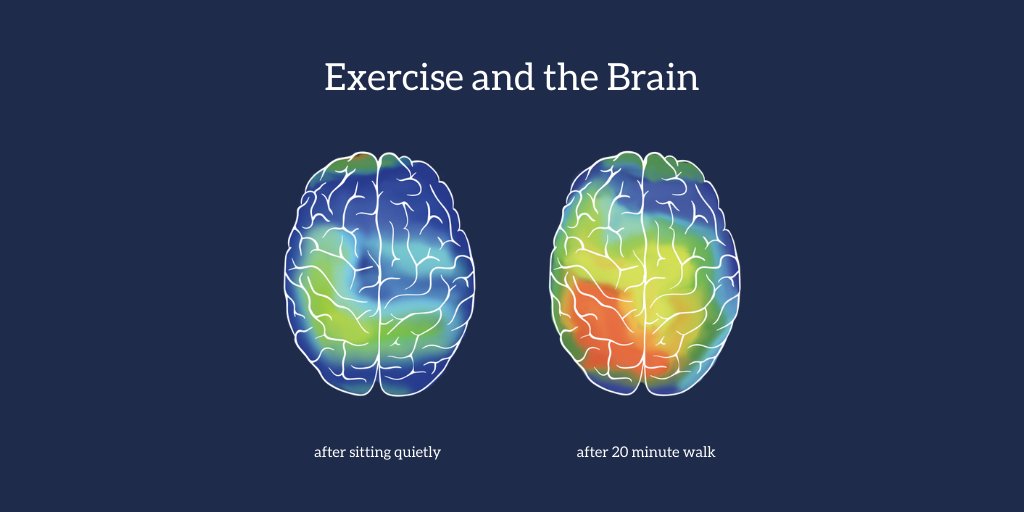
2 GET SOME MORNING LIGHT.
Ideally, a little sunshine early in the day. A useful signal for our body clock and a good way to start the morning.
3 FINISH THE SHOWER COLD.
Ten seconds of straight cold water.
Well, that's the plan. Usually closer to four!
4 COFFEE AND MY LITTLE COGNITIVE EXPERIMENT.
A double-shot coffee, full-cream milk, a little Lion's Mane mushroom powder, MCT oil and ground cinnamon.
I also take creatine as part of my morning routine.
For several months, I experimented with two other supplements — L-Tyrosine and Alpha-GPC — both promoted for their potential roles in supporting cognitive function.
Did they help?
Perhaps. But I couldn't confidently separate their effects from everything else I was doing.
And that's the thing with these little experiments.
And before anyone thinks I've discovered the ultimate brain-boosting cocktail, I haven't!
I enjoy the routine, the coffee certainly gives me a lift, and I'm happy to keep exploring what works for me.
5 BOOM. PLAY!
And here's the important bit.
Once I've created a little momentum, I try to tackle the task I've been avoiding.
Not wait until I feel like doing it.
Just get started.
Because quite often, once I'm underway, the difficult bit is behind me.
AND WHAT ABOUT NICOTINE?
There was a time when I occasionally used nicotine toothpicks when I needed some serious concentration.
And I'll admit something.
Nicotine can temporarily improve certain aspects of attention and alertness.
But I also recognised that relying on an addictive substance to switch my brain on wasn't a particularly clever long-term strategy.
So I moved away from them.
PAMPY SAYS...
I don't pretend to have all the answers about how my brain works.
And I'm certainly not suggesting my little routine is a treatment for ADHD.
But I've learnt something useful over the years.
For me, movement, morning light, a familiar routine and a little momentum can make an enormous difference.
And if you recognise yourself in any of this, perhaps it's worth exploring how your own brain responds to different tasks, environments and routines.
We're not all wired to approach things in exactly the same way.
And sometimes, understanding how YOU work is half the battle.
Now, if you'll excuse me, I've got to finish this friggin article.
FOUR WAYS TO GET STRONGER.
WHICH ONE SOUNDS LIKE YOU?
Four different programs. Four different starting points. Whether you're chasing a better golf swing, rebuilding some strength or simply wanting your body to work better — there's something here worth exploring.
 PROGRAM 01
READY TO GIVE YOUR CORE A PROPER WORKOUT?
You've been training regularly, feel confident moving, and reckon you're ready for something a little more dynamic? This one's for you. Inspired by Australian water polo athlete Annie, six medicine-ball exercises challenge your core strength, control and functional movement. Not just for elite athletes — but certainly for women ready to step things up.
EXPLORE ANNIE'S CORE ROUTINE PROGRAM 02
CAN'T HIT A MILLION BALLS? TRAIN THE SWING INSTEAD.
Love your golf? Wouldn't mind taking a few shots off the card — and a few dollars off your mates? You don't have to live on the driving range. Seven practical exercises targeting the trunk strength, stability and rotation that support a more controlled, repeatable swing. Train at home, in the gym or even in the office.
TRAIN YOUR GOLF SWING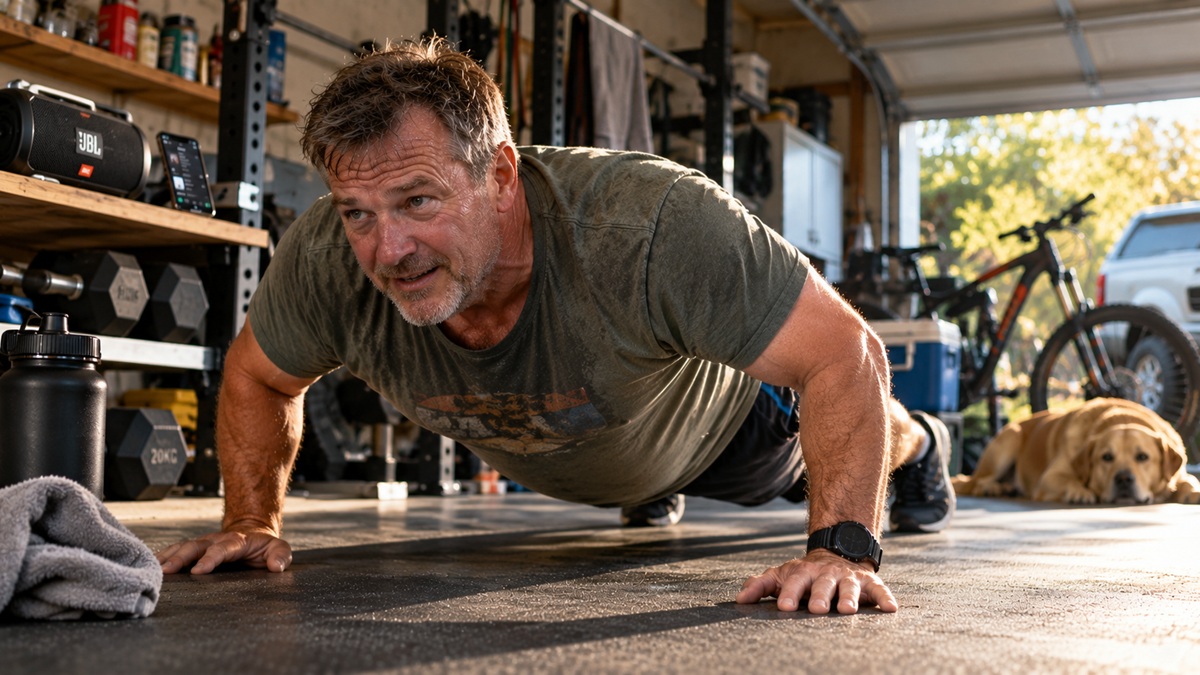 PROGRAM 03
ON THE BACK NINE OF LIFE? TIME TO TIGHTEN A FEW THINGS UP.
Once a warrior, now carrying a few clunky parts? You're not alone, mate. Nine graded strength routines for blokes who want to rebuild some useful muscle, improve structural strength and move with a bit more confidence. No heroics. No need to train like you're 25 again. Just sensible, progressive work at your level.
FIND YOUR STRENGTH LEVEL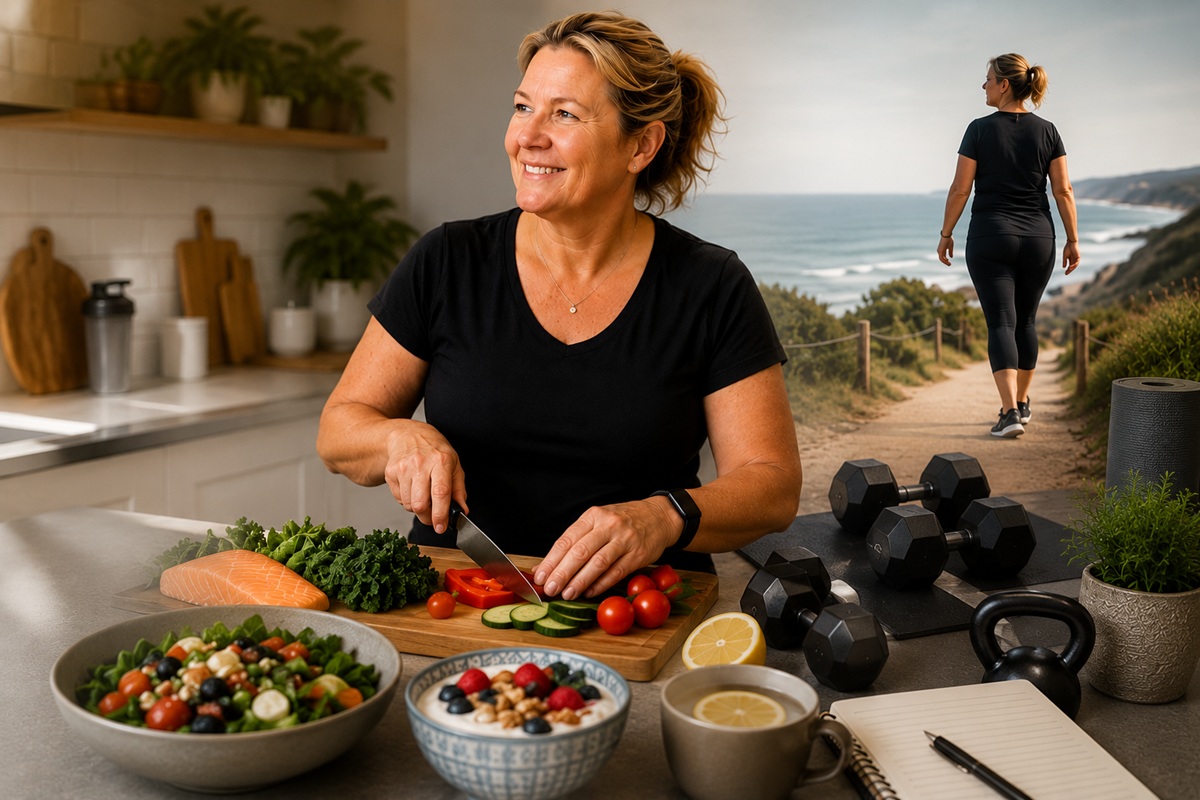 PROGRAM 04
MENOPAUSE CHANGING THE RULES? LET'S WORK WITH YOUR BODY.
Your body's changing. Your sleep, energy, strength or confidence might be changing with it. But there's plenty you can still influence. Elane's practical approach explores how movement, strength training and everyday lifestyle choices can support women through menopause and beyond. A popular Pampy's Post feature worth discovering — or revisiting.
EXPLORE ELANE'S APPROACH