
BODY FAT LOSS
WHAT 35 YEARS HAS TAUGHT ME!
35 years. Hundreds of people. One lesson: there's no one-size-fits-all approach.


The science, the experience, and a real bloke called John.
A QUICK HEADS-UP: This is a detailed article, and perhaps best enjoyed in parts. If body composition and weight management aren't of particular interest to you, feel free to move on to the next Pampy's Post article!
35 YEARS — AND STILL LEARNING!
Now 35 years into my career as a health professional, I've spent an enormous amount of time helping people manage their weight, improve their metabolic health and, in particular, reduce excess body fat where it may affect health.
And over those years, my approach has changed. Quite a few times, actually!
Not because I've been chasing the latest dietary trend, miracle supplement or social media sensation. Quite the opposite.
It's been shaped by experience — by the many people I've worked with, the changes we've made, the results we've measured, and importantly, what people have been able to sustain.
So, rather than simply rattle off another list of weight-loss recommendations, I thought I'd share what I've come to believe matters most, why I believe it, and how I approach helping someone find and maintain a healthier body composition.
And to make things a little more interesting, I'll introduce you to John.
John's a mate of mine who has kindly agreed to let me share his real-life experience. As we work through the article, I'll use John's journey to illustrate how some of these principles can translate into meaningful, measurable changes.
FIRST, SOMETHING IMPORTANT!
THERE'S NO ONE-SIZE-FITS-ALL APPROACH TO BODY-FAT MANAGEMENT!
Our genetics, age, biological sex, hormonal health, dietary habits, physical activity, sleep and emotional wellbeing all influence how we manage energy and store body fat.
And the differences between individuals can be enormous.
The underlying physiological principles are shared. How we apply them is very much an individual affair.
Or, as I often remind people: N = 1.
SO, WHAT HAVE I FOUND MATTERS MOST?
Over the years, I've become increasingly interested in how people respond to dietary carbohydrates — particularly refined sugars and highly processed, energy-dense foods.
WHY?
Because, in my experience, changing the type and quality of carbohydrates people consume can produce some of the most noticeable improvements in appetite control, blood glucose management, triglycerides and, importantly, body composition.
That doesn't mean carbohydrates are inherently bad. Far from it!
Nor does it mean that insulin is the villain, or that calories suddenly cease to matter.
But I've repeatedly found that reducing excess refined carbohydrates can be an enormously useful starting point, particularly for people whose dietary habits, appetite regulation and metabolic markers suggest there's room for improvement.
AND TO UNDERSTAND WHY,
we need to have a very quick conversation
about insulin.
Nothing complicated. Promise!
INSULIN — LET'S KEEP THIS SUPER SIMPLE!
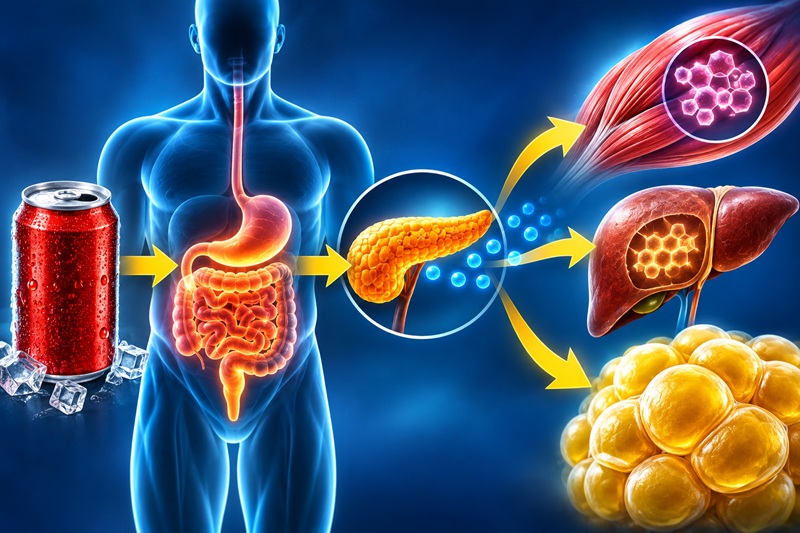
Let's say John drinks a can of Coca-Cola.
Within a relatively short time, the sugar is absorbed into his bloodstream and his blood glucose begins to rise.
Now, blood glucose is an essential fuel. But our bodies need to keep its concentration within a carefully regulated range.
So John's pancreas responds by releasing insulin.
Think of insulin as one of the body's important fuel-management hormones.
It helps John's muscle and other tissues take up glucose, encourages the storage of glucose as glycogen, and reduces glucose production by the liver.
Some of that glucose may be used immediately for energy. Some may be stored for later.
John has two particularly interesting energy reserves:
TANK ONE — GLYCOGEN
1,500–2,000 kcal
Stored mainly in his muscles, with a smaller amount in his liver. Depending on body size, muscle mass, training and recent food intake, this is a rough estimate of John's stored glycogen energy. It's relatively small, but readily available — particularly as exercise intensity increases.
TANK TWO — BODY FAT
A HUGE RESERVE!
Even a lean endurance athlete can carry tens of thousands of calories in stored body fat. At my own relatively lean body composition, I estimate my reserves contain around 60,000 calories of potential energy. That's quite a fuel tank!
And unlike glycogen, our capacity to store body fat is enormous.
SO, HOW DOES JOHN GAIN BODY FAT?
If John regularly consumes more energy than his body expends, the surplus can contribute to increasing his body-fat stores.
Insulin is involved in regulating fuel storage and release, but the process isn't quite as simple as filling the glycogen tank and automatically tipping every leftover gram of sugar into fat.
The body is constantly using, storing and releasing a mixture of fuels.
And this is where John's food choices become particularly interesting.
A can of sugary soft drink delivers energy quickly, but provides very little protein, fibre or lasting fullness.
For some people, that means consuming quite a few calories without feeling particularly satisfied.
And if that pattern is repeated throughout the day — alongside other highly processed, energy-dense foods — it's easy to see how total energy intake can creep upwards.
More energy coming in than going out, consistently over time, means more energy potentially being stored as body fat.
Change the type of food someone eats, and you can often change how hungry they feel, how much they naturally consume, and how comfortably they manage their body composition.
And that brings me to one of my strongest practical observations.
IT'S NOT JUST HOW MUCH YOU EAT. IT'S WHAT YOU EAT!
Of course, calories matter.
Protein, dietary fat, carbohydrate and alcohol can all contribute to total energy intake.
But they don't necessarily have the same effects on appetite, fullness, digestion or the amount of energy used to process them.
Protein, for example, generally produces greater satiety and has a higher thermic effect than dietary fat or carbohydrate.
Fibre-rich, minimally processed foods can also make it easier to feel satisfied without consuming excessive energy.
And this is one reason I've found that helping people replace refined, sugary foods with satisfying, protein-rich, nutrient-dense alternatives can be so effective.
Not because we've somehow switched off the laws of energy balance — but because we've made that balance easier to manage!
And for John, as we'll discover, understanding and applying these principles became an important part of his journey.
GENETICS — WHY SOME PEOPLE GET AWAY WITH MURDER!

Ever had a mate who seems to eat whatever the hell they like, rarely exercises, enjoys a few beers, and somehow remains as lean as a rake?
Meanwhile, someone else only has to look at a chocolate biscuit and reckons they've gained a kilo!
Well, there's actually some interesting physiology behind these differences.
And after 35 years working with hundreds of men and women, I've become increasingly convinced that our genetic makeup plays a significant role in how easily we gain, store and lose body fat.
But genetics isn't the entire story.
LET'S TALK INSULIN SENSITIVITY — AND WHY PEOPLE DIFFER!
Now, when I'm explaining this to someone, I often describe three broad metabolic tendencies.
They're not formal medical classifications — simply a useful way of explaining the differences I've observed between people.
SELECT A PROFILE TO EXPLORE IT. OPENING ANOTHER WILL CLOSE THE PREVIOUS ONE.
1. THE NATURALLY LEAN MOB!
We all know a few of these lucky buggers!
People who seem to maintain a relatively lean body composition throughout much of their lives, without paying enormous attention to their food choices or activity levels.
Some have inherited favourable appetite regulation, energy expenditure, fat distribution and insulin sensitivity.
Their bodies may be particularly effective at responding to insulin, allowing glucose to be managed with relatively modest amounts of the hormone.
But there's another important consideration.
Some naturally lean people also unconsciously compensate for eating more — perhaps by moving more, eating less later, or simply having a naturally smaller appetite.
Being lean doesn't necessarily mean they're metabolically healthy. And it certainly doesn't mean they're immune to insulin resistance, elevated blood lipids or cardiovascular disease.
Nevertheless, in my experience, some people genuinely appear to have a much easier time maintaining their body composition than others.
2. THE MIDDLE-AGE CREEP!
Now, this is a group I've spent an enormous amount of my professional life helping!
People who were relatively lean and active throughout their twenties and thirties, only to find their body composition gradually changing as they moved into their forties, fifties and beyond.
The waistband gets a little tighter.
The bathroom scales slowly climb.
And what used to work for managing their weight doesn't seem quite as effective anymore.
Why?
Well, several things can be happening.
We may gradually lose muscle mass, particularly if resistance training isn't part of our lives.
Daily movement can decline. Work becomes more sedentary. Sleep can deteriorate. Hormonal changes may influence appetite, muscle maintenance and where we store body fat.
And for some, insulin sensitivity also declines — particularly when increasing abdominal fat and reduced physical activity enter the picture.
Interestingly, ageing doesn't automatically mean our metabolism falls off a cliff!
Much of what people describe as a slowing metabolism can involve changes in body composition, movement, lifestyle and hormonal health.
And that's encouraging, because several of these influences are modifiable.
I've repeatedly seen people in their fifties, sixties and seventies make terrific improvements in their body composition and metabolic markers.
3. THE MOB WHO HAVE TO WORK A LITTLE HARDER!
Then there are people who appear to have a much tougher time managing their body composition — sometimes from quite a young age.
They may inherit a stronger tendency towards increased appetite, lower satiety, abdominal fat accumulation or insulin resistance.
And when these tendencies meet an environment filled with convenient, energy-dense, highly processed foods, maintaining a healthy body composition can become particularly challenging.
Some people in this group may produce higher amounts of insulin to maintain normal blood glucose.
Over time, if insulin resistance progresses, their blood glucose, triglycerides and other metabolic markers may begin to deteriorate.
But here's an important distinction.
Insulin resistance doesn't automatically cause body-fat gain, and body-fat gain doesn't always mean someone is insulin resistant.
The relationship runs in both directions and involves genetics, fat distribution, muscle, liver health, physical activity and energy balance.
And this is exactly why I prefer to assess the individual rather than simply judge their health by their appearance.
SO, WHERE DOES JOHN FIT INTO ALL THIS?
Well, this is where John's story becomes particularly interesting.
Rather than assume his body composition was simply the result of eating too much or exercising too little, I wanted to understand the bigger picture.
His food choices. His appetite. His daily activity. His muscle mass. His sleep. And, where appropriate, a few useful metabolic health measurements.
Because the important question wasn't whether John had been dealt a favourable or unfavourable genetic hand.
It was what we could realistically influence from his starting point.
And that's something I've learned repeatedly throughout my career.
We can't choose our genetics.
But we can influence our food environment, physical activity, muscle mass, sleep habits and, often, our metabolic health.
AND WHAT ABOUT MEN VERSUS WOMEN?
Another important consideration.
Biological sex, hormonal health and life stage can influence where we store body fat, our muscle mass and our metabolic responses. These patterns differ on average between males and females, but there's considerable variation between individuals.
On average, females require a higher proportion of essential body fat, and their body composition can change considerably through puberty, pregnancy, the postnatal years and menopause.
Males, meanwhile, are generally more prone to accumulating abdominal visceral fat — the type associated with increased cardiometabolic risk.
But neither sex has a monopoly on metabolic challenges!
And I certainly wouldn't suggest that females are automatically more insulin resistant than males.
Again, individual circumstances matter enormously.
PAMPY'S POINT!
Genetics may influence the hand we're dealt, but it doesn't necessarily determine how the game finishes.
Some people will find managing body fat relatively straightforward.
Others will need considerably more attention to their food choices, activity, sleep and lifestyle.
And that's precisely why I don't believe in handing everybody the same dietary prescription and expecting the same result.
THE PRINCIPLES REMAIN.
THE APPLICATION MUST FIT THE PERSON.
Which brings me to something I consider particularly useful when helping someone like John.
Rather than guessing what's happening beneath the skin, why not assess a few relevant health markers and see what story they tell us?
WHAT I ASSESS
AND WHY I BOTHER!
Seven of my favourite measurements when helping someone understand their body composition and metabolic health.
Now, here's something I've become increasingly interested in over my 35 years working with people wanting to improve their body composition.
Rather than simply weigh someone, why not try to understand what's happening beneath the skin?
Because two people can weigh exactly the same, stand the same height, and have vastly different body compositions — and potentially very different metabolic health profiles.
And the bathroom scales?
Well, they're useful. But they certainly don't tell the whole story!
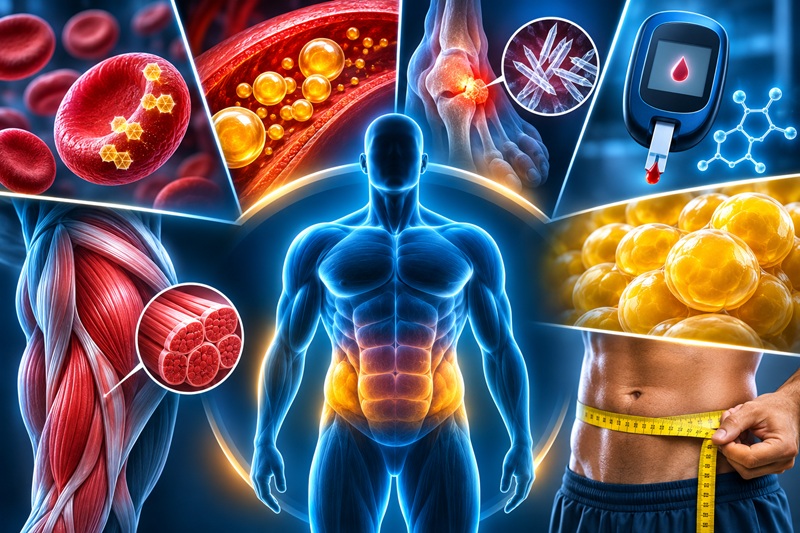
When someone like John comes to see me wanting to improve his body composition, I'm particularly interested in a handful of assessments.
Some are simple body measurements. Others involve a small finger-prick blood sample, where appropriate.
They're not all necessary for everybody, and importantly, none of these measurements on its own tells us how efficiently someone is burning body fat.
But together, they can help us understand someone's starting point, identify potential health concerns and monitor meaningful changes.
HERE ARE MY SEVEN FAVOURITES!
CLICK ANY ASSESSMENT TO EXPLORE WHY I USE IT. OPENING ANOTHER CLOSES THE PREVIOUS ONE.
1. HbA1c — HOW'S YOUR LONG-TERM BLOOD SUGAR MANAGEMENT?
This is one of my favourite metabolic health measurements.
Red blood cells have a rather important job — carrying oxygen around the body.
But as glucose circulates in our bloodstream, some naturally attaches to haemoglobin within these cells. We call this glycation.
The HbA1c test measures the proportion of haemoglobin that has become glycated, giving us an indication of average blood glucose exposure over approximately the previous 2–3 months.
Why do I like assessing it?
Because consistently elevated blood glucose may indicate that someone's glucose regulation isn't working as well as it should.
And that can be particularly relevant when we're discussing excess abdominal body fat, dietary habits and metabolic health.
With John, I'm interested in whether his HbA1c sits within a healthy range — and, if elevated, whether it improves as we make appropriate changes.
Importantly, a normal HbA1c doesn't necessarily rule out insulin resistance, and pushing an already healthy result lower isn't automatically better.
ONE IMPORTANT CLARIFICATION: Glycated red blood cells aren't carrying unused sugar as an alternative to oxygen. HbA1c is a marker of glucose exposure, not a direct measurement of oxygen delivery.
2. TRIGLYCERIDES — WHAT'S HAPPENING WITH BLOOD FATS?
Ahhh, triglycerides!
Another favourite of mine when discussing metabolic health.
Triglycerides are a form of fat circulating in the bloodstream, helping transport and store energy.
They're influenced by several things, including genetics, dietary intake, alcohol, metabolic health and physical activity.
Here's why I'm particularly interested.
In some people, particularly those with insulin resistance, excess refined carbohydrate intake and overall excess energy intake can contribute to elevated triglycerides.
And I've seen some terrific improvements in triglyceride measurements when people improve their dietary habits, reduce unnecessary body fat and become more active.
If John's triglycerides are elevated at his initial assessment, this becomes a particularly useful marker to follow.
Not because lower is endlessly better, but because a meaningful reduction towards a healthy range can be an encouraging sign of improving metabolic health.
3. URIC ACID — ANOTHER PIECE OF THE METABOLIC PUZZLE!
Now, this is one I tend to assess more often in men, particularly when there's a relevant history or reason to investigate.
Uric acid is a normal waste product formed when the body breaks down purines.
It's also influenced by kidney function, genetics, hydration, alcohol consumption and certain dietary factors.
And interestingly, high fructose intake can increase uric acid production in some circumstances.
Why might I include it?
Because elevated uric acid can occur alongside obesity, insulin resistance and other metabolic disturbances.
But it's important not to confuse association with cause.
High uric acid doesn't prove someone is insulin resistant, and it isn't a direct measure of fat-burning ability.
It's particularly relevant when someone has a history of gout, kidney concerns or elevated uric acid.
With John, I'd only include this assessment if there were a useful reason to do so.
And while I tend to use it more often with men, women can certainly develop elevated uric acid and gout too.
4. BLOOD KETONES — ARE WE PRODUCING AN ALTERNATIVE FUEL?
Now we're getting into an area I find fascinating!
When carbohydrate availability is reduced — perhaps through fasting, carbohydrate restriction or prolonged exercise — the liver can increase its production of ketones.
These provide an alternative energy source for several tissues, including the brain.
A small blood ketone measurement, usually beta-hydroxybutyrate, can help indicate whether someone is producing measurable ketones.
So why might I test John?
If we're experimenting with an appropriate lower-carbohydrate eating plan or fasting strategy, blood ketones may help us understand his response.
But here's the catch.
MORE KETONES DOESN'T NECESSARILY MEAN MORE BODY-FAT LOSS!
You can burn considerable amounts of fat without having elevated blood ketones. And ketones can be produced from dietary fat as well as stored body fat.
For me, they're an optional educational measurement — not a fat-loss scoreboard.
IMPORTANT: Ketone testing requires particular caution in people with diabetes, especially those taking insulin or SGLT2 medications.
5. MUSCLE-TO-WEIGHT RATIO — WHAT ARE WE TRYING TO PRESERVE?
Now, this is a big one!
Because when John tells me he'd like to lose weight, my first question is often:
"RIGHTO, JOHN. BUT WHAT SORT OF WEIGHT ARE WE TALKING ABOUT?"
Fat? Muscle? Water?
Because there's a world of difference!
Skeletal muscle is enormously valuable for strength, physical function and glucose disposal.
And when someone is deliberately reducing their body weight, I want to give them every opportunity to maintain — or even improve — their muscle mass.
This is why I particularly like looking at estimated skeletal muscle mass relative to total body weight.
If John's body-fat mass decreases while his muscle mass is maintained, his muscle-to-weight percentage may improve.
That's encouraging!
But remember, a percentage can rise simply because total body weight has fallen.
So I also want to consider his estimated muscle mass in kilograms, strength and physical function.
THE GOAL ISN'T SIMPLY A LIGHTER JOHN. IT'S A HEALTHIER, STRONGER JOHN!
6. BODY FAT — THE NUMBER WE'RE ACTUALLY INTERESTED IN!
Now we're talking!
If John's primary goal is to reduce excess body fat where it may affect health, then surely we should try to assess his body-fat composition rather than rely entirely on his bathroom scales.
Depending on what's available and appropriate, we might use bioelectrical impedance or another validated body-composition method.
These measurements can estimate body-fat percentage and fat mass.
They're not perfect. Hydration, recent food intake, exercise and the device itself can influence results.
But when we use the same method under reasonably consistent conditions, the trends can be useful.
And here's something I always remind people.
BODY FAT ISN'T THE ENEMY!
We need it for normal physiological function, energy storage, protection and hormonal health.
Nor is all body fat associated with the same health risks.
Visceral fat, stored around the internal abdominal organs, generally carries greater cardiometabolic concern than subcutaneous fat stored beneath the skin.
So with John, I'm interested in whether his overall body composition is moving in a healthier direction — not simply chasing the lowest possible body-fat percentage.
7. GIRTH MEASUREMENTS — THE TAPE MEASURE TELLS A STORY!
And finally, one of the simplest assessments of all.
A tape measure!
Particularly around the waist.
Why?
Because abdominal girth can provide useful information about central fat accumulation and associated metabolic risk.
And unlike some sophisticated body-composition devices, it's inexpensive, quick and easy to repeat.
Of course, girth measurements don't distinguish precisely between subcutaneous and visceral fat.
But if John's waist measurement is gradually reducing, particularly alongside improving metabolic markers and maintained muscle mass, that's a trend worth celebrating.
And sometimes, even when the bathroom scales barely move, the tape measure tells a very different story!
SO, WHAT AM I REALLY LOOKING FOR?
Well, I'm not necessarily looking for John to achieve seven textbook-perfect results.
I'M LOOKING FOR A PATTERN.
If John begins with excess body fat, elevated triglycerides, an increased waist measurement and less-than-ideal glucose regulation, we have several potentially useful markers to follow.
As we introduce appropriate dietary changes, fitting activity and better lifestyle habits, I'd like to see improvements in the measurements that genuinely need improving.
And if his muscle mass and strength remain healthy while his fat mass decreases?
Now we're getting somewhere!
But here's the really important bit.
NOT EVERY NUMBER NEEDS TO GO DOWN.
NOT EVERY TEST NEEDS REPEATING.
AND LOWER ISN'T ALWAYS BETTER!
A healthy result doesn't become healthier simply because we keep pushing it lower.
PAMPY'S POINT!
After 35 years, I've learned that the most useful assessments aren't necessarily the most complicated or expensive.
They're the ones that help us make better decisions.
Establish a sensible starting point. Make a few appropriate changes. Give those changes a fair chance. Then reassess and see what we've actually achieved.
And with John, that's exactly the approach I wanted to take.
WHICH BRINGS US TO THE REALLY INTERESTING QUESTION...
What changes have I found most effective in helping people improve their body composition — and keep it off?
WHAT I'VE FOUND
ACTUALLY WORKS!
My six-point approach to managing body fat — and how I'd apply it to someone like John.
MY SIX-POINT APPROACH TO MANAGING BODY FAT
Righto, we've talked about genetics, insulin, body composition and some of my favourite metabolic health assessments.
But here's the question most people really want answered.
"PAMPY, WHAT THE HELL SHOULD I ACTUALLY DO TO LOSE UNNECESSARY BODY FAT?"
Fair question!
After 35 years working with hundreds of people, I've developed a fairly consistent approach.
Has it changed over the years? Absolutely!
And will it continue to evolve? I certainly hope so.
But what follows is the approach I've found most useful in helping people improve their body composition — without making their lives a bloody misery!
And rather than simply give you six recommendations, I'll continue using my mate John to explain how I approach things.
Importantly, these are my preferred starting principles, not six compulsory rules for everybody.
Let's get into it.
SELECT ANY STRATEGY BELOW. OPENING ANOTHER WILL CLOSE THE PREVIOUS ONE.
1. FOOD FIRST — LESS REFINED CARBOHYDRATE, MORE REAL FOOD!

If I could only make one change to someone's lifestyle when reducing excess body fat was the priority, I'd usually start with their food.
And more specifically, the type and quantity of carbohydrates they're consuming.
Over the years, I've repeatedly observed that reducing refined sugars, sugary drinks, highly processed carbohydrates and frequent snacking can make a substantial difference to appetite, energy intake and body composition.
Not because carbohydrates are inherently fattening.
And certainly not because every rise in insulin automatically creates body fat.
But because the types of foods we choose can have an enormous influence on how hungry we feel, how satisfied we remain and how much energy we consume.
SO, WHAT WOULD I HAVE JOHN EAT?
Well, first I'd look at what John currently eats.
Then I'd build his meals around:
- Plenty of fibre: Vegetables, leafy greens, legumes, nuts, seeds and other minimally processed plant foods.
- Good, satisfying fats: Extra-virgin olive oil, avocado, nuts, seeds and oily fish.
- Adequate protein: Eggs, fish, poultry, meat, yoghurt, tofu or other suitable protein sources.
- Carbohydrates that earn their place: Fruit, legumes, whole grains and starchy vegetables, with quantities adjusted to John's activity, preferences and metabolic health.
And what would I encourage him to reduce?
Sugary drinks, confectionery, refined snack foods and those highly processed products that are remarkably easy to keep eating long after we've had enough!
AND WHILE WE'RE TALKING ABOUT PROTEIN...
Good grief. Has the world gone protein mad?
Protein cereals. Protein waters. Protein chocolate bars. Protein coffees. Protein ice creams.
I've even seen protein being promoted in alcoholic drinks!
Apparently, if you can squeeze a few extra grams of protein into something, you've suddenly created a health food!
Now, don't misunderstand me.
Protein is essential.
We need it for maintaining muscle, tissue repair, immune function and plenty of other important physiological jobs.
And adequate protein becomes particularly important when we're deliberately losing body fat, because I want John preserving as much muscle as possible.
But I don't believe everybody needs to eat like a competitive bodybuilder.
For most people, I'm interested in a sensible, adequate protein intake that supports their muscle mass, age, activity and health — not chasing enormous daily targets simply because social media says more is always better.
A PRACTICAL STARTING POINT: Many healthy adults losing weight may benefit from roughly 1.2–1.6 grams of protein per kilogram of an appropriate reference body weight daily, adjusted individually. Some older adults, athletes and people resistance training may benefit from more. Protein intake may need medical or dietetic guidance in certain circumstances, particularly with kidney disease.
My preference?
Get sufficient protein from real, satisfying food. Then stop worrying about adding it to absolutely everything!
I don't want John starving himself. I want him eating nutritious, satisfying food that makes managing his appetite and overall energy intake easier.
And if reducing refined carbohydrates helps him achieve that? Terrific!
But low-carb doesn't mean no-carb, and loading every meal with unlimited cheese, butter and bacon isn't my idea of metabolic health either.
2. FASTING — MY FAVOURITE 17:7 APPROACH!

Now, here's something I've tinkered with considerably over the years.
Time-restricted eating.
And my personal favourite, when appropriate, is a 17:7 eating pattern.
Seventeen hours without calorie-containing food or drinks, followed by a seven-hour eating window.
And that's it until midday the following day.
No breakfast!
Now, before the breakfast police come knocking, let me explain.
I'm certainly not suggesting that breakfast is unhealthy.
But I don't believe everybody needs to eat it simply because we've been told it's the most important meal of the day.
WHY DO I LIKE THIS APPROACH?
For some people, removing breakfast and late-night snacking can make managing total food intake considerably simpler.
Fewer eating opportunities. Less mindless grazing. A more structured routine. And potentially, better appetite awareness.
During the fasting period, insulin levels generally fall and the body continues shifting between available energy sources, including stored fat.
But here's the important bit.
FASTING DOESN'T MAGICALLY GUARANTEE BODY-FAT LOSS!
If John consumes more energy than he needs during his seven-hour eating window, he can still gain body fat.
And the research doesn't consistently show that time-restricted eating produces greater weight loss than other approaches when total energy intake is comparable.
Nevertheless, I've found it a useful practical tool for some people.
HOW WOULD I INTRODUCE IT TO JOHN?
Gradually.
Perhaps start with a 12-hour overnight break from eating.
Then 14 hours.
And if John feels comfortable, his nutrition remains adequate and his circumstances suit, we might experiment with 16:8 or my preferred 17:7.
But if he's miserable, ravenous, sleeping poorly or struggling to meet his nutritional needs?
We change the plan!
Fasting is a tool, not a test of character.
IMPORTANT: Fasting isn't suitable for everybody, including some people taking diabetes medications, those with a history of disordered eating, during pregnancy, or in other relevant medical circumstances.
I don't want John winning a fasting competition. I want him finding an eating routine he can comfortably maintain.
3. MOVE MORE — BUT YOU DON'T NEED TO SMASH YOURSELF!

Ahhh, exercise!
Now we're in familiar territory.
And here's something that occasionally surprises people when they come to see me wanting to lose body fat.
I don't immediately prescribe hard, breathless exercise sessions.
Quite the opposite, actually.
My favourite starting point is often comfortable, sustainable aerobic activity.
Walking. Cycling. Swimming. Easy jogging, if appropriate.
DTI — DEFAULT TRAINING INTENSITY.
DON'T TRY TO IMPRESS!
WHY EASY AEROBIC EXERCISE?
At lower exercise intensities, the body generally derives a greater proportion of its energy from fat oxidation than it does during very high-intensity efforts.
And this is something I particularly like teaching.
You don't need to be gasping for air, drenched in sweat or producing large amounts of lactate to be improving your aerobic fitness.
In fact, lactate is a useful fuel, not a waste product, and we produce some even at rest.
So when I say easy aerobic exercise, I'm talking about comfortable, predominantly aerobic activity where lactate production and clearance remain relatively balanced.
For John, that might mean 30–45 minutes of brisk walking or comfortable cycling on most days.
An intensity where he can still hold a conversation.
Nothing heroic!
Now, an important distinction.
BURNING A HIGHER PROPORTION OF FAT DURING EXERCISE DOESN'T AUTOMATICALLY MEAN LOSING MORE BODY FAT OVER TIME.
Long-term body-fat loss still depends on the overall balance of energy intake and expenditure.
But easy aerobic activity has some enormous advantages.
It's generally easier to recover from, can be repeated frequently, improves aerobic fitness and insulin sensitivity, and helps build a sustainable exercise habit.
And that's exactly what I want.
AND DON'T FORGET THE MUSCLE!
Alongside John's aerobic activity, I'd introduce appropriate resistance movements.
- Squats or sit-to-stands.
- Push-ups or wall presses.
- Rows.
- Hip hinges.
- Loaded carries.
Whatever suits his ability and circumstances.
Because when someone loses weight, I don't want them losing unnecessary muscle along with the fat.
Resistance training helps preserve muscle, improve strength and maintain physical function.
And muscle is particularly valuable for glucose disposal and long-term metabolic health.
My goal isn't simply to make John lighter. It's to make him fitter, stronger and metabolically healthier.
You don't need to train like an athlete to improve your body composition. But you do need to move.
And in my experience, comfortable aerobic activity performed consistently, supported by fitting resistance training, beats occasional heroic workouts that leave people exhausted and reluctant to repeat them.
4. SLEEP & STRESS — AND WHAT ABOUT CORTISOL?
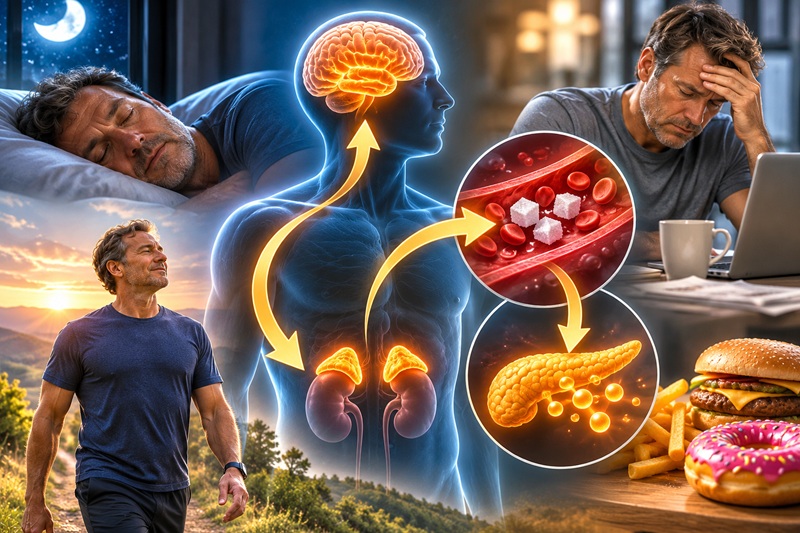
Now, this is where things can become particularly interesting.
Because I've met plenty of people who are making a genuine effort with their food and exercise, yet are constantly tired, stressed and struggling with their appetite.
And sometimes, before I ask them to do more, I want to know how well they're recovering.
FIRST — SLEEP!
Poor or insufficient sleep can influence appetite, food choices, glucose regulation and how we feel during physical activity.
And when we're tired, those convenient, highly palatable foods can become particularly appealing!
But there's another interesting player in all this.
CORTISOL — OUR STRESS-RESPONSE HORMONE!
Cortisol is produced by our adrenal glands and plays an essential role in helping us respond to physical and emotional demands.
It also helps regulate blood glucose, energy availability and our natural sleep–wake cycle.
Normally, cortisol follows a daily rhythm — generally rising towards morning, helping us wake up, and declining towards evening.
Pretty clever!
But when we're regularly sleeping poorly, experiencing prolonged stress or disrupting our natural sleep rhythms, cortisol regulation can become less favourable.
And here's where it gets interesting from a metabolic perspective.
Cortisol can stimulate the liver to release and produce more glucose, helping ensure we have energy available to respond to a challenge.
That's perfectly normal during an appropriate stress response.
However, when cortisol exposure is persistently elevated, it can contribute to reduced insulin sensitivity and higher blood glucose in some people.
And what happens when blood glucose rises?
Well, assuming the pancreas is functioning appropriately, it may need to release additional insulin to help manage that glucose.
EVEN WITHOUT JOHN DRINKING A CAN OF COCA-COLA, HIS BODY'S OWN STRESS RESPONSE CAN INFLUENCE HIS BLOOD GLUCOSE AND INSULIN REQUIREMENTS!
Now, that doesn't mean stress automatically makes John gain body fat.
Nor does every stressful day produce chronically elevated cortisol.
But prolonged stress, disrupted sleep, increased appetite and reduced insulin sensitivity can combine to make managing his body composition more challenging.
And that's why I take sleep seriously!
SO, WHAT WOULD I WANT TO KNOW ABOUT JOHN?
- Is he getting enough sleep?
- Does he wake feeling reasonably refreshed?
- Is his sleep regularly interrupted?
- Is he relying on caffeine and sugary snacks to get through the afternoon?
- Is his sleep routine reasonably consistent?
I'm not looking for a perfect sleep score from a fancy smartwatch.
I'm looking for habits that give his body a reasonable opportunity to recover.
For most adults, that means aiming for approximately seven to nine hours of sleep, recognising individual needs vary.
AND THEN THERE'S EMOTIONAL STRESS!
Work pressure. Family responsibilities. Financial worries. Life!
We all have them.
And our bodies don't always distinguish neatly between the physical and psychological demands placed upon us.
The stress-response system can become activated by both.
But here's something else I've observed repeatedly.
When people are emotionally stretched, their food choices and hunger patterns can change considerably.
Some lose their appetite.
Others find themselves reaching for convenient, energy-dense foods more frequently.
And when poor sleep joins the party, the combination can be particularly unhelpful!
So with John, I might introduce a few simple strategies.
- A regular walk outdoors.
- A little breathing practice.
- Less late-night screen time.
- A more consistent bedtime.
- Some enjoyable activity that helps him switch off.
And perhaps the occasional reminder that he doesn't have to solve every bloody problem in the world before going to sleep!
Cortisol isn't a bad hormone — it's an essential survival hormone.
But when sleep, stress and recovery become chronically unbalanced, our appetite, glucose regulation and insulin sensitivity may be affected.
And that can make managing body composition more difficult.
So before I tell John to eat less and exercise harder, I want to know whether he's giving himself a reasonable opportunity to recover.
If John's exhausted and emotionally stretched, prescribing more exercise and an increasingly restrictive diet might be exactly the wrong approach.
Sometimes, improving sleep and managing stress makes everything else a little easier to sustain!
5. HYDRATION — SIMPLE, BUT WORTH GETTING RIGHT!

Now, this might sound almost too obvious.
Drink enough water!
But hydration is something I routinely discuss when helping people change their dietary habits and activity levels.
Particularly when reducing carbohydrate intake.
Why?
Because when glycogen stores decrease, some of the water associated with that stored glycogen is also lost.
Changes in insulin and sodium handling can contribute to early fluid shifts too.
And this explains why people sometimes experience a surprisingly large drop on the bathroom scales during their first week of a lower-carbohydrate eating plan.
BUT MUCH OF THAT EARLY CHANGE MAY BE WATER — NOT BODY FAT!
It's an important distinction.
I don't want John celebrating three kilograms of supposed fat loss when a substantial portion may simply be fluid.
Nor do I want him dehydrated, feeling ordinary and blaming his new eating plan.
So I'd encourage regular fluid intake, particularly around exercise, hot weather and periods of increased sweating.
Water is usually my preferred everyday drink.
But hydration needs vary with body size, activity, climate, health and medications.
And more isn't always better — excessive water intake can be dangerous too.
Water doesn't magically melt body fat.
But sensible hydration supports normal physiological function, exercise performance and wellbeing.
And replacing sugary drinks with water can remove a surprising amount of unnecessary dietary energy.
That's a win in my book!
6. GLP-1 MEDICATION — YES, I'M A FAN!

Now, here's a subject that certainly gets people talking!
Ozempic. Wegovy. Mounjaro. You've probably heard of them.
And you may also have heard about retatrutide, a newer investigational medicine being studied in clinical trials. Its approval and availability need to be checked at the time of publication.
And after working with approximately 200 clients using GLP-1-based medications, I've become increasingly interested in the role these treatments can play in managing obesity and improving metabolic health.
In my experience, many of these clients have achieved encouraging results.
And yes, I'm a fan — when the medication is clinically appropriate, prescribed and monitored by their treating doctor.
I've placed medication sixth in my educational framework because I want to explain the lifestyle foundations first — not because everybody must complete steps one to five before medication is considered. For some people, earlier medical treatment alongside lifestyle support is entirely appropriate.
WHAT DO THESE MEDICATIONS ACTUALLY DO?
GLP-1 is a hormone involved in appetite regulation and glucose management.
Medications such as semaglutide act on GLP-1 receptors, helping people feel fuller, reducing appetite and supporting glucose regulation.
Tirzepatide acts on both GIP and GLP-1 receptors.
In simple terms, many people find they're less hungry, feel satisfied with smaller meals and aren't constantly thinking about food.
And for someone who has spent years struggling with appetite and weight management, that can be enormously helpful.
SO, WHY NOT JUST GIVE EVERYBODY AN INJECTION?
Because these are medical treatments, not lifestyle accessories.
They aren't appropriate for everyone.
They can cause side effects, including nausea, vomiting, constipation and other gastrointestinal problems, and there are less common but important medical risks that require proper assessment.
They can also be expensive, and weight regain after stopping treatment is common.
And importantly, when someone loses substantial weight, some of that loss may include lean tissue.
Which brings me to something I consider particularly important.
THE DUMBBELL CLAUSE!
I DON'T WANT JOHN SIMPLY BECOMING A SMALLER, WEAKER VERSION OF HIMSELF!
If John and his doctor decide that medication is appropriate, terrific.
But I still want John paying attention to his food quality, adequate protein intake, hydration and resistance training.
I want him reducing unnecessary body fat while preserving as much useful muscle, strength and physical function as possible.
And that's where my role can complement his medical care.
His doctor manages the medication and clinical monitoring.
I help John with appropriate exercise, dietary education, body-composition trends and sustainable lifestyle habits.
I don't see GLP-1-based medications as cheating.
Nor do I see them as a substitute for understanding how to eat, move and look after yourself.
For the right person, under appropriate medical supervision, they can be a valuable addition to a broader health-management plan.
And if medication helps someone achieve improvements they previously found enormously difficult?
Well, I reckon that's worth celebrating!
PAMPY'S POINT!
Six strategies. One individual. And a lifetime of learning.
What works for John won't necessarily be the perfect approach for someone else.
But after 35 years, these are the foundations I've found particularly useful when helping people improve their body composition and metabolic health.
THE BEST PLAN IS ONE THAT WORKS FOR THE PERSON — AND CAN BE SUSTAINED.
And there's one more very important piece of this puzzle.
HUNGER! Because if we're constantly hungry, even the most beautifully designed plan can become a bloody challenge to maintain.
Which brings us to the final section — appetite, hormones and John's real-life results.
THE HUNGER GAME
AND JOHN'S JOURNEY!
Appetite, hormones, the results of real lifestyle changes — and a few final thoughts after 35 years.
SO, THERE YOU HAVE IT — MY SIX-POINT APPROACH!
Nothing particularly revolutionary.
No miracle supplement.
No secret fat-burning exercise.
And certainly no guarantee that everybody will respond in exactly the same way.
Just six areas I've found worth considering when helping someone improve their body composition:
And here's the thing.
I don't necessarily introduce all six at once!
With John, I'd first consider his assessment results, daily routine, preferences, health circumstances and what he's realistically prepared to change.
Then we'd build something that fits.
Because after 35 years, I've learned that the best program isn't necessarily the most scientifically complicated.
IT'S THE ONE THAT DELIVERS MEANINGFUL IMPROVEMENTS — AND THAT SOMEONE CAN ACTUALLY LIVE WITH.
And that brings us back to John.
Let's have a look at where he started, what we decided to change, and what happened next!
THE HUNGER GAME — WHO'S REALLY IN CHARGE OF YOUR APPETITE?

Now, before we get to John's actual results, there's something I reckon deserves a little more attention.
HUNGER!
Because I've spent 35 years watching people attempt to lose body fat, and one thing has become increasingly obvious.
If someone's constantly hungry, thinking about food, battling cravings and feeling deprived, their chances of maintaining a new eating plan can become enormously challenging.
And this is where our hormones, brain and food choices become particularly interesting.
MEET THREE IMPORTANT PLAYERS!
EXPLORE THE THREE HORMONES BELOW. OPENING ANOTHER WILL CLOSE THE PREVIOUS ONE.
GHRELIN — THE HUNGER MESSENGER!
Ghrelin is a hormone produced mainly in the stomach.
Its levels often rise before meals, helping signal hunger to the brain.
And here's something fascinating.
Our bodies can learn when to expect food!
If John has eaten breakfast at 7 am for the past 30 years, he might initially feel hungry at precisely that time when we experiment with delaying his first meal.
But hunger isn't necessarily a continuous, steadily increasing sensation.
It can come in waves, influenced by habits, meal timing, sleep and other signals.
And over time, some people find their appetite adjusts to a different eating routine.
LEPTIN — THE LONG-TERM ENERGY MESSENGER!
Leptin is produced mainly by our fat cells.
It helps communicate information about stored energy to the brain.
Generally, the more body fat someone carries, the higher their circulating leptin levels.
But here's the interesting bit.
People carrying excess body fat can also have reduced sensitivity to leptin's signals.
So despite having plenty of stored energy, their appetite-regulating system may not respond as effectively as we'd hope.
And when John loses body fat, his leptin levels will generally fall.
That's normal — but it can also contribute to increased hunger and the body's tendency to defend its previous weight.
INSULIN — THE FUEL-MANAGEMENT HORMONE!
We've already met insulin.
It's essential for managing blood glucose and helping regulate energy storage and use.
It also communicates with the brain and participates in longer-term appetite regulation.
But insulin isn't simply an on/off switch for hunger or fat storage.
And an insulin rise after eating doesn't automatically mean John will become hungry again an hour later.
What interests me more is how John's overall eating pattern affects his glucose regulation, satisfaction, appetite and total energy intake.
SO, HOW DO MY SIX STRATEGIES INFLUENCE JOHN'S HUNGER?
We've discussed the hormones. Now let's bring this back to something practical.
How might the six strategies we've already discussed help John manage his appetite?
SELECT A STRATEGY TO EXPLORE IT.
1. LOWER-CARB, HIGH-FIBRE, SATISFYING FOOD
This is often where I see the biggest practical change.
Replace sugary drinks, refined snacks and highly processed foods with nutritious, fibre-rich meals containing adequate protein and appropriate healthy fats.
And John may find himself feeling satisfied for longer.
Why?
Because protein, fibre, food volume and dietary fat can influence digestion, fullness and gut-derived appetite signals.
The result?
Potentially fewer cravings, less grazing and less interest in the biscuit tin!
Not everyone responds identically, but this is something I've repeatedly observed in practice.
2. MY 17:7 EATING WINDOW
Initially, John might feel hungry at his usual breakfast time.
Fair enough!
His body has become accustomed to eating then.
But some people find that after adjusting to a consistent eating window, those familiar morning hunger signals become less troublesome.
And by removing late-night grazing and unnecessary snacking, they may find themselves eating less without deliberately counting every calorie.
Importantly, this doesn't happen for everybody.
If fasting leaves John ravenous, irritable or overeating later, we modify the approach.
3. EASY AEROBIC ACTIVITY & RESISTANCE TRAINING
Now, this is interesting.
Exercise influences appetite differently depending on the individual, intensity, duration and recovery.
Some people experience a temporary reduction in hunger following exercise.
Others become hungrier later.
And while easy aerobic activity doesn't guarantee appetite suppression, I've found that regular, manageable movement can help people establish a healthier daily routine.
Resistance training is particularly important for maintaining muscle during fat loss.
Because the aim isn't simply to burn more calories.
It's to create a healthier, stronger body that John can maintain.
4. SLEEP & STRESS MANAGEMENT
Ever noticed how a poor night's sleep can leave you craving something sweet the following afternoon?
I certainly have!
Insufficient sleep can influence hunger, food reward and appetite-regulating hormones, although the exact ghrelin and leptin responses vary between studies.
And emotional stress can make highly palatable food particularly appealing.
So when John improves his sleep and manages stress more effectively, he may find his appetite and food choices become easier to manage.
Not because we've magically switched off hunger.
But because we're reducing some of the influences that make managing it more difficult.
5. HYDRATION
Now, water isn't an appetite-suppressing miracle.
And I certainly don't want John trying to drown his hunger!
But adequate hydration supports normal function, and replacing sugary drinks with water can substantially reduce unnecessary energy intake.
Sometimes, the simplest changes are the most useful.
6. GLP-1 MEDICATION
And here's where things become particularly interesting.
GLP-1-based medications can influence appetite and fullness through effects on the brain and gastrointestinal system.
Many people report feeling satisfied with smaller meals, experiencing fewer cravings and thinking about food less frequently.
That reduction in persistent food-related thoughts — sometimes called food noise — can be enormously meaningful.
And it's something I've heard repeatedly from clients using these medications.
But these effects aren't identical for everybody, and medication must remain under appropriate medical supervision.
I DON'T WANT JOHN SPENDING THE REST OF HIS LIFE FIGHTING HUNGER!
Hunger isn't a character flaw. It's a powerful biological signal. My aim isn't to teach people to ignore it — it's to help them understand and manage it.
I want him developing a way of eating and living that helps him feel comfortably satisfied while improving his body composition.
Because in my experience, when appetite becomes more manageable, the entire process often becomes more sustainable.
Not because we've discovered a miracle fat-burning switch.
But because John's no longer relying entirely on willpower to manage every meal.
AND FINALLY — MEET JOHN. THE RESULTS SPEAK FOR THEMSELVES!
Well, we've covered quite a bit of ground!
Insulin, genetics, hunger, body-fat storage, metabolic assessments and the six strategies I've found most useful over my 35 years working in health and wellness.
But enough of my blabbing!
Let's look at what can happen when someone decides to make meaningful, sustainable changes.
Meet my mate, John.
Over the past three years, I've had the pleasure of working with John as he's progressively transformed his body composition, physical health and daily habits.
And what a transformation!
Not through some ridiculous starvation diet.
Not through punishing exercise sessions.
And certainly not through a magical fat-burning supplement!
Rather, John has worked consistently towards improving his food choices, managing his appetite, becoming more active and developing habits that fit his life.
And we've been able to monitor his progress along the way.
JOHN'S TRANSFORMATION — BY THE NUMBERS!
Here are some of the changes we've measured between February 2023 and October 2026.
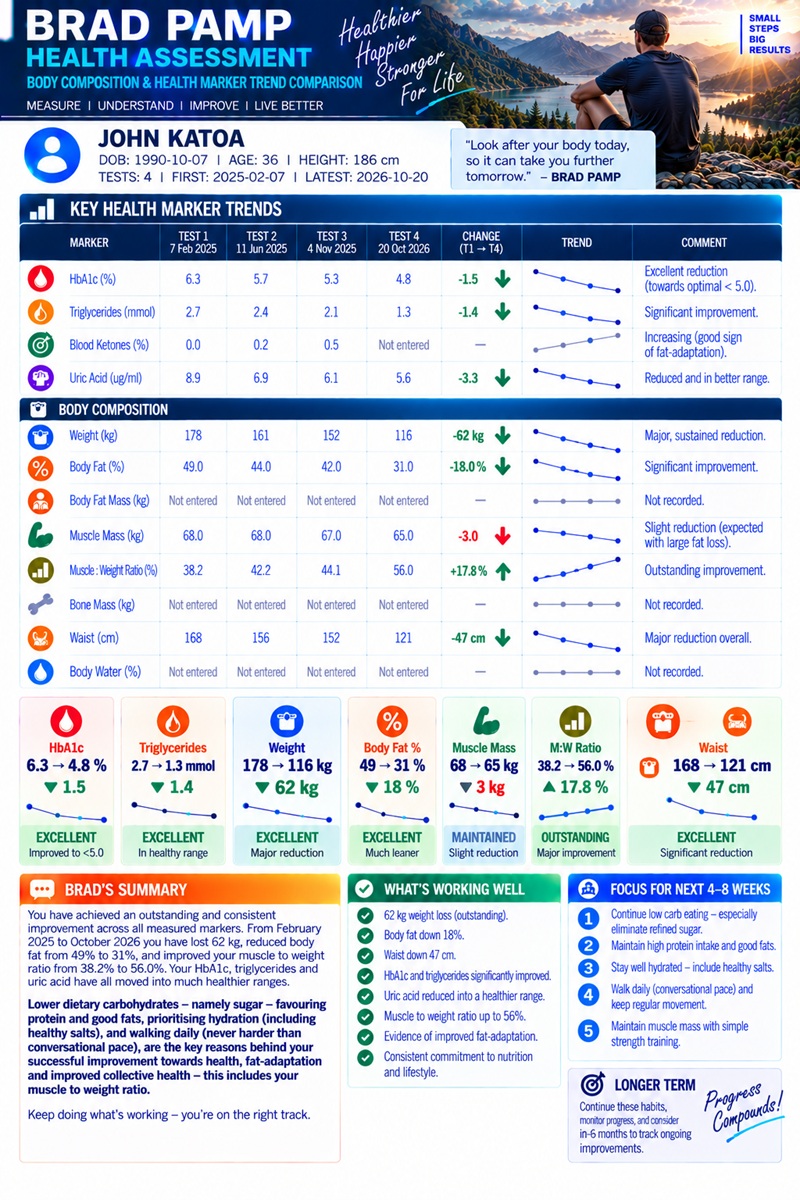
That's 62 kilograms of body weight gone, 47 centimetres off his waist, and some terrific improvements in his measured metabolic health markers.
And while his estimated muscle mass has reduced slightly, his muscle-to-weight ratio has improved substantially.
Of course, body-composition measurements have limitations, and we shouldn't mistake every kilogram lost for pure body fat.
But when we consider John's waist reduction, body-fat percentage, blood markers and progressive photographs together, the overall picture is enormously encouraging.
AND WHAT ABOUT JOHN'S ACTUAL APPROACH?
John initially embraced the first five principles I've discussed — improving his food choices, meal timing, physical activity, sleep and hydration.
And over his first six months, he lost an extraordinary 40 kilograms.
Subsequently, under his doctor's direction, John introduced Wegovy, alongside his ongoing lifestyle changes, and progressively lost a further 22 kilograms.
Lifestyle strategies 1–5.
Lifestyle habits plus doctor-prescribed Wegovy.
LIFESTYLE STRATEGIES AND MEDICALLY PRESCRIBED TREATMENTS NEEDN'T BE COMPETING APPROACHES. THEY CAN COMPLEMENT ONE ANOTHER.
And importantly, the habits John developed remain relevant to maintaining his results over the longer term.
AND HERE'S THE BIT I PARTICULARLY LIKE...
This wasn't a six-week transformation challenge.
It wasn't a race to reach a particular number on the bathroom scales.
And it certainly wasn't about becoming the leanest bloke in the room.
It was about John progressively changing his habits, improving his health and finding something he could sustain.
Have a look at his photographs.
They tell a terrific story of consistent effort over time.
And while I'm enormously pleased with his measured results, I'm even more impressed by the commitment he's shown towards looking after himself.
JOHN, MATE — BLOODY WELL DONE!
IMPORTANT CONTEXT: John's experience is his own. These are his individual results, not a promise that everyone following a similar approach will experience the same changes.
AND WHAT IF YOU'D LIKE A LITTLE HELP YOURSELF?
Now, before I wrap up, something a little more personal.
If you've read this far and thought, "Gee, I'd actually appreciate some private guidance with my own body composition or metabolic health," you're very welcome to make contact.
But here's the thing.
If I were in your shoes, and somebody suggested I contact this Brad Pamp bloke to discuss my body fat, would I feel entirely comfortable picking up the phone?
Nuh!
Probably not, to be fair!
And I genuinely understand that.
Body weight, body shape, eating habits and personal health can be sensitive subjects.
Nobody particularly enjoys feeling judged, embarrassed or being told everything they're doing wrong.
And the last thing I'd want is for someone to feel uncomfortable about seeking a little help.
You don't need to be fit, have your eating sorted, or even know exactly what you'd like to change before getting in touch.
So, perhaps all I can offer is this.
I've been working in health, exercise and nutrition for 35 years, and during that time I've had the privilege of helping well over a thousand people with their health and lifestyle goals.
People of different ages, backgrounds and fitness levels. People starting from all sorts of different circumstances.
And one thing I've learned is that everybody has their own story.
I don't believe in judgement, lectures or handing everybody the same diet and exercise prescription.
I enjoy listening, understanding someone's circumstances, explaining what their health measurements might be telling us, and helping them find practical changes that fit their life.
Sometimes that's about reducing excess body fat where it presents a health concern.
Sometimes it's improving fitness, strength, sleep or metabolic health.
And sometimes it's simply helping someone feel a little more comfortable and confident about looking after themselves.
My consultations are private and confidential, and there's certainly no obligation to embark on a program.
Just a conversation, some useful education and, if appropriate, a little guidance towards a healthier way forward.
And if you'd rather simply take something useful from this article and put it into practice yourself?
Well, that's terrific too!
Because ultimately, that's why I enjoy writing these Pampy's Posts.
Keep moving. Keep learning. And look after yourself.
Cheers,
BP