
We spend enormous time discussing body weight, body fat, cholesterol, blood sugar, blood pressure and cardiovascular fitness.
Yet one of the most important predictors of long-term health, function, resilience and quality of life is often ignored.
Not vanity muscle.
Not bodybuilding muscle.
Functional, healthy, protective muscle tissue.
From my perspective, preserving muscle mass is one of the most important health priorities at ANY age — but particularly after 40 years of age.
Because once muscle mass begins to decline significantly, almost every major system in the body begins to suffer.
WHY MUSCLE MASS MATTERS
1. Muscle is Your Metabolic Engine
Muscle tissue is highly metabolically active.
The more quality muscle tissue you carry:
- the better your body regulates blood glucose
- the better your insulin sensitivity
- the better your metabolic flexibility
- the easier it is to maintain healthy body composition
- the easier it is to manage appetite and energy balance
Low muscle mass is strongly associated with:
- insulin resistance
- type 2 diabetes
- metabolic syndrome
- obesity
- fatigue
- poor energy regulation
In simple terms: muscle acts like a giant sponge for blood glucose.
Lose muscle, and the body becomes progressively worse at handling energy.
2. Muscle Protects You Against Aging
One of the biggest reasons older adults lose independence is not necessarily disease.
It is weakness.
Reduced muscle mass and strength contribute to:
- falls
- fractures
- slower reaction time
- poor balance
- inability to recover from illness
- reduced walking speed
- loss of mobility
- loss of independence
Muscle preservation is strongly linked with:
- healthier aging
- longer independent living
- reduced frailty
- better recovery from surgery and illness
- lower mortality risk
They are survival goals.
3. Muscle Supports Hormonal Health
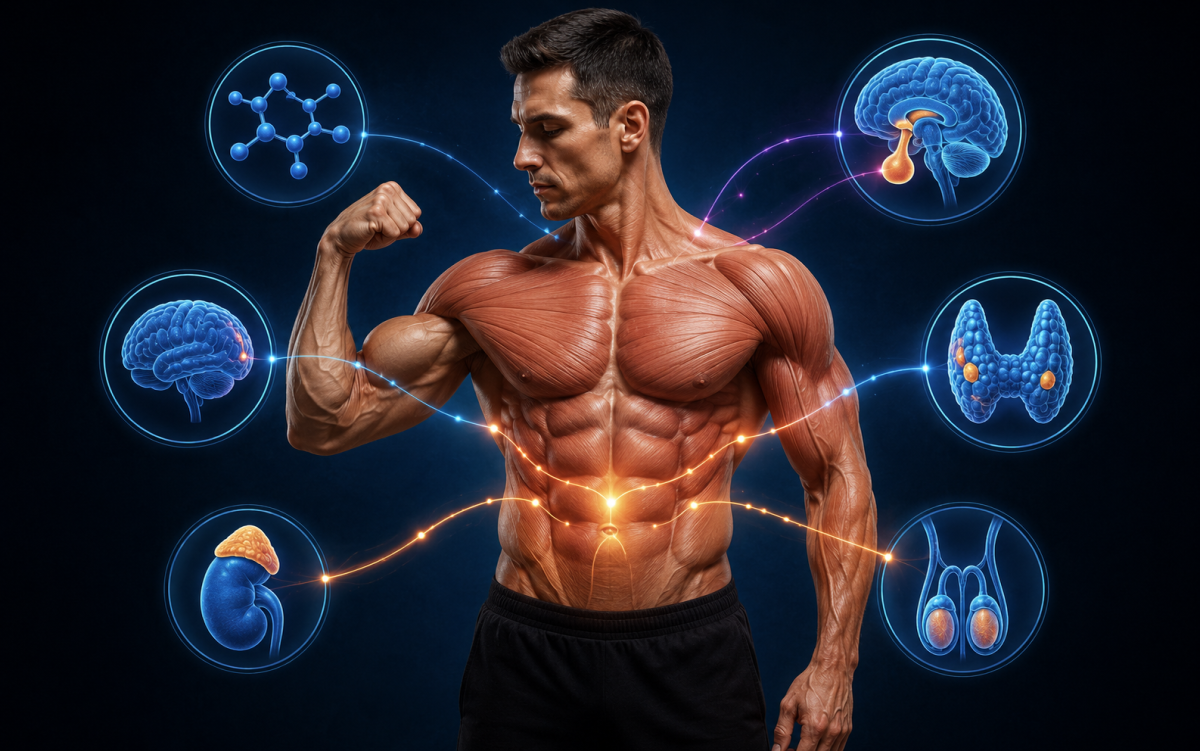
Healthy muscle tissue plays a major role in hormonal regulation.
Resistance training and muscle preservation support:
- testosterone balance
- growth hormone release
- insulin sensitivity
- metabolic hormone function
- healthier cortisol regulation
As muscle mass declines:
- metabolic rate often slows
- recovery worsens
- energy levels drop
- hormonal resilience weakens
This becomes particularly important during:
- middle age
- menopause
- andropause
- periods of chronic stress
- inactivity
- illness recovery
4. Muscle Supports Bone Density & Skeletal Health
Muscle and bone work together.
Strong muscles place healthy stress through the skeletal system, helping preserve:
- bone density
- tendon strength
- ligament integrity
- joint stability
Without regular muscular loading:
- bones weaken
- posture declines
- joints stiffen
- connective tissue deteriorates
This is one reason sedentary lifestyles age people rapidly.
The body adapts to inactivity.
Unfortunately, not in a good way.
5. Muscle Supports the Immune System
This is a point many people never consider.
Muscle tissue acts as a reserve tank during illness, stress, injury and recovery.
When people become severely unwell, hospitalised or inactive: the body often breaks down muscle tissue rapidly.
Those with greater muscle reserves typically:
- tolerate illness better
- recover faster
- maintain function longer
- cope better with stress and inflammation
Low muscle mass is increasingly linked to:
- poorer immune resilience
- higher inflammatory burden
- poorer outcomes during illness
Muscle is not just movement tissue.
It is protective tissue.
6. Muscle Supports Psychological Health
This matters enormously.
People with better strength and muscle function often report:
- greater confidence
- improved mood
- better stress management
- higher motivation
- improved self-image
- improved resilience
Loss of muscle mass often parallels:
- reduced confidence
- lower movement tolerance
- fear of aging
- fear of injury
- social withdrawal
- declining physical identity
Movement capability changes mindset.
Strength changes mindset.
Capability builds confidence.
WHAT CAUSES MUSCLE LOSS?

Many people think muscle loss is simply “old age”.
That is only partially true.
The real issue is often accumulated disuse.
1. Sedentary Lifestyle
The human body is designed to move, lift, climb, carry and resist force.
Modern life removes almost all of this.
Too much:
- sitting
- driving
- screen time
- office work
- passive living
creates rapid muscular decline.
If muscles are not challenged, the body sees no reason to preserve them.
2. Lack of Resistance Exercise
Walking is excellent for health.
But walking alone is often insufficient to preserve meaningful muscle mass long-term.
Muscles need:
- tension
- loading
- resistance
- mechanical challenge
Without resistance: the body progressively sheds muscle tissue.
This becomes increasingly accelerated after 40–50 years of age.
3. Poor Protein Intake
Muscle tissue is built from amino acids.
Many people — particularly aging adults — simply do not consume enough quality protein.
Low protein intake can impair:
- muscle repair
- recovery
- strength maintenance
- immune function
- hormone production
Quality protein sources may include:
- eggs
- fish
- lean meats
- dairy
- whey protein
- legumes
- high-protein whole foods
As we age, protein becomes MORE important, not less.
4. Chronic Dieting & Under-Eating
Repeated calorie restriction can contribute to muscle loss.
Many people unintentionally lose muscle while trying to lose body fat.
Extreme dieting, low-protein dieting and under-fuelling can:
- lower metabolic rate
- reduce strength
- impair recovery
- accelerate sarcopenia (age-related muscle loss)
5. Inactivity Through Injury, Illness or Stress
Muscle declines rapidly during:
- injury
- hospitalisation
- illness
- burnout
- chronic stress
- poor sleep
This is why maintaining movement during stressful life periods is so important.
Even small amounts of resistance work can help preserve muscle tissue.
6. GLP-1 Medication
While GLP-1 medication can be a life-changer for some people, a key downside based on emerging data is the possible loss in muscle mass alongside body fat reduction.
This is particularly relevant if:
- protein intake is inadequate
- resistance exercise is absent
- rapid weight loss occurs
- overall calorie intake becomes too low
Some users can lose significant lean muscle tissue during aggressive weight reduction phases.
Importantly: this loss can often be reduced or countered through:
- appropriate resistance training
- adequate protein intake
- structured movement
- ongoing muscle mass monitoring
HOW SHOULD YOU TEST MUSCLE MASS?
Option 1 — DEXA Scan
A DEXA scan is one of the gold-standard methods for assessing:
- lean muscle mass
- body fat
- bone density
It is:
- non-invasive
- quick (often ~5 minutes)
- painless
- highly accurate
Typical cost: around $150–$200.
DEXA provides an excellent baseline assessment.
Option 2 — Commercial Bioimpedance Testing

High-end commercial bioimpedance systems can also provide excellent trend tracking.
Importantly: I am NOT referring to cheap home bathroom scales.
Most home units are highly inconsistent and often inaccurate.
However, reputable commercial-grade bioimpedance systems can provide valuable information regarding:
- muscle mass trends
- hydration
- body composition
- metabolic tracking
The key is consistency and trend monitoring over time.
Brad Pamp can provide this non-invasive on-site testing and ongoing muscle mass trend tracking.
HOW TO PRESERVE MUSCLE MASS
1. Resistance Exercise
This is the cornerstone.
Muscle must be challenged regularly.
This does NOT mean bodybuilding.
Simple resistance strategies may include:
- bodyweight exercises
- resistance bands
- dumbbells
- machine weights
- hill walking
- loaded carries
- structured strength training
The goal: regular muscular tension.
At any age.
2. Prioritise Protein & Whole Food Nutrition
Protein should become a deliberate priority with aging.
A practical approach:
- protein first
- plenty of vegetables
- healthy fats
- adequate hydration
- minimise ultra-processed foods
Muscle preservation requires:
- amino acids
- energy
- recovery nutrients
You cannot build or maintain tissue from poor-quality fuel.
3. Stay Physically Active Daily
The body adapts to movement.
And it adapts to inactivity.
Daily movement matters enormously:
- walking
- gardening
- climbing stairs
- carrying loads
- mobility work
- recreational activity
Movement is biological signalling.
The body responds to what you repeatedly ask it to do.
4. Medical Intervention (When Appropriate)
In some circumstances, medical support may be appropriate.
This may include:
- hormone investigation
- nutritional intervention
- supervised supplementation
- clinical review of metabolic health
- treatment of underlying disease processes
In more advanced cases, medically supervised therapies may assist muscle preservation.
However: these should support — not replace — movement, resistance training and nutrition.
FINAL THOUGHT
Muscle mass is not just about appearance.
It is deeply connected to:
- metabolic health
- aging quality
- resilience
- strength
- immune function
- independence
- confidence
- survival
The older we get, the more valuable muscle becomes.
If you want to age well:
preserve your muscle.
Protect it.
Train it.
Feed it.
Challenge it.