
WHEN YOU CAN'T
HIT A MILLION BALLS!
Seven golf-specific exercises to build strength, stability and a better swing.
YOU DON'T HAVE TO HIT A MILLION BALLS TO IMPROVE YOUR GOLF!
As an exercise physiologist and keen golfer who simply doesn't have the time to hit a million balls, I've been giving some thought to another way of improving my golf.
I've chatted with a handful of golf professionals, spent some time surfing the net to see what the likes of Scottie Scheffler and Rory McIlroy do away from the course, and drawn on my own 35-plus years working in exercise physiology.
And then I asked myself a simple question.
What would best suit an average, ageing golfer like me, who still wants to strike the ball well, but doesn't have endless hours to practise?
The answer? Train the body that swings the club!
You see, the golf swing, from tee to green, is a wonderfully coordinated, controlled, yet highly dynamic rotational movement.
It's not simply a matter of swinging your arms at a little white ball.
Your trunk, hips, pelvis and surrounding musculature must work together to create, transfer and control rotational force.
And the stronger, more stable and better coordinated these regions become, the greater your potential to produce a repeatable, controlled and powerful golf swing.
Of course, this doesn't replace actually hitting golf balls. You still need to practise the skill.
But it does give you another way of improving the physical machinery responsible for delivering the club to the ball.
And here's the beauty of it. You can do much of this at home, in the gym or, with a little creativity, even in the office!
THE PROS DON'T JUST HIT BALLS. THEY TRAIN!
Watch the world's best golfers and you'll quickly appreciate that their physical preparation extends well beyond the driving range.
Strength, mobility, balance, rotational control and stability are all part of the equation.
Yes, the arms and shoulders play important roles, but much of the power and control in a golf swing is generated and transferred through the lower body and trunk.
Think of your core as the connection between the ground and the golf club.
If that connection is weak, unstable or poorly coordinated, producing and transferring force efficiently becomes more difficult.
And while we're not all blessed with Rory's swing or Scottie's ball-striking ability, we can certainly train many of the physical qualities that support them.
SEVEN EXERCISES. ONE PURPOSE.
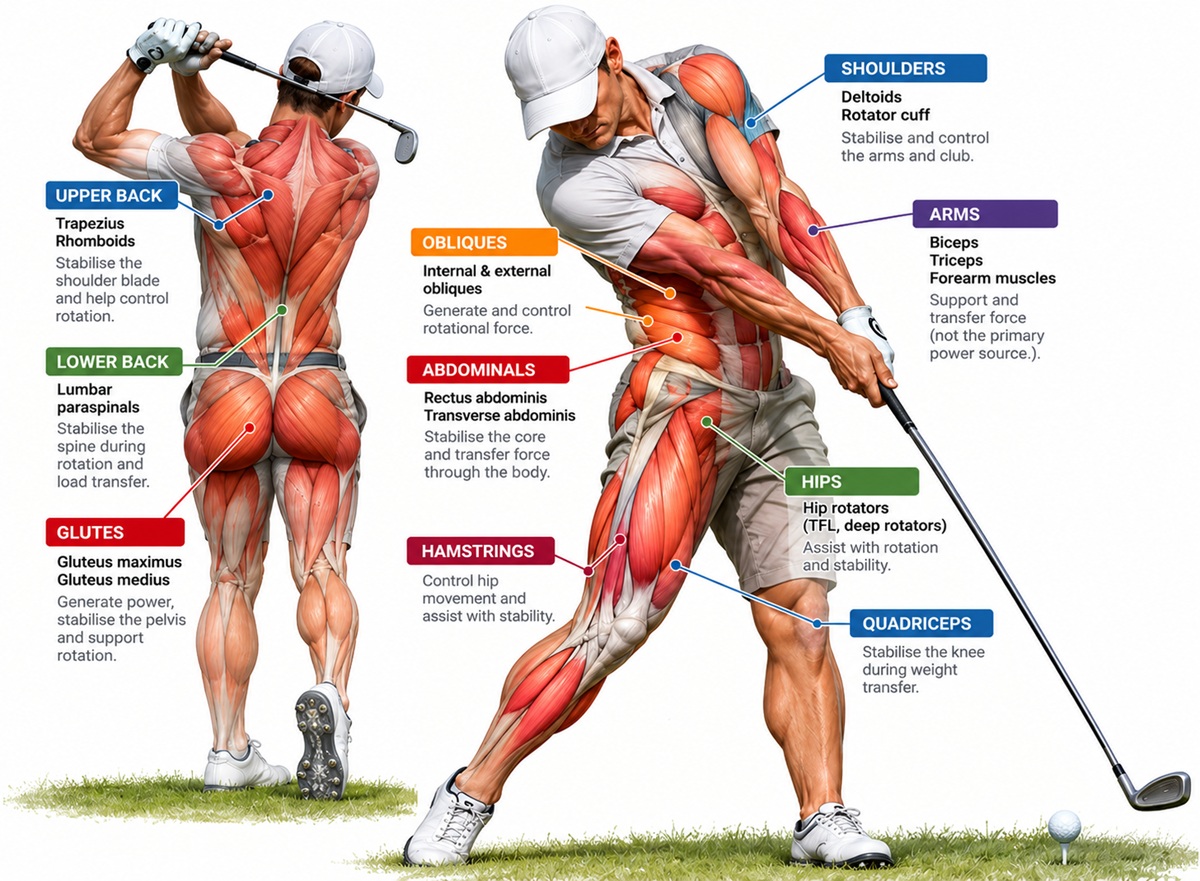
I've put together seven golf-specific strengthening and stabilising exercises that I'm currently integrating into my own week.
Some are relatively straightforward. Others are a tad more challenging, particularly when you begin adding resistance while balancing or rotating.
All seven focus on developing some combination of:
The key muscle groups include your abdominals, internal and external obliques, spinal stabilisers, glutes and hip musculature.
I've included a demonstration of each exercise, the principal muscles involved, its degree of difficulty, my suggested starting resistance and a simple sets-and-repetitions protocol.
One important note: I'm a right-handed golfer, so my demonstrations reflect that. Lefties, simply reverse the relevant positions and directions.
And remember, we're training the body to support a better golf swing, not trying to reproduce a full-speed swing against enormous resistance!
HOW TO TRAIN — A LITTLE PATIENCE, PLEASE!
If you've never performed these movements before, expect a few things.
Firstly, some will feel a tad awkward.
You might wobble. You might struggle to find your balance. You might even feel a little inept!
That's perfectly normal.
Secondly, setting up your equipment and moving between exercises might take a session or two before you find your rhythm.
And thirdly, you may experience a little muscular soreness, particularly around your trunk and hips, as you introduce unfamiliar movements.
Mild soreness can be a normal response to new exercise. But it's certainly not the objective, nor is it proof of a better session.
We're chasing improved strength, stability and control — not soreness!
My suggestion is to begin conservatively.
Use lighter resistance, move slowly enough to maintain control and allow your body to become familiar with the movements before increasing the load.
Don't be surprised if you find yourself improving quite quickly, particularly with balance and coordination.
Over time, the movements should feel more natural, the session should flow more efficiently and your ability to control rotation under resistance should improve.
Will that automatically have you striking every ball down the middle?
Of course not!
But building a stronger, more stable and better coordinated body gives you a better physical foundation from which to swing.
Be patient! And yes, I'm particularly talking to the blokes who think every exercise needs to be performed with the heaviest weight available!
THE SEVEN GOLF EXERCISES
Each exercise includes a demonstration, muscles involved, starting protocol and my own coaching observations.
SO, HOW OFTEN SHOULD YOU TRAIN?
My suggestion?
Start with two sessions per week, preferably with a day or two between them.
You don't necessarily need to perform all seven exercises in your first session. Begin with three or four that feel comfortable, then gradually introduce the more challenging movements.
Once you're familiar with the exercises and can maintain good form, work towards completing the full routine.
And remember, this isn't a race.
A controlled six repetitions performed beautifully will achieve far more than twelve performed with poor balance and questionable technique.
If you have an existing back, hip, shoulder or other musculoskeletal problem, some movements may need to be modified or avoided. Loaded rotation isn't suitable for everyone.
FINALLY, FROM ONE GOLFER TO ANOTHER...
I'm not suggesting these seven exercises will suddenly turn us into Scottie Scheffler or Rory McIlroy.
If only!
Golf remains a game of skill, timing, technique, touch and, occasionally, a fair amount of luck.
But I do believe there's considerable value in improving the strength, stability and coordination of the body responsible for swinging the club.
Particularly as we get a little older.
And particularly when we don't have the luxury of spending endless hours on the driving range.
So, while I may not have time to hit a million balls, I can certainly find a little time during my week to strengthen and stabilise the machinery that hits them.
Stronger trunk. Better stability. More controlled rotation.
And hopefully, a few more golf balls finding the middle of the clubface!
Now, if only I could do something about that bloody putting!
Pampy
YOUR SEVEN-EXERCISE SESSION
Watch the demonstration. Read the protocol. Perform the movement with control.
Start with 3–4 exercises if you're new to the routine.
CONTROL FIRST. LOAD SECOND. We're strengthening the machinery that swings the club!
TRAIN SMART. SWING BETTER.
Two sessions per week. Start light. Build gradually. Let the quality of your movement guide your progress.
And remember — you still need to hit a few golf balls!