
IS YOUR
“BETTER” BEER
ACTUALLY BETTER?
Your gut may not have received the memo.
I've been hearing something repeatedly from blokes lately.
And when I hear the same story often enough, I become interested.
These Aren't Anti-Beer Blokes
Quite the opposite.
They enjoy a beer.
But, increasingly health-conscious in their 40s and 50s, they've made what appears to be a pretty sensible swap.
Normal beer → low-carb beer.
Or:
Full-strength beer → mid-strength, half-strength or zero-alcohol beer.
On Paper, It Sounds Like A Win.
Alcohol
Calories
Carbohydrate
Choice?
Except I'm hearing another part of the story.
“Pampy, those bloody beers give me wind.”
The Story I'm Hearing
Occasionally diarrhoea or changes in bowel habits.
And I've now heard versions of this from enough men that it's worth discussing.
So I went digging.
Firstly — I need to correct
one assumption.
I Initially Suspected...
These newer beers were simply loaded with additives to make an artificially manufactured beer taste like normal beer.
That's not entirely fair.
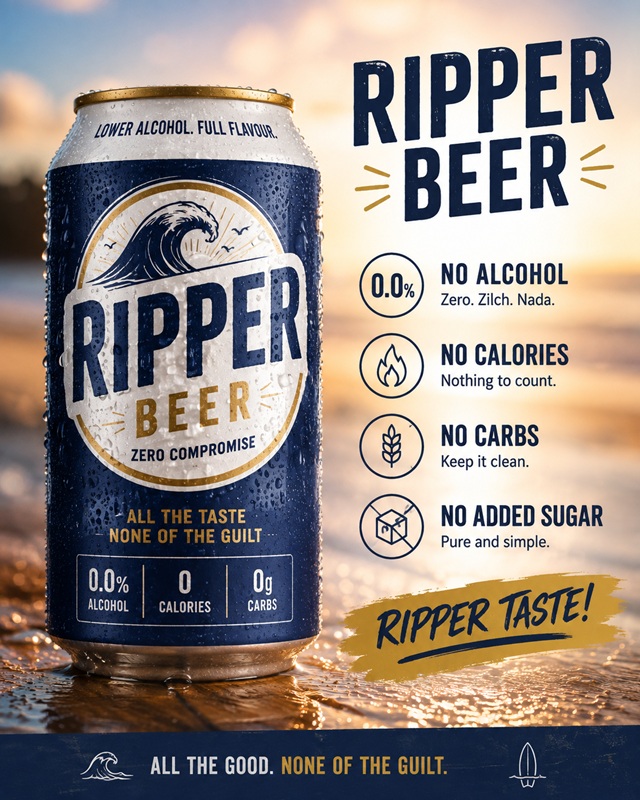
Take Better Beer Zero Carb.
Its published ingredients are beautifully simple:
That's beer.
So Let's Be Fair
I'm certainly not going to accuse Better Beer — or every low-carb brewer — of filling its cans with artificial rubbish when the evidence doesn't support it.
But modern brewing has become clever.
Very clever.
And there is considerably more food technology involved in producing some low-carb, low-alcohol and alcohol-free beers than most blokes standing at the bottle-shop fridge would ever realise.
How Do You Make Beer Without The Carbs?
Traditional lager is remarkably simple.
Change that equation and you can change the finished beer.
Modern brewing can use specific enzymes to drive more complete carbohydrate breakdown and fermentation.
FSANZ has specifically approved enzymes such as alpha-glucosidase for use in brewing, including the production of low-alcohol and lower-carbohydrate beer.
And here's something consumers probably don't realise:
Processing aids don't necessarily have to appear on the ingredient label of the finished product.
That Doesn't Mean They're Dangerous
FSANZ has assessed these products for safety.
It simply means:
“Four ingredients on the front” doesn't necessarily describe every technological step involved in making the beer.
Other Brewing Tools
Acidity regulators such as citric and lactic acid can also legally be used in beer to manipulate pH and flavour.
Again — permitted, assessed and not inherently sinister.
But modern beer production certainly isn't always just Grandpa throwing barley, hops, water and yeast into a vat.
Then there's
0.0 beer.
This Is Where Things Become Interesting
Making beer and then taking the alcohol away changes flavour.
Alcohol contributes body, mouthfeel, aroma and the way flavour compounds are perceived.
So manufacturers need to recreate some of that experience.
Heineken explains its process quite openly.
Heineken 0.0 is brewed, the alcohol is removed using vacuum distillation, and the product is then blended with natural flavourings to restore its characteristic flavour profile.
It also retains some malt sugars that would normally have been fermented into alcohol.
That's not necessarily unhealthy.
But physiologically it isn't exactly the same drink as traditional lager either.
Now here's something that
really caught my eye.

Dietary Fibre — In Beer?
Some of the low-carb beers I've looked at contain a surprisingly meaningful amount of dietary fibre.
Better Beer Middy, for example, lists:
per 355 mL can
across six cans
Their Halfy lists the same.
That's interesting.
One Beer?
No drama for most people.
But let's talk about how Australian blokes actually drink beer.
Six cans.
Now we're potentially looking at:
30 grams of dietary fibre + more than two litres of carbonated fluid.
What Could Happen?
If components of that fibre reach the large bowel and become fermented by gut bacteria, what happens?
Gas.
That's what fermentation does.
Add a couple of litres of carbonation and suddenly...
“These beers make me fart all night”
doesn't sound quite so mysterious.
Important: We're Asking A Question, Not Claiming Proof
I'm not saying we've proven that's what's happening.
We haven't.
And the manufacturer doesn't specify the source or fermentability of that fibre on the nutritional information I've seen.
But it certainly gives us a biologically plausible question worth asking.
Don't Confuse Gas With An “Inflamed Gut”
This distinction matters.
Feeling uncomfortable after six beers doesn't prove you've developed inflammatory bowel disease.
There is surprisingly little human evidence showing that alcohol-free beer itself damages the gut microbiome.
In fact, one small controlled study had healthy men drink either 330 mL of alcoholic or non-alcoholic beer every day for four weeks.
Both groups actually experienced an increase in gut bacterial diversity.
So I'm not prepared to write:
“ZERO BEER DESTROYS YOUR MICROBIOME.”
The Evidence Simply Isn't There
What I am prepared to say is:
If a particular drink repeatedly makes your gut feel lousy, pay attention.
Your individual response matters.
And Don't Forget The Big Elephant Sitting At The Bar
Alcohol.
We can spend all day debating carbs, calories, enzymes, flavourings and brewing technology.
But excessive alcohol itself has considerably stronger evidence for negatively affecting the gastrointestinal system.
So I'm certainly not arguing:
“Normal beer is healthy — drink up.”
It's not.
My argument is different.
The
“health halo”
worries me.
Put This On A Can...
...and something interesting can happen psychologically.
The drink earns itself a health halo.
And once something feels healthier, we sometimes give ourselves permission to consume more of it.
This is where the maths becomes inconvenient.
Zero Carb Doesn't Mean Zero Alcohol
A 355 mL Better Beer Zero Carb is still approximately 4.2% alcohol and around 1.2 standard drinks.
Zero carbohydrate hasn't changed that calculation.
Australian Guidelines
Australia's current alcohol guidelines recommend healthy adults consume no more than:
per week
on any one day
The Important Bit
And the most important sentence in those guidelines is probably the shortest:
The less you drink, the lower your risk.
So here's
my position.
If You Genuinely Enjoy A Normal Lager...
...and you digest it perfectly well...
...I would rather see you become excellent at drinking less of it than convince yourself you've found a metabolic loophole allowing you to drink unlimited quantities of something carrying a “low-carb” badge.
Ones you genuinely enjoy.
Preferably with food.
That's the important bit.
That's Very Different...
...to smashing six, eight or ten “better” beers because they only have X calories or virtually no carbohydrates.
The number still matters.
The volume still matters.
And the alcohol still matters.
What About Alcohol-Free?
If alcohol-free beer helps you replace alcoholic drinks altogether?
Fantastic.
That's a legitimate use of the product.
Lower alcohol exposure is a substantial benefit.
But again:
0.0 doesn't mean unlimited.
Particularly if six of them leave your abdomen looking like
you're carrying a beach ball.
Try The Pampy Beer Experiment
If you've noticed wind, bloating or gut discomfort since changing beers, don't guess.
Run your own little experiment.
Stop It
For a couple of weeks, stop the beer that's causing the symptoms. See what happens.
Trial It
On another occasion, trial one or two. Not six. Observe your gut.
Compare It
Compare against one or two traditional beers you previously tolerated. Same food. Similar timing.
You're performing your own crude little N=1 experiment.
Listen To The Result
If Beer A repeatedly leaves you comfortable and Beer B repeatedly turns the bedroom into a biohazard...
I probably don't require a double-blinded clinical trial to tell you which one agrees with you.
Perhaps “better”
is actually this.
Maybe We've Overcomplicated Beer.
Maybe the healthier drinking strategy isn't necessarily inventing increasingly clever beer.
Maybe it's rediscovering something much simpler.
No brewer has yet invented the magical product that allows us to consume endlessly without eventually paying some sort of physiological tax.
That's usually how health works.
YOU STILL DON'T GET IT FOR FREE.
Pampy
Further Reading / Sources
Better Beer nutritional information and ingredients — Better Beer Australia
Brewing processing aids and alpha-glucosidase — Food Standards Australia New Zealand
Australian alcohol guidelines — National Health and Medical Research Council
Beer and gut microbiota study — PubMed