

Metabolic Balance & Weight Management
One-on-One with Brad Pamp
After more than 35 years working full-time in the health, exercise and nutrition industry, one thing has become incredibly clear to me:
Maintaining a healthy weight and balanced metabolism is becoming increasingly difficult for many people living in the modern Western world.
And this isn’t because people are lazy.
Despite more gyms, more exercise promotion, more health influencers and more dietary advice than ever before, obesity and metabolic illness continue to rise dramatically across the Western world.
Modern lifestyles are now heavily surrounded by industrialised, highly processed and aggressively marketed foods engineered to be convenient, cheap, hyper-palatable and difficult to resist.
For many people, particularly those genetically more carbohydrate intolerant, this environment can make maintaining a healthy body weight feel almost impossible.
And importantly — I understand that.
The Two Fuel Systems
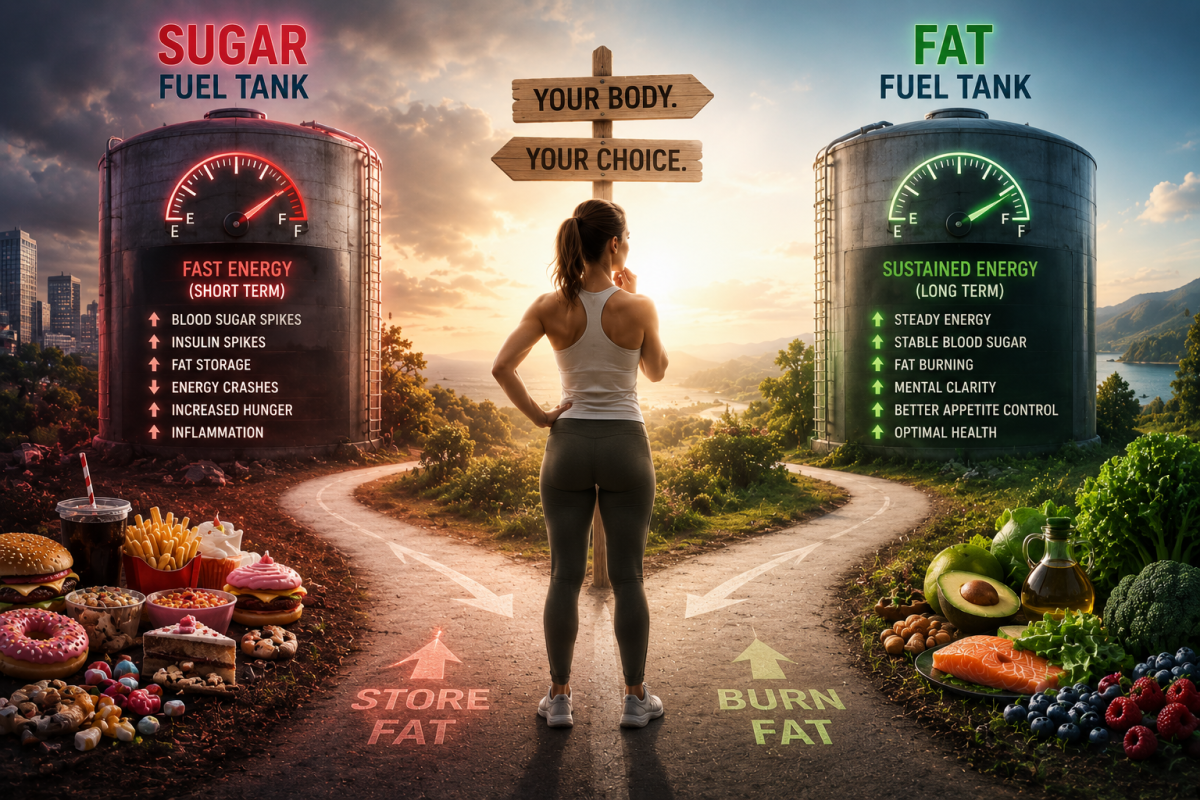
The human body essentially has two major fuel systems.
One is sugar-based energy — stored in limited amounts as glycogen.
The other is fat-based energy — stored more abundantly as triglycerides within body fat tissue.
In simple terms, the metabolism can either become heavily dependent on sugar or more efficient at drawing energy from stored fat.
My view is that when the body spends most of the day — during sleep, daily living and exercise — efficiently accessing fat as a fuel source, body weight, energy levels, appetite regulation and metabolic health are usually far more stable.
It’s when the system becomes overly reliant on sugar that many people begin running into trouble.
- Excess body fat gain
- Blood glucose instability
- Elevated triglycerides
- Fatty liver stress
- Increased inflammation
- Poor energy levels
- Reduced exercise tolerance
- Increased sedentary behaviour
- Metabolic syndrome and related disease risk
The Hormonal Control System
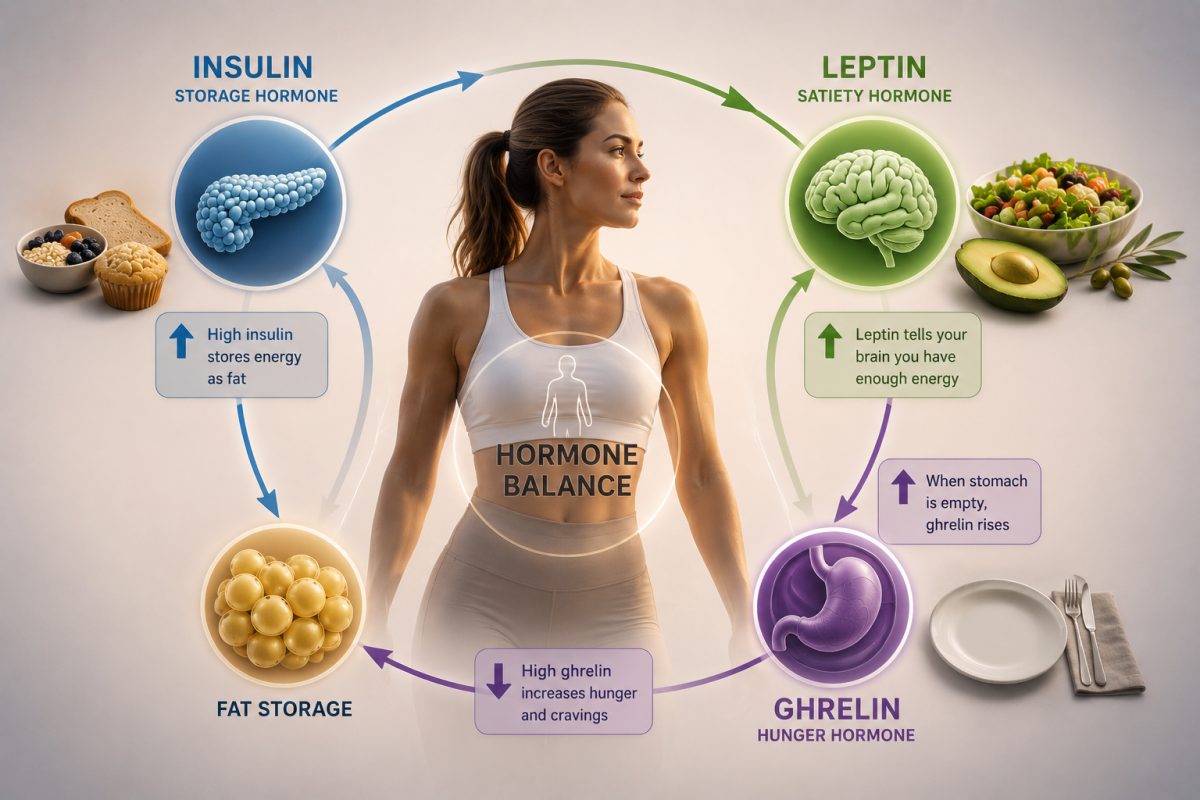
One of the most important — and often poorly understood — aspects of weight management is the relationship between the hormones insulin, leptin and ghrelin.
These hormones are heavily involved in appetite regulation, energy balance, fat storage and long-term body composition.
They help determine whether the body can:
- Burn energy efficiently
- Feel satisfied
- Control hunger
- Increase movement and motivation
When disrupted, the body may:
- Store excessive body fat
- Feel constantly hungry
- Experience cravings
- Slow the metabolic system down
Insulin — The Storage Hormone
Insulin is released from the pancreas primarily in response to rising blood glucose levels.
When we consume highly processed foods — particularly those rich in refined sugars and rapidly absorbed carbohydrates — blood glucose can rise quickly and excessively.
The body views this as a metabolic problem requiring immediate management.
Insulin helps remove excess glucose from the bloodstream and transport it into storage.
Initially, glucose is stored in limited reserves within the liver and muscle tissue as glycogen.
However, once those storage tanks are full, the excess energy is then very efficiently converted and stored as body fat.
Frequent intake of industrialised foods can create a near constant elevation in insulin demand.
When insulin remains elevated too often, the metabolism becomes increasingly biased toward storing energy rather than accessing stored fat as fuel.
Leptin — The Body Fat Feedback Signal
Leptin is a hormone released primarily from fat cells.
As body fat increases, leptin should signal the brain to reduce appetite, increase daily movement, improve satiety and prevent excessive further fat gain.
In healthy metabolic conditions, leptin acts as a natural body weight regulator.
However, modern industrialised food patterns can interfere with this system.
Over time, excessive processed food intake, chronic overeating, elevated insulin levels, inflammation, poor sleep and ongoing metabolic stress may contribute to what is commonly described as leptin resistance.
This means the brain no longer properly hears the leptin signal.
Even though body fat stores are increasing, appetite regulation becomes impaired.
Ghrelin — The Hunger Hormone
Ghrelin is commonly referred to as the hunger hormone.
It is primarily released from the stomach and signals the brain that the body is seeking food.
Under healthy conditions, ghrelin rises before meals and reduces after eating.
However, poor-quality food choices, unstable blood glucose patterns, poor sleep, stress and excessive processed food intake can dysregulate this system significantly.
- Extremely calorie dense
- Low in fibre
- Highly refined
- Rapidly absorbed
- Poor at creating lasting satiety
Blood glucose rises rapidly. Insulin spikes. Energy crashes often follow. Hunger returns quickly.
Importantly, this is not always a lack of discipline. Very often, it reflects genuine disruption to the body’s normal appetite regulation systems.
The Industrialised Food Problem
The modern food environment is unlike anything humans evolved around.
Many processed foods are specifically engineered to maximise reward, taste, convenience and repeat consumption.
Highly refined carbohydrates, sugars, artificial flavour enhancers and hyper-palatable food combinations can overstimulate dopamine reward pathways within the brain.
This creates stronger cravings, reduced satiety and a greater drive to continue eating — often beyond true physiological need.
- Larger insulin responses
- Poorer leptin signalling
- Increased ghrelin rebound hunger
- Greater fat storage
- Reduced energy stability
- Increased fatigue and inactivity
My Approach
My role is not to judge people.
My role is to help simplify the process.
The first step is always conversation.
I want to understand the individual, their lifestyle, food patterns, stress load, sleep quality, movement history, exercise capacity and relationship with food.
- Dietary assessment
- Carbohydrate intolerance screening
- Lifestyle and activity review
- Sleep and stress evaluation

I then like to non-invasively assess an individual’s current metabolic position using:
- HbA1c
- Blood glucose
- Triglycerides
- Uric acid
- Body composition scanning
- Skeletal muscle mass
- Body fat percentage
- Muscle-to-weight ratio
- Bone density markers
Continuous Glucose Monitoring
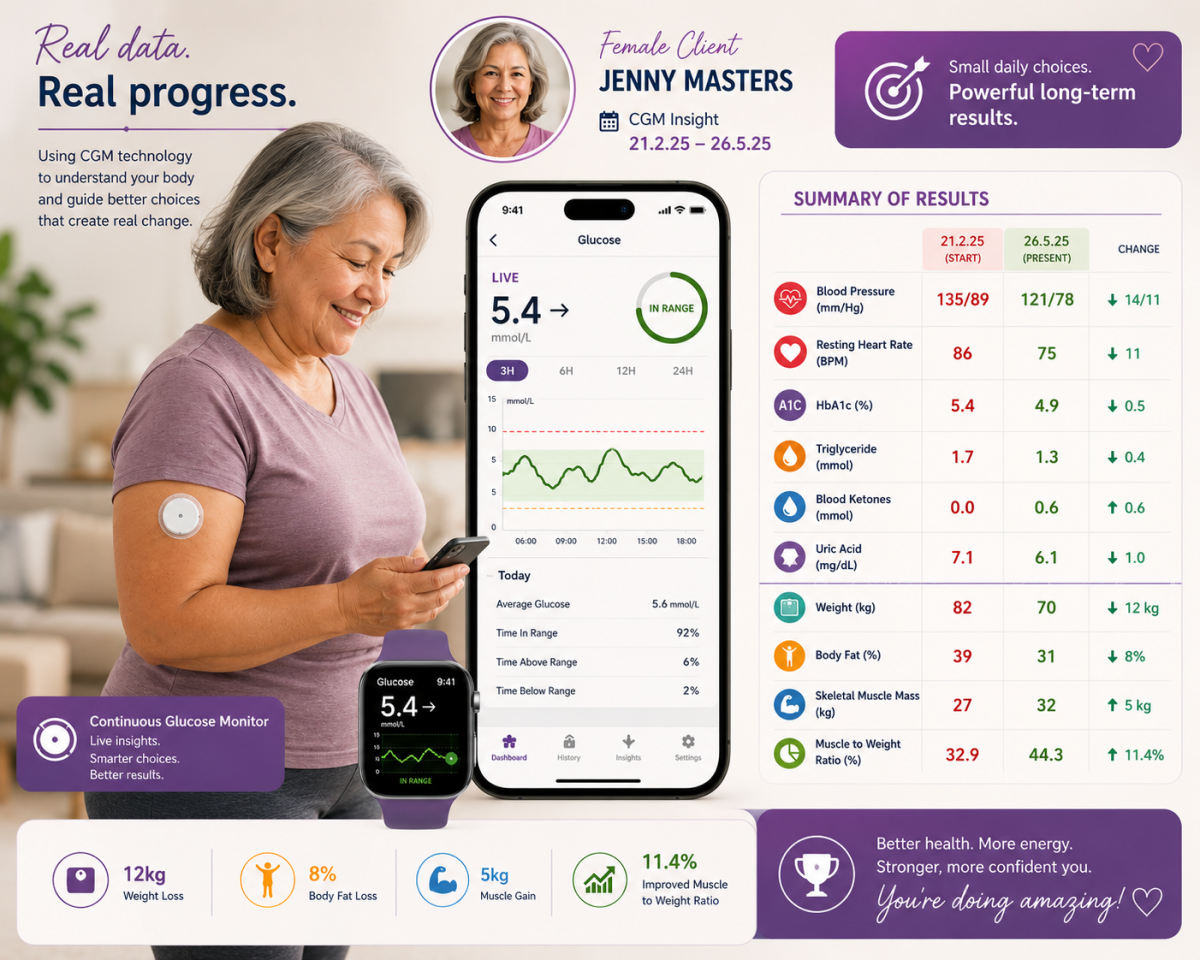
An increasingly valuable strategy I now use with many clients during the early stages of restoring metabolic balance and improving body composition is the inclusion of a Continuous Glucose Monitor.
A CGM provides live feedback on blood glucose behaviour throughout the day and night.
It allows both the client and myself to clearly observe how specific foods, meal timing, stress, sleep, exercise and lifestyle choices influence blood glucose stability in real time.
Rather than relying on generic dietary theory, the CGM provides highly individualised feedback.
It becomes a highly practical teaching tool that allows individuals to better understand their own metabolism — often for the first time in their life.
GLP-1 Therapy & Resistance Exercise

For some clients, we additionally work alongside their Physician in the appropriate and medically supervised use of GLP-1 agonist medications.
When professionally prescribed and combined with improved nutritional behaviour, better metabolic awareness and appropriate physical activity, these medications can significantly assist appetite regulation and weight management outcomes for selected individuals.
Importantly, my philosophy is that GLP-1 therapy should not simply focus on reducing body weight alone.
The goal should always be improving overall body composition, preserving muscle tissue, improving metabolic health and restoring long-term lifestyle habits.
Maintaining skeletal muscle mass is critically important for metabolic health, physical function, posture, strength, long-term weight management and healthy ageing.
My Philosophy
My philosophy is not about extreme dieting. It is not about punishment. And it is certainly not about chasing perfection.
It is about restoring better metabolic balance through realistic nutrition, smarter movement, improved recovery, better food awareness and creating a lifestyle the individual can actually sustain long-term.
The body is remarkably adaptive.
Appetite becomes more stable. Energy improves. Cravings reduce. Body composition begins changing more naturally.
And importantly — the process becomes far more sustainable long-term.
Sometimes the first conversation is the most important step.
CONTACT BRAD PAMP