WHY SHOULD YOU CARE ABOUT QUALITY SLEEP?
We can become strangely accepting of poor sleep.
“I'm just not a great sleeper.”
“Five or six hours does me.”
“I always wake around 3am.”
“I'll catch up on the weekend.”
Maybe.
But sleep isn't simply downtime while we wait for tomorrow to arrive.
While you're sleeping, your brain and body are extraordinarily busy — repairing, restoring, regulating and preparing you to go again.
And when quality sleep repeatedly goes missing, eventually something else usually starts paying the bill.
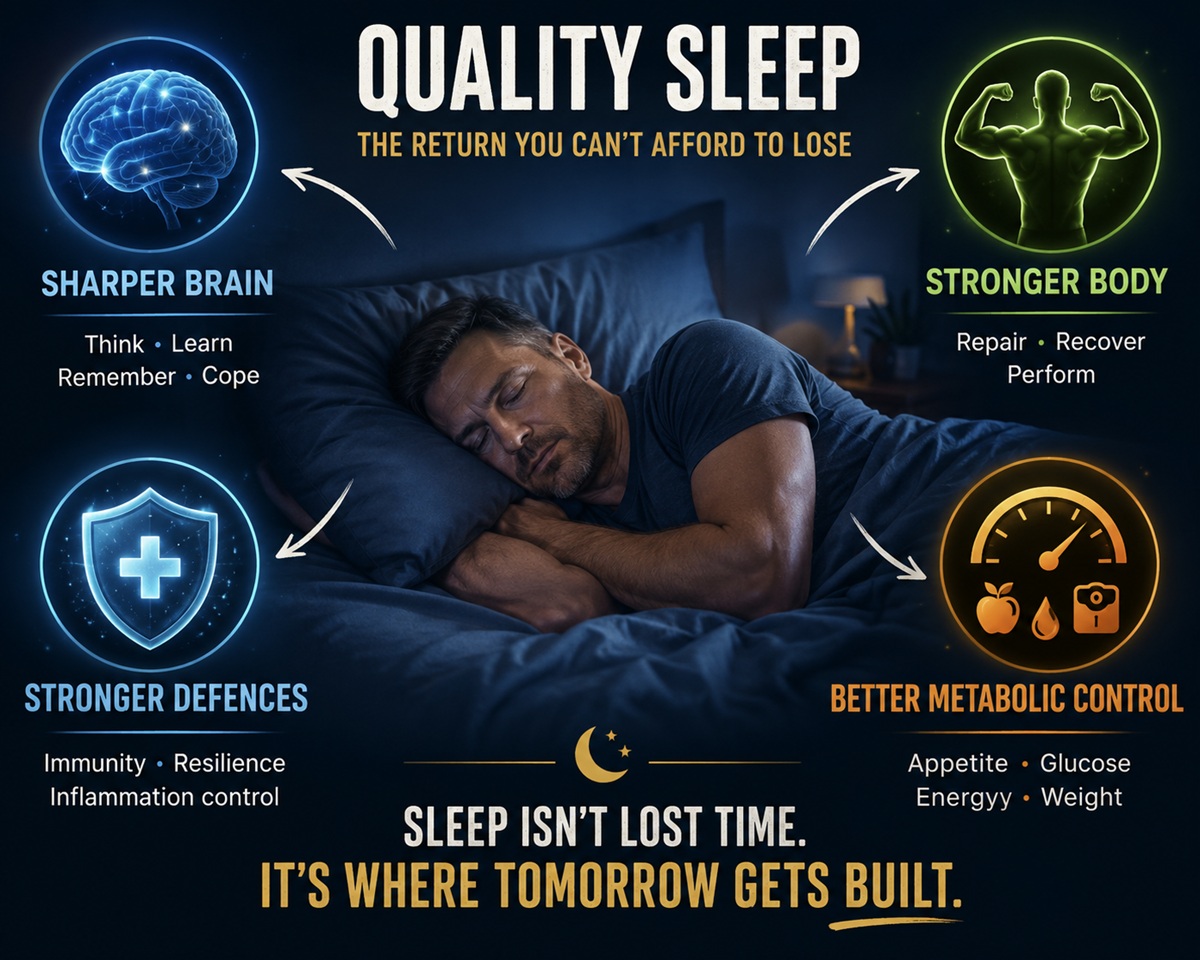
🧠 YOUR BRAIN
Quality sleep supports memory, learning, concentration, decision-making and emotional control.
We've all experienced the opposite.
One rotten night's sleep and we're often foggy, forgetful, less patient and considerably easier to annoy!
Sleep well and your brain simply has a better platform from which to operate.
💪 YOUR BODY
This is your recovery window.
Training, working and simply living create physical stress.
Sleep provides the conditions for tissue repair, muscular recovery, nervous-system restoration and physical performance.
If you're training hard but sleeping poorly, you're potentially undermining some of the very adaptation you're training for.
Training provides the stimulus.
Recovery allows the return.
🛡️ YOUR IMMUNE SYSTEM
Sleep and immune function are closely connected.
Repeatedly shortening or fragmenting sleep can compromise immune responses and increase inflammatory signalling.
It's one reason that when we're run-down and underslept, every sniffle circulating around the office suddenly seems to know our name.
⚖️ YOUR METABOLISM & APPETITE
Poor sleep doesn't just make you tired.
It can influence glucose regulation, appetite, food choice and the hormonal systems involved in energy balance.
And there's the practical bit:
After a lousy night's sleep, how many people wake craving salmon, broccoli and a brisk walk?
Exactly.
We're more likely to chase coffee, sugar, convenience food and the couch.
Which means poor sleep can quietly start influencing the following day's behaviour as well.
THE RETURN FROM QUALITY SLEEP
Righto. If sleep gives us all that back, what the hell is actually happening during those hours we're unconscious?
WHAT ACTUALLY HAPPENS WHEN YOU SLEEP?
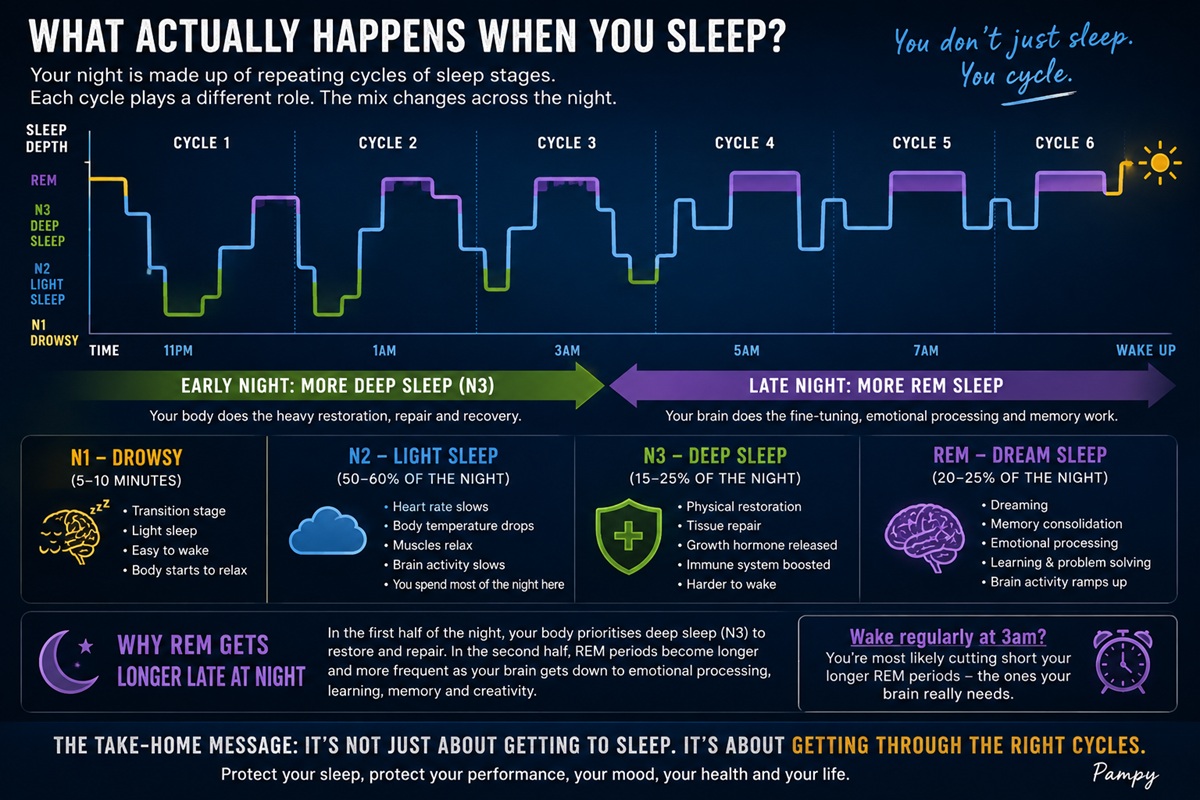
YOU DON'T JUST SLEEP. YOU CYCLE.
A night of sleep isn't one continuous block.
Your brain moves repeatedly through different stages of sleep, each doing a slightly different job.
THE MIX CHANGES THROUGH THE NIGHT
Earlier in the night we tend to experience more deep N3 sleep.
As the night progresses, REM periods generally become longer and more prominent.
That's particularly relevant if you're regularly finding yourself wide awake around 2–3am.
So the goal isn't simply to spend eight hours near a mattress. It's to give your brain and body enough opportunity to move through the right sleep stages, in the right sequence, across the whole night.
HOW MUCH SLEEP DO YOU REALLY NEED?
We've all heard it:
Well… maybe.
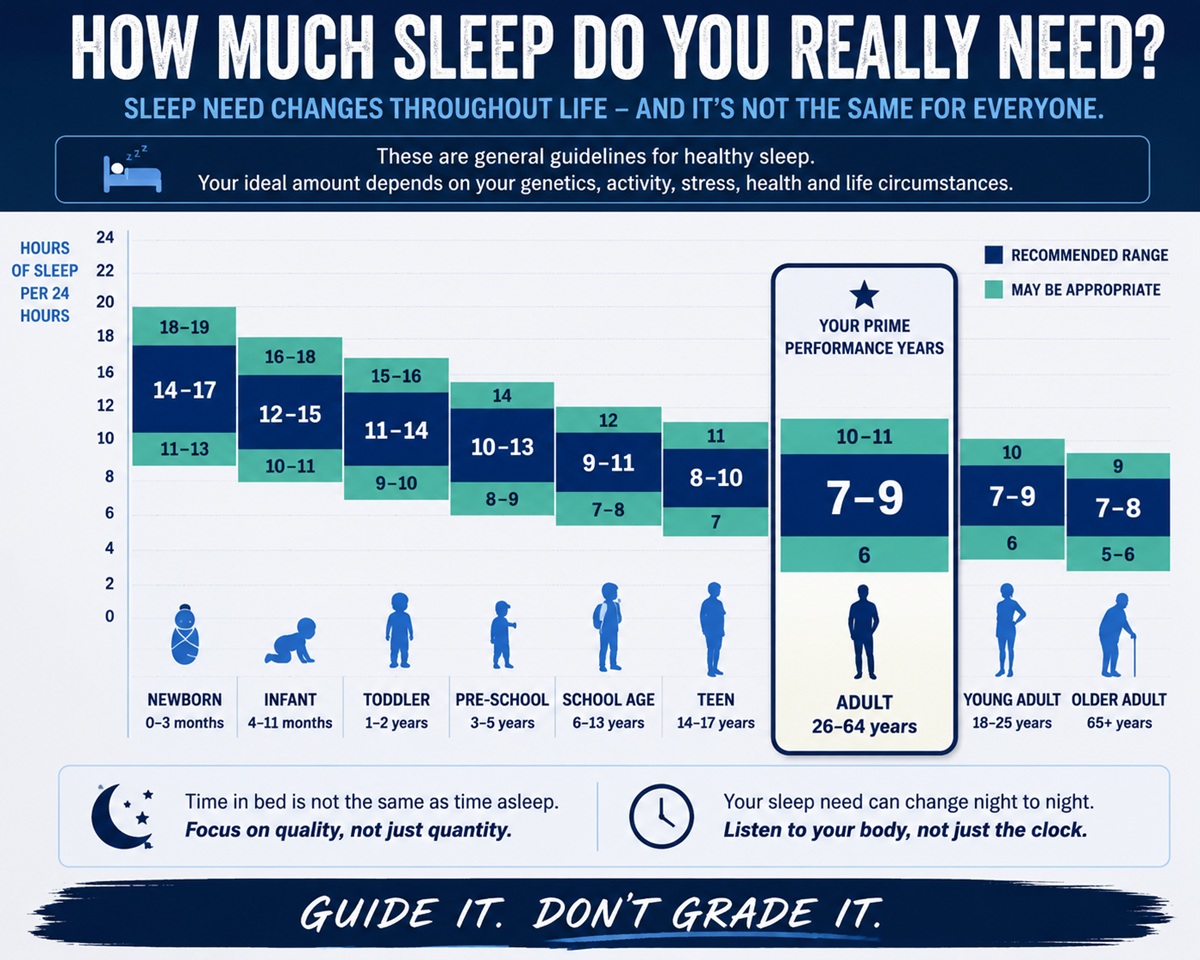
Sleep need isn't identical for everyone.
Age, genetics, physical activity, training load, illness, stress, accumulated sleep debt and what's happening in your life can all influence how much sleep you need — and that requirement won't necessarily be identical every night.
GUIDELINES — NOT A NIGHTLY PASS OR FAIL MARK.
There are useful population guidelines, and we'll show those below. But the goal isn't to win a competition for hours spent in bed. It's to achieve sufficient, restorative and appropriately timed sleep that allows you to function at your best the following day.
AND DON'T LET YOUR WATCH RUIN A PERFECTLY GOOD MORNING!
Here's another relatively new wrinkle.
Plenty of us now wake up, roll over and immediately ask our watch:
“So… how did I sleep?”
And suddenly, despite feeling reasonably good 30 seconds earlier, we're convinced we're cactus!
Wearable sleep data can be useful for spotting patterns and trends.
But it's still an estimate — particularly when it attempts to determine precisely which sleep stage you were in during the night.
Just don't let the technology use you.
Look for patterns across weeks, rather than obsessing over last night's score.
WANT TO KNOW WHAT YOUR SLEEP METRICS ACTUALLY MEAN?
I covered wearable sleep data and what those numbers are actually trying to tell you in Pampy's Post JUL26a.
Perhaps ask yourself one very old-fashioned question before opening the app:
Your energy, mood, concentration, training readiness and tendency to fall asleep during the day provide useful information too.
hours a night is the general target range.
SOME WILL NEED MORE. SOME WILL NEED LESS.
Some people will genuinely function beautifully toward one end of that range; others will need the other.
And importantly:
TIME ASLEEP ≠ TIME IN BED.
Eight hours between getting into bed and getting out doesn't necessarily mean you slept for eight hours.
The Take-Home
Don't chase a perfect number.
Don't chase a perfect sleep score.
Chase consistently good sleep — and consistently good days.