
ARE YOU A LION, BEAR, WOLF OR DOLPHIN?
We're not all wired the same when it comes to our internal clock.
Some of us spring out of bed ready to go. Others need a few hours before the brain and body properly come online.
And some of us are still thinking clearly long after most people have hit the pillow.
Sleep specialist Dr Michael Breus popularised a simple way of describing these tendencies using four animals: Lion, Bear, Wolf and Dolphin.
It's a useful way to start thinking about one important idea:
Your natural tendency toward earlier or later sleep and wake timing matters.
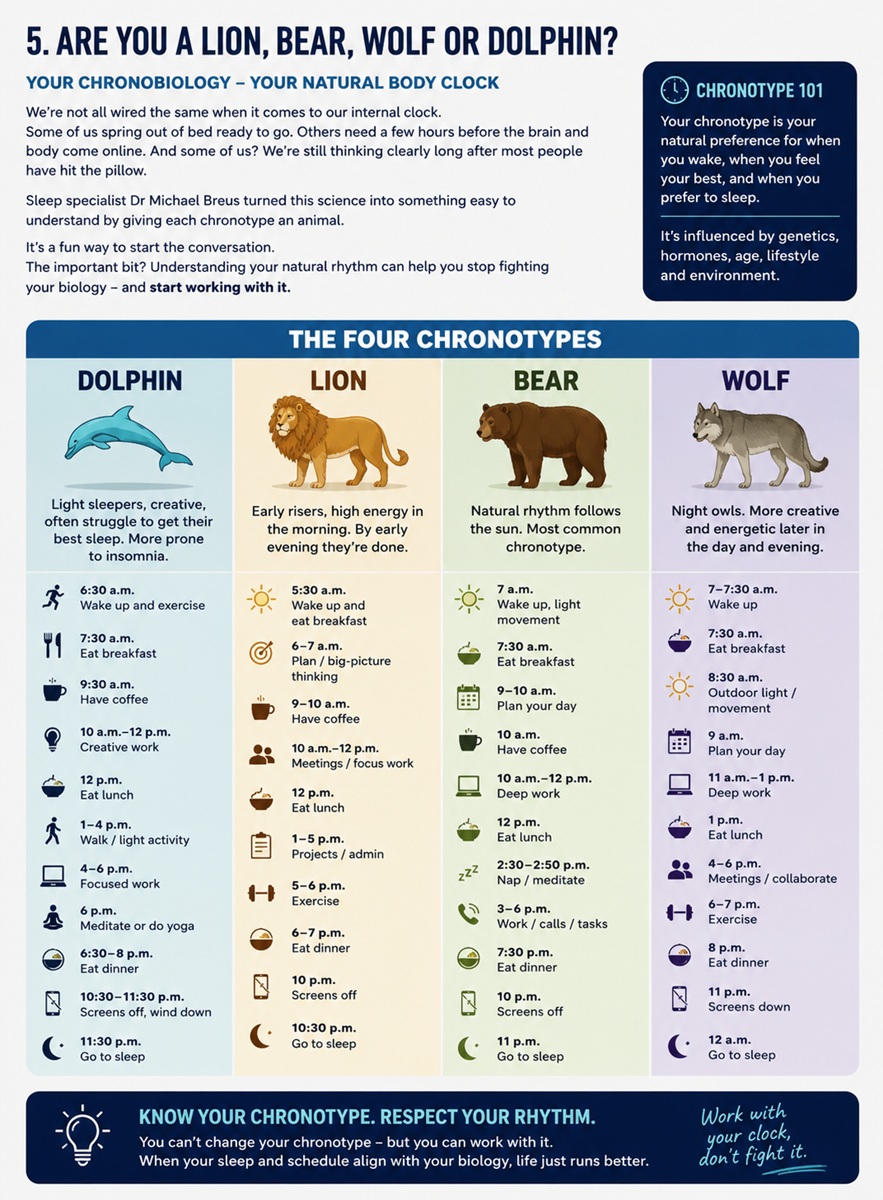
DON'T GET TOO HUNG UP ON THE ANIMAL.
The labels are simply an easy way to describe chronotype. The useful bit is recognising whether your body naturally tends toward earlier or later sleep and wake times — and where practical, working with that tendency rather than constantly fighting it.
WHY THE HELL AM I AWAKE AT 3AM?
For me, this became the question.
Getting to sleep generally wasn't the problem.
I'd hit the pillow, drift off reasonably quickly and get several hours of seemingly good sleep.
Then...
Eyes open.
Sometimes for no obvious reason whatsoever.
And here's where things can go pear-shaped.
You check the clock.
You roll over.
Ten minutes later you check again.
Now you're thinking about tomorrow. Work. Training. Something somebody said yesterday. Something you need to do next Thursday.
And before long you're no longer resting.
You're actively trying to sleep.
Anyone who's been there knows how ridiculously unsuccessful that can be.
SO WHY 3AM?
Firstly, there's nothing magical about 3am.
Our sleep isn't one continuous eight-hour coma.
As we saw above, we move repeatedly through different stages of sleep. Earlier in the night we generally experience more deep N3 sleep.
As the night progresses, deep sleep reduces and REM periods become longer, with brief awakenings between sleep cycles being perfectly normal.
Most of the time we don't even remember them.
The problem can arise when something turns that brief awakening into a proper one.
Or sometimes...
absolutely nothing obvious.
You simply become conscious.
And then your own brain takes over.
THE 3AM LOOP
CONCEDE.
One of the most useful things I've learnt about my own sleep is remarkably simple:
Stop trying so bloody hard to sleep.
Sleep isn't a squat.
You can't grit your teeth and force out another rep.
In fact, the harder I've tried to make myself sleep, the more awake I've often become.
THERE'S SOME GOOD SLEEP SCIENCE BEHIND THIS TOO.
One of the principles used in CBT-I — Cognitive Behavioural Therapy for Insomnia — is stimulus control.
The idea is beautifully simple:
So if I've been properly awake for a while, rather than starting a wrestling match with my pillow, I concede.
Maybe read something decidedly unexciting, breathe, stretch gently or simply sit quietly.
Then, when those heavy eyes return...
Back to bed.
We're going to come back to this in the Sleeping Reboot, because there are several things I've found can help prevent the 3am awakening in the first place — and a few strategies that have helped me enormously when it happens.
WAKING UP ISN'T ALWAYS THE PROBLEM.
WHAT HAPPENS NEXT CAN BE.
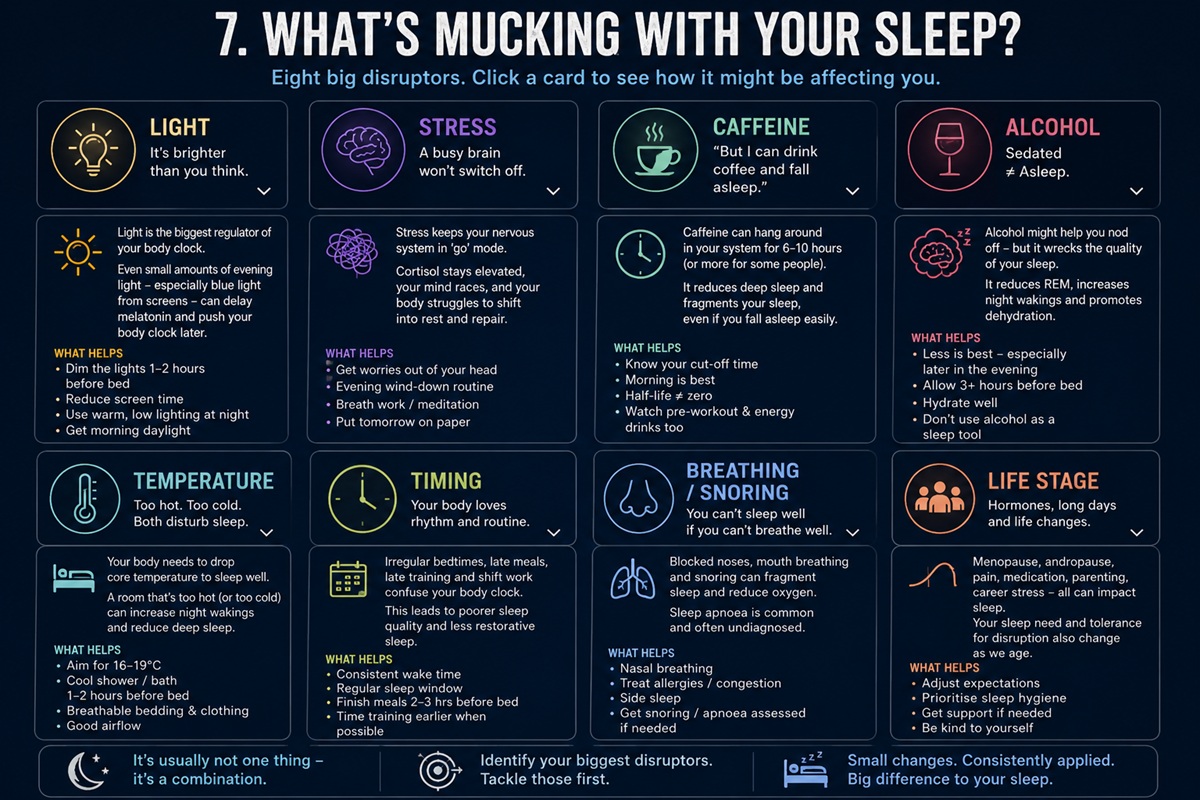
WHAT'S MUCKING WITH YOUR SLEEP?
Sometimes the answer is obvious.
Sometimes several little things are stacking together.
And sometimes the culprit is something you've simply become accustomed to.
These are some of the most common things worth looking at before deciding you're simply “a bad sleeper.”
Righto — we've done enough talking about sleep.
Now let's actually build a better night.
THE 24-HOUR SLEEP CLOCK
Here's something I probably underestimated for years.
I thought improving sleep was mostly about what I did in the hour before bed.
Dark room. Quiet. Cool. Relax. Eyes shut. Job done.
Not quite.
Your brain and body run on an internal roughly 24-hour circadian clock.
And that clock is constantly taking cues from the world around you — particularly light and darkness, but also movement, exercise, meals and the regular timing of your day.
ZEITGEBERS — FANCY WORD. SIMPLE IDEA.
These external timing cues are often called zeitgebers — German for “time-givers.” They help your body clock understand where it is in the day.
YOUR BODY CLOCK NEEDS TO KNOW WHAT TIME IT IS.
Give it strong, consistent signals during the day and you're helping create the conditions for sleep later that night.
Give it mixed signals — little daylight, sitting indoors all day, caffeine late, bright light at night, late meals, irregular bedtimes — and we shouldn't be surprised when the clock gets a little confused.
☀️ MORNING — TELL YOUR BODY: WE'RE UP.
Morning light is one of the strongest signals to your circadian system.
Get outside.
Move.
Let your brain receive a very clear message:
Night is finished. The day has started.
And interestingly, what you do here helps influence what happens many hours later.
🏃 DAY — BUILD THE SIGNAL.
Daytime should look and feel like daytime.
Move your body. Work. Train. Eat. Interact with people. Get outside periodically.
If you're going to use caffeine, use it as a daytime stimulant rather than an evening life-support system.
We want a strong contrast between:
DAY = LIGHT + ACTIVITY
and
NIGHT = DARK + QUIET
🌅 SUNSET — TAKE YOUR FOOT OFF THE PEDAL.
As natural light disappears, start allowing your environment to change with it.
You don't need to wander around the house carrying a candle.
But perhaps your lounge room at 9pm shouldn't look like the MCG under lights either.
🌙 EVENING — PREPARE, DON'T FORCE.
As biological night approaches, melatonin signalling increases and the body's temperature-regulation systems help prepare us for sleep.
This is where we can work with the process rather than fight it.
Dimmer lights.
Less stimulation.
A comfortable, cooler sleeping environment.
And perhaps most importantly...
STOP TRYING TO SQUEEZE ANOTHER DAY INTO YOUR NIGHT.
Emails. Work. Food. Alcohol. Netflix. News. Social media.
Eventually, something has to tell the brain:
We're done.
😴 NIGHT — LET THE ARCHITECTURE DO ITS JOB.
Now we're back to those sleep cycles.
Earlier in the night, deep sleep tends to dominate.
As morning approaches, REM becomes increasingly prominent.
Your job isn't to manage any of this.
Your job is to create the conditions and get out of the way.
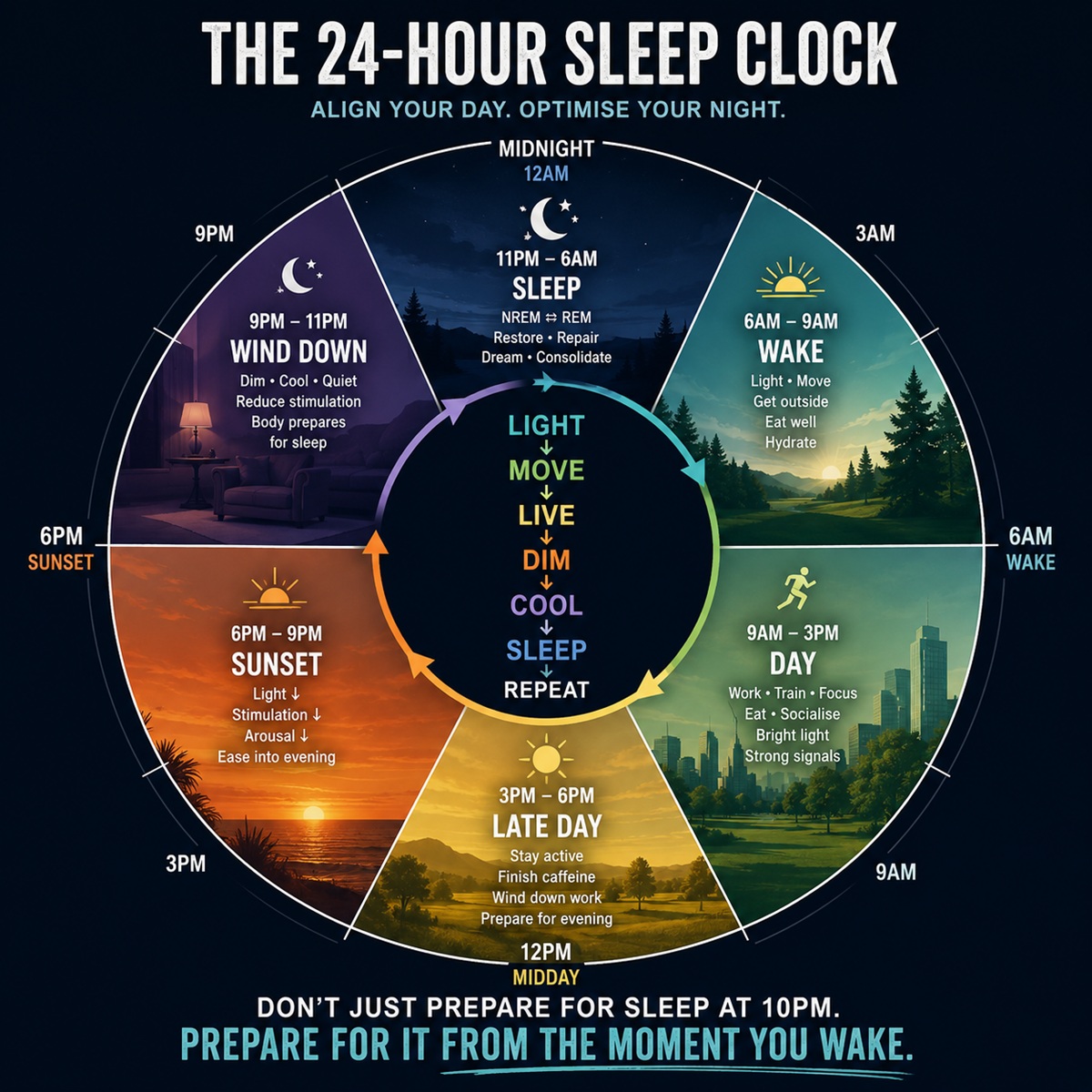
☀️ MORNING — AND AROUND WE GO AGAIN.
Circadian wake-promoting signals increase.
Core body temperature begins rising.
Alertness returns.
Light hits the eyes.
Movement begins.
And the clock gets another strong:
“RIGHTO — WE'RE UP.”
Don't just prepare for sleep at 10pm.
Prepare for it from the moment you wake.
THE GOLDEN SLUMBERS REBOOT
We've talked about sleep.
We've talked about circadian rhythm.
We've talked about what's potentially mucking with it.
Now comes the useful bit.
Over the years I've tinkered with plenty of strategies in an effort to improve my own sleep — particularly that annoying habit of finding myself wide awake at 3am.
Some have helped enormously.
Some probably help because they reinforce a good routine.
Some I simply enjoy.
And a few have done bugger all.
TRY THE GOLDEN SLUMBERS REBOOT.
Don't treat this as a prescription.
Treat it as a 24-hour experiment.
Better still, give it several consecutive days.
Remove some of the obvious sleep disruptors. Strengthen the signals that tell your body DAY and NIGHT. Create a bedroom that's actually designed for sleeping.
Then see what happens.
☀️ WAKE — GET UP
When your normal waking time arrives:
GET UP.
Don't spend another 40 minutes bargaining with the snooze button.
A reasonably consistent wake time provides an important daily anchor for the sleep/wake cycle.
CURTAINS OPEN OUTSIDE IF POSSIBLETell the brain very clearly: NIGHT'S OVER.
☀️ GET LIGHT — AND GET MOVING
This is probably one of the strongest tools in the entire reboot.
Get outside reasonably soon after waking.
Walk. Jog. Ride. Stretch. Move.
And allow natural outdoor light to reach your eyes — without staring at the sun, obviously.
Morning light is a major timing signal for the circadian system, and controlled light studies support its ability to shift sleep/wake timing; trials and reviews also show benefits for some insomnia outcomes.
Barefoot on the grass?
I enjoy it.
It feels bloody good.
But I'd call that Pampy's optional extra, rather than tell you grounding your feet is resetting your circadian clock.
The evidence-backed bit is LIGHT + MOVEMENT.
🚿 SHOWER — AND MY LITTLE COLD ZAP
Have your normal shower.
I like finishing mine with a few seconds of cold water.
It wakes me up and has become part of my “righto, we're going” morning ritual.
☕ BREAKFAST... OR DON'T
Eat a nutritious breakfast if breakfast works for you.
If you normally fast comfortably, I don't see a need to force-feed yourself purely because we're rebooting sleep.
The bigger goal is regularity and good nutrition across the day.
And then... COFFEE.
Yes please.
Coffee is part of my morning and I'm not giving it up unnecessarily.
But caffeine has a long enough biological life that timing matters.
In one controlled study, a substantial 400 mg caffeine dose still disrupted sleep when consumed six hours before bed.
So if sleep is currently ordinary: bring the caffeine forward.
MORNING COFFEE? BEAUTIFUL. LATE-AFTERNOON RESCUE? MAYBE NOT.🛏️ RESET THE BEDROOM
This one isn't some great physiological intervention.
It's simply good housekeeping.
Wash the bed linen.
Air the room.
Make the bed.
If conditions allow, get some fresh air through the bedroom.
I also like putting the pillows and bedding out in fresh air and sunlight.
Does sunlight hitting my pillow magically improve my circadian rhythm?
No.
Does climbing into fresh, clean bedding in a cool, uncluttered bedroom make sleep more inviting?
For me — absolutely.
🥗 EAT MORE EARLIER — LESS LATER
Rather than saving a mountain of calories for 8:30pm, I prefer to eat substantially during the day and keep dinner relatively simple.
Good lunch.
Lighter evening meal.
Not starving.
Not stuffed.
We don't need to turn this into another dietary program.
The goal is simply to avoid asking the digestive system to process the Christmas lunch just as we're asking everything else to settle down.
🍷 TONIGHT — ZIP ALCOHOL
Not because alcohol is evil.
Because tonight we're conducting an experiment.
And alcohol is a particularly interesting sleep disruptor because it can create the illusion that it's helping.
You may fall asleep more easily after drinking.
Research shows alcohol can alter sleep architecture and reduce REM sleep, including at relatively modest doses.
Alcohol can also worsen snoring and sleep-disordered breathing in susceptible people.
So for the reboot: ZERO.
Let's see what your sleep looks like without it.
🌙 DIM THE WORLD
As evening arrives, make the house look like evening.
Turn down unnecessary lights.
Cover annoying LEDs in the bedroom.
Phone brightness down — better still, phone away.
Television isn't required to illuminate the entire suburb.
We spent the morning telling the brain:
DAY!
Now we're sending the opposite signal:
NIGHT'S COMING.
☕ CREATE A WIND-DOWN RITUAL
Peppermint tea if that's your thing.
Chamomile if you prefer.
I'd be careful about selling either as a sleeping medication.
For me, the value is also behavioural:
warm drink → sit down → slow down → day finished.
And don't drink a bucket of it immediately before bed if that simply means you'll be getting up at 1am for a wee!
🧘 PAMPY OPTION — SHAKTI MAT + BREATHING
I've found a few minutes on an acupressure/Shakti-style mat combined with slow, controlled breathing a useful way to transition out of the day.
There is research suggesting acupressure can improve subjective sleep measures, although studies are varied and that evidence doesn't establish that lying on a commercial Shakti mat for three minutes treats insomnia.
Not magic.
🌡️ COOL ROOM — BUT I'D CHANGE ONE OF MY OLD RULES
I absolutely like:
lighter bedding initially + extra blanket within reach.
We want a comfortable thermal environment that allows the normal decline in core body temperature associated with sleep.
But I would remove my old “don't warm the feet” recommendation.
The physiology is actually rather interesting.
Warming the hands and feet can increase peripheral heat loss, which can help the body's core cool and facilitate sleep onset.
Research has linked distal skin warming with sleep propensity, and a meta-analysis found a warm bath or shower before bed can help shorten sleep onset.
Cold feet aren't a sleep objective.
If your feet are freezing, put the bloody socks on.
📖 READ SOMETHING BORING
Hard copy.
Proper mindless drivel - like the book link below
Low light.
Nothing work-related.
Nothing that's going to send you into an existential crisis.
We're not trying to become smarter at 10:30pm.
We're trying to become sleepier.
How To Lose Kegs Without Busting A Gut →🎧 QUIET THE ENVIRONMENT
This is where my own tinkering box comes in.
I've had success with:
EYE MASK BLUETOOTH SLEEP HEADBAND RAIN / STEADY SOUND EAR BLOCKING PZIZZ / GUIDED WIND-DOWNThese aren't compulsory components of good sleep.
They're simply ways of reducing light, unpredictable noise and mental stimulation — three things I've become increasingly sensitive to as I've got older.
AND IF 3AM STILL ARRIVES...
Eyes open.
Brain starts.
You look at the clock.
Remember our rule from earlier.
Don't turn sleep into a competition.
Don't lie there becoming increasingly pissed off that you're not unconscious.
Keep things dark and quiet. Avoid grabbing the phone. If you're clearly awake and becoming frustrated, get out of bed, do something quiet in dim light and return when sleepy.
DON'T FORCE SLEEP. CREATE THE CONDITIONS FOR IT.
And tomorrow morning?
Get up and start the clock again.
🧰 PAMPY'S TINKERING BOX
These sit outside the core Golden Slumbers Reboot.
They're personal tools and experiments I've found useful — but I don't put them on the same level as the big rocks above.
A simple environmental tool. If darkness helps me, block the light.
Useful for masking unpredictable environmental noise.
Something I've personally found useful as part of winding down.
⚠️ MOUTH TAPING — I'VE TRIED IT, BUT...
I've experimented with mouth taping and personally found encouraging nasal breathing helpful.
But the evidence for routine mouth taping remains limited, and it isn't something I'd suggest blindly — particularly if you have nasal obstruction, significant snoring or possible sleep apnoea.
Get the breathing problem assessed rather than taping over it.
💊 OCCASIONAL SLEEP AIDS
Other aids I've successfully used, FYI:
These are not the Golden Slumbers Reboot.
In particular, sedating medication such as Restavit / doxylamine is something I'd discuss with your doctor or pharmacist, especially if you're using it repeatedly, taking other medication, or experiencing next-day grogginess.
MY GOAL ISN'T TO BECOME BETTER AT KNOCKING MYSELF OUT.
IT'S TO BECOME BETTER AT SLEEPING.
WHEN IT'S MORE THAN A BAD PATCH
Persistent sleep problems shouldn't simply trigger another sleep hack.
If you've worked on the basics and you're repeatedly lying awake night after night, the answer may not be another supplement or Pampy strategy.
It may simply be time to make an appointment with your doctor.
That's what I'd do.
